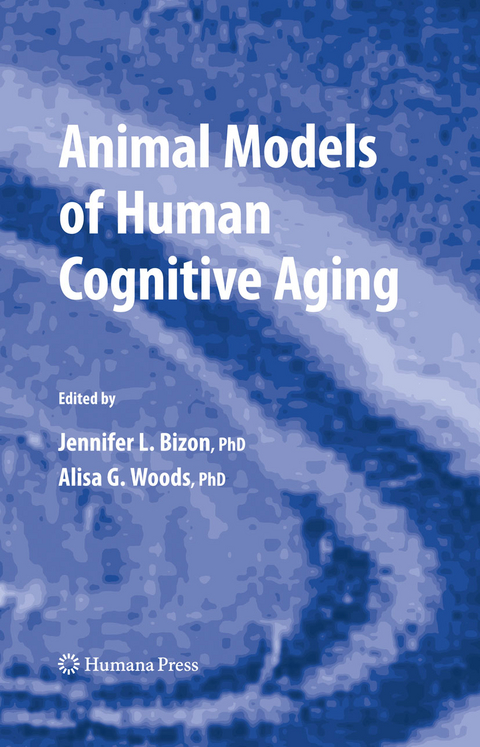
Animal Models of Human Cognitive Aging (eBook)
XII, 208 Seiten
Humana Press (Verlag)
9781597454223 (ISBN)
Significant improvements in lifestyle and medical science are leading to an ever increasing elderly population in the United States and other developed nations. The U.S census bureau estimates that the number of people over 65 will nearly double by 2030, and that the elderly will comprise nearly one-fifth of the world's entire population within the next 20 years. In Animal Models of Human Cognitive Aging, Jennifer Bizon, Alisa Woods, and a panel of international authorities comprehensively discuss the use of animal models as a tool for understanding cognitive changes associated with the aging process. The book provides substantive background on the newest and most widely used animal models in studies of cognition and aging, while detailing the normal and pathological processes of brain aging of humans in relation to those models. Additional chapters comprehensively review frontal cortical deficits and executive function in primates as related to humans, and the use of transgenic modulation in mice to model Alzheimer's and other age-related diseases. Groundbreaking and authoritative, Animal Models of Human Cognitive Aging provides a valuable resource for Neuroscientists, Gerontological Scientists and all aging medicine researchers, while serving as a primer for understanding current brain aging studies.
Significant improvements in lifestyle and medical science are leading to an ever increasing elderly population in the United States and other developed nations. The U.S census bureau estimates that the number of people over 65 will nearly double by 2030, and that the elderly will comprise nearly one-fifth of the world's entire population within the next 20 years. In Animal Models of Human Cognitive Aging, Jennifer Bizon, Alisa Woods, and a panel of international authorities comprehensively discuss the use of animal models as a tool for understanding cognitive changes associated with the aging process. The book provides substantive background on the newest and most widely used animal models in studies of cognition and aging, while detailing the normal and pathological processes of brain aging of humans in relation to those models. Additional chapters comprehensively review frontal cortical deficits and executive function in primates as related to humans, and the use of transgenic modulation in mice to model Alzheimer's and other age-related diseases. Groundbreaking and authoritative, Animal Models of Human Cognitive Aging provides a valuable resource for Neuroscientists, Gerontological Scientists and all aging medicine researchers, while serving as a primer for understanding current brain aging studies.
Chapter 1. Normal and Pathological Aging – From Animals to Humans Nicole C. Berchtold and Carl W. Cotman Chapter 2. Non-Human Primate Models of Cognitive Aging Agnès Lacreuse and James G. Herndon Chapter 3. Age-related Effects on Prefrontal Cortical Systems: Translating Between Rodents, Nonhuman Primates, and Humans Mark G. Baxter Chapter 4. Comparison of Different Cognitive Rat Models of Human Aging Candi LaSarge and Michelle Nicolle Chapter 5. Mouse Models of Cognitive Aging: Behavioral Tasks and Neural Substrates Michael E. Calhoun Chapter 6. Impact of Aß and Tau on Cognition in Mouse Models of Alzheimer’s Disease Maya A. Koike, Kristoffer Myczek, Kim N. Green and Frank M. LaFerla Chapter 7. Hormonal Influences on Brain Aging and Age-Related Cognitive Decline Danielle K Lewis and Farida Sohrabji Chapter 8. Timing Deficits in Aging and Neuropathology Fuat Balci, Warren H. Meck, Holly Moor, and Dani Brunner
| Erscheint lt. Verlag | 12.11.2008 |
|---|---|
| Reihe/Serie | Aging Medicine | Aging Medicine |
| Zusatzinfo | XII, 208 p. |
| Verlagsort | Totowa |
| Sprache | englisch |
| Themenwelt | Geisteswissenschaften ► Psychologie ► Allgemeine Psychologie |
| Geisteswissenschaften ► Psychologie ► Entwicklungspsychologie | |
| Geisteswissenschaften ► Psychologie ► Verhaltenstherapie | |
| Medizin / Pharmazie ► Pflege | |
| Medizin / Pharmazie ► Studium | |
| Naturwissenschaften ► Biologie ► Humanbiologie | |
| Naturwissenschaften ► Biologie ► Zoologie | |
| Schlagworte | Alzheimer • Alzheimer's disease • Animal Models • Brain Aging • Cognition • Cognitive Aging • Executive Function • Transgenic Modulation |
| ISBN-13 | 9781597454223 / 9781597454223 |
| Informationen gemäß Produktsicherheitsverordnung (GPSR) | |
| Haben Sie eine Frage zum Produkt? |
 PDF (Wasserzeichen)
DRM: Digitales Wasserzeichen
Dieses eBook enthält ein digitales Wasserzeichen und ist damit für Sie personalisiert. Bei einer missbräuchlichen Weitergabe des eBooks an Dritte ist eine Rückverfolgung an die Quelle möglich.
Dateiformat: PDF (Portable Document Format)
Mit einem festen Seitenlayout eignet sich die PDF besonders für Fachbücher mit Spalten, Tabellen und Abbildungen. Eine PDF kann auf fast allen Geräten angezeigt werden, ist aber für kleine Displays (Smartphone, eReader) nur eingeschränkt geeignet.
Systemvoraussetzungen:
PC/Mac: Mit einem PC oder Mac können Sie dieses eBook lesen. Sie benötigen dafür einen PDF-Viewer - z.B. den Adobe Reader oder Adobe Digital Editions.
eReader: Dieses eBook kann mit (fast) allen eBook-Readern gelesen werden. Mit dem amazon-Kindle ist es aber nicht kompatibel.
Smartphone/Tablet: Egal ob Apple oder Android, dieses eBook können Sie lesen. Sie benötigen dafür einen PDF-Viewer - z.B. die kostenlose Adobe Digital Editions-App.
Buying eBooks from abroad
For tax law reasons we can sell eBooks just within Germany and Switzerland. Regrettably we cannot fulfill eBook-orders from other countries.
aus dem Bereich