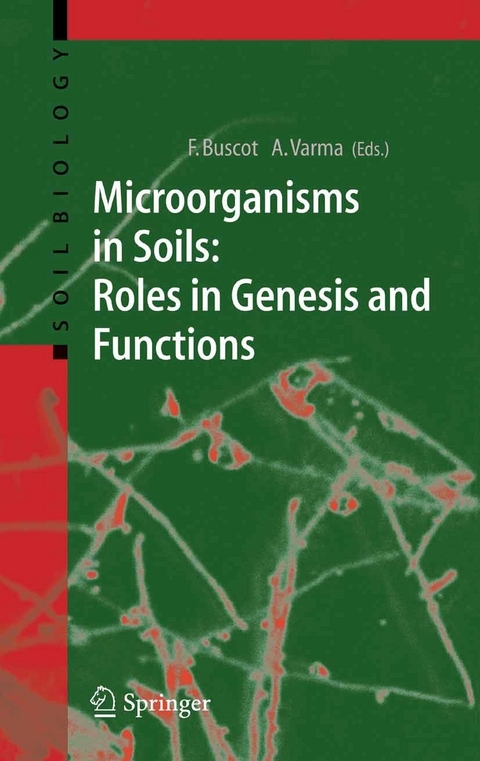
Microorganisms in Soils: Roles in Genesis and Functions (eBook)
422 Seiten
Springer Berlin (Verlag)
9783540266099 (ISBN)
For this third volume of the series Soil Biology, internationally renowned scientists shed light on the significant roles of microbes in soil. Key topics covered include: bioerosion, humification, mineralization and soil aggregation; Interactions in the mycorrhizosphere; microbes and plant nutrient cycling; Microbes in soil surface or toxic metal polluted soils; Use of marker genes and isotopes in soil microbiology, and many more.
Preface 5
Contents 8
Contributors 17
Part I Introduction 22
What Are Soils? 23
1 Introduction 23
2 Soil Genesis 24
3 Biogeochemical Processes in Soils 28
4 Biotic Interactions Involving Soil Microorganisms 31
5 Integrative Considerations on Functions of Microorganisms in Specific Soil Compartments 33
6 Conclusion or Back to Biodiversity of Soil Microbes 35
References 36
Microbial Diversity in Soils 38
1 Introduction 38
2 Origin of Microbial Diversity 39
3 Types of Soil Microorganisms 41
4 Microbial Diversity and Biological Spheres 52
5 Microbial Diversity and Chemical Transformation 56
6 Microbial Diversity and Biotic Interactions 61
7 Conclusion 66
References 68
Part II Microorganisms and Soil Genesis 75
Role of Microorganisms inWear Down of Rocks and Minerals 76
1 RockWeathering or RockWear Down? 76
2 Carbon Dioxide and RockWear Down 80
3 Balance of Carbon Dioxide Sources and Sinks 85
4 RockWear Down as a Potential Carbon Dioxide Sink 87
5 The Fractal Dimension of Biological RockWear Down 88
6 Calcium Carbonate and SilicateWear Down, Dissolution and PrecipitationWith Special Reference to Biological Rock Degradation 91
7 Conclusions 96
References 97
Humification and Mineralization in Soils 102
1 Definitions and Introduction 102
2 Soil Organic Matter Resources 103
3 Mineralization and Humification Pathways 108
4 Conclusions 119
References 121
Importance of Microorganisms for Soil Aggregation 124
1 Introduction 124
2 Evidence of the Role of Soil Microorganisms 125
3 Microbial Metabolites Responsible for Soil Aggregation 127
4 Manipulation of Microbially Mediated Processes to Improve Soil Aggregation 130
5 Conclusion 132
References 132
Part III Microorganisms and Biogeochemical Processes in Soils 137
Microbial Energetics in Soils 138
1 Introduction 138
2 Soil, Energy and Microorganisms 139
3 Microbial Communities 142
4 Microbial Metabolism in Soil 144
5 Holistic Approaches to Evaluate Energetic Strategies of Soil Microbial Communities 148
6 Conclusions 151
References 151
Role of Microorganisms in Carbon Cycling in Soils 154
1 Introduction 154
2 Carbon Sources 155
3 Spatial Distribution and Protection of Carbon Sources 157
4 Spatial Distribution of Soil Microorganisms and Their Activities 158
5 Microorganisms and Enzymes Involved in C Cycling 162
6 Dynamics of Organic Matter Decomposition in Agroecosystems 163
7 Soil Organic Matter, Below-Ground Processes and Climate Change 166
References 168
Contribution of Bacteria to Initial Input and Cycling of Nitrogen in Soils 173
1 Introduction 173
2 Nitrogen Transformations in the Soil 174
3 Bacteria Involved in the Nitrogen Cycle 176
4 Nitrogen Fluxes 181
References 186
Influence of Microorganisms on Phosphorus Bioavailability in Soils 191
1 Introduction 191
2 Microbial Effects on Rhizodeposition 191
3 Mechanisms of Microbial Influence on Phosphorus Availability 193
4 Interactions Between Microorganisms and Higher Plants from Competition to Symbiosis 198
5 Phosphorus-Mobilizing Microorganisms as Biofertilizers 198
6 Conclusions 201
References 202
Part IV Biotic Interactions Involving Soil Microorganisms 206
Interactions Between Mycorrhizal Fungi and Bacteria to Improve Plant Nutrient Cycling and Soil Structure 207
1 Introduction 207
2 Beneficial Bacteria and Fungi in Agro- and Natural Ecosystems 208
3 Interactions Between Mycorrhizal Fungi and Symbiotic N2- Fixing Rhizobial Bacteria 209
4 Interactions Between Mycorrhizal Fungi and Phosphate- Solubilizing Bacteria 213
5 Interactions Between Mycorrhizal Fungi and Phytostimulators Azospirillum Bacteria 216
6 Interactions Improving Soil Structure Stabilization 217
7 Conclusions 220
References 220
Mycorrhizosphere: Strategies and Functions 225
1 Introduction 225
2 The Rhizosphere 226
3 Evolution of the Rhizosphere 229
4 Anatomy of the Root Through the Eyes of aMicrobiologist 230
5 Production of Chemical Compounds in the Rhizosphere by Plant Roots 232
6 Microbial Diversity in the Rhizosphere 234
7 What Are Mycorrhizal Fungi? 235
8 Types of Mycorrhizal Fungi 236
9 Functions of Mycorrhizal Fungi 239
10 TheMycorrhizosphere 247
11 Interactions in the Mycorrhizosphere 249
12 Conclusion 254
References 259
Interactions Between Microorganisms and Soil Micro- and Mesofauna 265
1 Introduction 265
2 Interactions in the Detritus FoodWeb 267
3 The Role of Micro- and Mesofauna as Drivers of Microbial Decomposition Processes 272
4 Feedbacks of Faunal–Microbial Interactions on Plant Growth 274
5 Conclusions 279
References 280
Part V Function of Microbes in Specific Soil Compartments 288
Transgenic Rhizospheres of Crop Plants: Their Impact on Indigenous Soil Fungi 289
1 Introduction 289
2 Experiments with Saprotrophic and Mycorrhizal Fungi 291
3 Conclusions 294
References 297
Regulation of Microbial Activities in Functional Domains of Roots and Invertebrates 301
1 Introduction 301
2 DeterminantsofMicrobialActivities: TheHierarchicalModel 301
3 MicrobialAdaptiveStrategies: TheSleepingBeautyParadox 303
4 Predation in Micro-FoodWebs 303
5 The External Rumen Strategy 304
6 Internal Mutualisms in Earthworms and Termites 305
7 Selection of Microflora in the Functional Domains of Soil Ecosystem Engineers 306
8 Conclusion and Implications for Soil Management 311
References 312
Microorganisms of Biological Crusts on Soil Surfaces 316
1 Introduction 316
2 Oxygenic Phototrophs 317
3 Heterotrophic Organisms 325
4 Conclusions 329
References 329
Microorganisms in Toxic Metal- Polluted Soils 333
1 Introduction 333
2 Metals in Soils 334
3 Effects of Toxic Metals on Microbial Communities 336
4 Metal Resistance and Tolerance Mechanisms 340
5 Microbial Transformations of Toxic Metals 343
6 Metalloid Transformations 347
7 Biomineralogy of Metal–Microbe Interactions 348
8 Mycorrhizas 350
9 Bioremediation 351
10 Phytoremediation 351
11 Conclusions 352
References 353
Part VI Techniques to Investigate Soil Microorganisms 365
Marker Genes in Soil Microbiology 366
1 Introduction 366
2 Definition of Marker Genes and Their First Applications in Soil Microbiology 367
3 Ribosomal RNA as an Intrinsic Marker 369
4 Polymerase Chain Reaction and Soil-ExtractedNucleicAcids 370
5 Cloning, Sequencing and Profiling Marker Genes from Soil 371
6 Structural and Functional Diversity of Soil Microbial Communities as Seen with Intrinsic Marker Genes 374
7 Expression of Intrinsic Marker Genes and Detection of Gene Transfer Potentials 376
8 Recombinant Marker Genes 377
9 Detection of In Situ Gene Transfer and Gene Expression with Recombinant Marker Genes 379
10 Recombinant Marker Genes as Biosensors 380
11 Conclusions and the Future of Marker Genes 381
References 382
Assessing Functions of Soil Microbes with Isotopic Measurements 390
1 Introduction 390
2 Natural Abundance Measurements 391
3 Compound-Specific Measurements and Isotopic Tracers 403
4 Conclusions and Future Research 404
References 405
Subject Index 410
| Erscheint lt. Verlag | 4.1.2007 |
|---|---|
| Reihe/Serie | Soil Biology | Soil Biology |
| Zusatzinfo | XXII, 422 p. 71 illus. |
| Verlagsort | Berlin |
| Sprache | englisch |
| Themenwelt | Naturwissenschaften ► Biologie ► Ökologie / Naturschutz |
| Naturwissenschaften ► Geowissenschaften ► Geologie | |
| Technik | |
| Schlagworte | Bacteria • Biology • carbon cycle • Erosion • Fauna • Fungi • humification • Invertebrates • microbe • microbes • Microbiology • Microorganism • Mycorrhiza • nitrogen • nutrient cycles • nutrient cycling • rhizosphere • soil genesis • soil microbes |
| ISBN-13 | 9783540266099 / 9783540266099 |
| Informationen gemäß Produktsicherheitsverordnung (GPSR) | |
| Haben Sie eine Frage zum Produkt? |
 PDF (Wasserzeichen)
DRM: Digitales Wasserzeichen
Dieses eBook enthält ein digitales Wasserzeichen und ist damit für Sie personalisiert. Bei einer missbräuchlichen Weitergabe des eBooks an Dritte ist eine Rückverfolgung an die Quelle möglich.
Dateiformat: PDF (Portable Document Format)
Mit einem festen Seitenlayout eignet sich die PDF besonders für Fachbücher mit Spalten, Tabellen und Abbildungen. Eine PDF kann auf fast allen Geräten angezeigt werden, ist aber für kleine Displays (Smartphone, eReader) nur eingeschränkt geeignet.
Systemvoraussetzungen:
PC/Mac: Mit einem PC oder Mac können Sie dieses eBook lesen. Sie benötigen dafür einen PDF-Viewer - z.B. den Adobe Reader oder Adobe Digital Editions.
eReader: Dieses eBook kann mit (fast) allen eBook-Readern gelesen werden. Mit dem amazon-Kindle ist es aber nicht kompatibel.
Smartphone/Tablet: Egal ob Apple oder Android, dieses eBook können Sie lesen. Sie benötigen dafür einen PDF-Viewer - z.B. die kostenlose Adobe Digital Editions-App.
Buying eBooks from abroad
For tax law reasons we can sell eBooks just within Germany and Switzerland. Regrettably we cannot fulfill eBook-orders from other countries.
aus dem Bereich