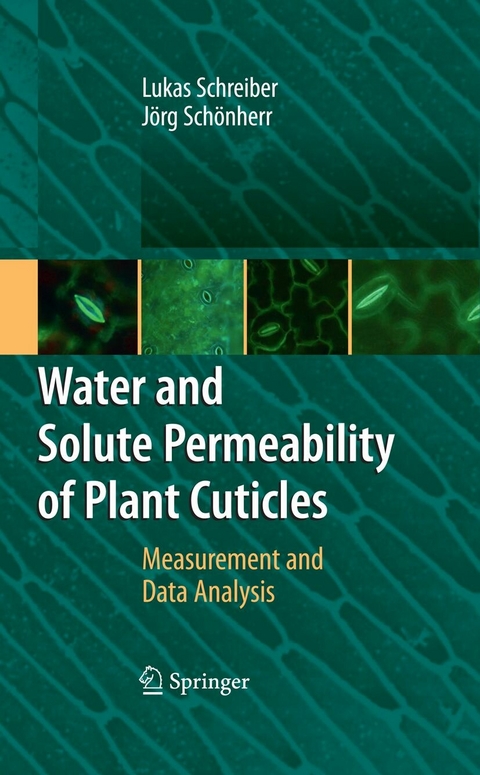
Water and Solute Permeability of Plant Cuticles (eBook)
XIII, 299 Seiten
Springer-Verlag
978-3-540-68945-4 (ISBN)
Preface 5
Acknowledgements 7
Contents 8
Chemistry and Structure of Cuticles as Related to Water and Solute Permeability 13
1.1 Polymer Matrix 14
1.2 Cutin Composition 15
1.3 Soluble Cuticular Lipids 20
1.4 Fine Structure of Cuticles 26
Problems 39
Solutions 40
Quantitative Description of Mass Transfer 43
2.1 Models for Analysing Mass Transfer 44
2.2 Steady State Diffusion Across a Stagnant Water Film 50
2.3 Steady State Diffusion Across a Stagnant Water Film Obstructed by Cellulose and Pectin 51
2.4 Steady State Diffusion of a Solute Across a Dense Non- Porous Membrane 52
2.5 Diffusion Across a Membrane with Changing Concentrations 57
2.6 Determination of the Diffusion Coefficient from Sorption or Desorption Kinetics 60
2.7 Summary 63
Problems 63
Solutions 63
Permeance, Diffusion and Partition Coefficients: Units and Their Conversion 65
3.1 Units of Permeability 65
3.2 Diffusion Coefficients 70
3.3 Partition Coefficients 70
Problems 72
Solutions 72
Water Permeability 73
4.1 Water Permeability of Synthetic Polymer Membranes and Polymer Matrix Membranes: A Comparison of Barrier Properties 73
4.2 Isoelectric Points of Polymer Matrix Membranes 77
4.3 Ion Exchange Capacity 80
4.4 Water Vapour Sorption and Permeability as Affected by Cations and Vapour Pressure 86
4.5 Diffusion and Viscous Transport ofWater: Evidence for Aqueous Pores in Polymer Matrix Membranes 90
4.6 Water Permeability of Isolated Astomatous Cuticular Membranes 105
4.7 Permeances of Adaxial and Abaxial Cuticles 130
4.8 Water Permeability of Isolated Cuticular Membranes as Compared to Intact Leaves 131
4.9 The Shape of the Water Barrier in Plant Cuticles 132
Problems 133
Solutions 134
Penetration of Ionic Solutes 137
5.1 Localisation of Aqueous Pores in Cuticles 138
5.2 Experimental Methods 141
5.3 Cuticular Penetration of Electrolytes 145
5.4 Cuticular Penetration of Fe Chelates 154
Problems 155
Solutions 156
Diffusion of Non-Electrolytes 157
6.1 Sorption in Cuticular Membranes, Polymer Matrix, Cutin and Waxes 157
6.2 Steady State Penetration 165
6.3 Diffusion with Changing Donor Concentrations: The Transient State 188
6.4 Simulation of Foliar Penetration 202
6.5 Diffusion in Reconstituted Isolated Cuticular Waxes 204
Problems 213
Solutions 214
Accelerators Increase Solute Permeability of Cuticles 217
7.1 Sorption of Plasticisers inWax and Cutin 218
7.2 Plasticisation of Cuticular Wax: Evidence from Spectroscopy 224
7.3 Effects of Plasticisers on Diffusion of Lipophilic Solutes inWax 227
7.4 Effects of Plasticisers on Transport in Cuticles 234
7.5 Effects of Plasticisers onWater and Ion Transport 241
Problems 242
Solutions 242
Effects of Temperature on Sorption and Diffusion of Solutes and Penetration of Water 245
8.1 Sorption from Aqueous Solutions 245
8.2 Solute Mobility in Cuticles 251
8.3 Water Permeability in CM and MX 259
8.4 Thermal Expansion of CM, MX, Cutin andWaxes 263
8.5 Water Permeability of Synthetic Polymers as Affected by Temperatures 265
Problems 269
Solutions 270
General Methods, Sources of Errors, and Limitations in Data Analysis 271
9.1 Isolation of Cuticular Membranes 271
9.2 Testing Integrity of Isolated CM 273
9.3 Effects of Holes on Permeance, Rate Constants and Diffusion Coefficients 274
9.4 Distribution ofWater and Solute Permeability 275
9.5 Very High or Very Low Partition Coefficients 276
9.6 Cutin and Wax Analysis and Preparation of Reconstituted CuticularWax 276
9.7 Measuring Water Permeability 278
9.8 Measuring Solute Permeability 280
Appendix A 287
SI units used, fundamental constants, abbreviations, and symbols 287
Appendix B 291
Physico-Chemical Properties of Chemicals 291
Appendix C 295
References 297
Index 307
| Erscheint lt. Verlag | 31.1.2009 |
|---|---|
| Zusatzinfo | XIII, 299 p. |
| Verlagsort | Berlin |
| Sprache | englisch |
| Themenwelt | Naturwissenschaften ► Biologie ► Botanik |
| Technik | |
| Schlagworte | Cuticular lipids • Desiccation • Ecology • environmental stress • Foliar penetration • Plant Protection • Regulation • Transport |
| ISBN-10 | 3-540-68945-1 / 3540689451 |
| ISBN-13 | 978-3-540-68945-4 / 9783540689454 |
| Informationen gemäß Produktsicherheitsverordnung (GPSR) | |
| Haben Sie eine Frage zum Produkt? |
 PDF (Wasserzeichen)
DRM: Digitales Wasserzeichen
Dieses eBook enthält ein digitales Wasserzeichen und ist damit für Sie personalisiert. Bei einer missbräuchlichen Weitergabe des eBooks an Dritte ist eine Rückverfolgung an die Quelle möglich.
Dateiformat: PDF (Portable Document Format)
Mit einem festen Seitenlayout eignet sich die PDF besonders für Fachbücher mit Spalten, Tabellen und Abbildungen. Eine PDF kann auf fast allen Geräten angezeigt werden, ist aber für kleine Displays (Smartphone, eReader) nur eingeschränkt geeignet.
Systemvoraussetzungen:
PC/Mac: Mit einem PC oder Mac können Sie dieses eBook lesen. Sie benötigen dafür einen PDF-Viewer - z.B. den Adobe Reader oder Adobe Digital Editions.
eReader: Dieses eBook kann mit (fast) allen eBook-Readern gelesen werden. Mit dem amazon-Kindle ist es aber nicht kompatibel.
Smartphone/Tablet: Egal ob Apple oder Android, dieses eBook können Sie lesen. Sie benötigen dafür einen PDF-Viewer - z.B. die kostenlose Adobe Digital Editions-App.
Buying eBooks from abroad
For tax law reasons we can sell eBooks just within Germany and Switzerland. Regrettably we cannot fulfill eBook-orders from other countries.
aus dem Bereich