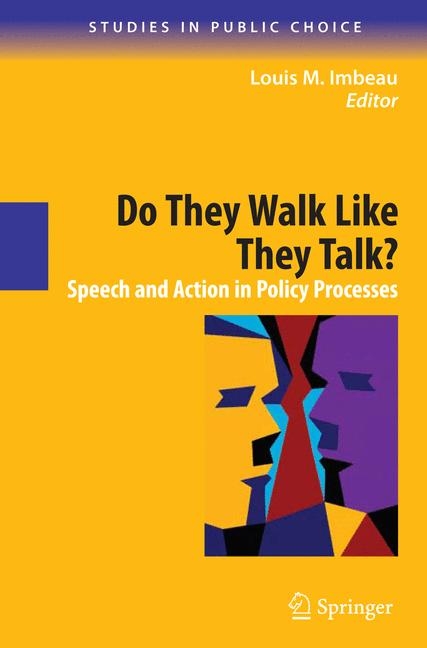
Do They Walk Like They Talk? (eBook)
XIV, 306 Seiten
Springer New York (Verlag)
978-0-387-89672-4 (ISBN)
George Bush's 1988 campaign pledge, 'Read my lips: no new taxes,' has become a mantra for those who distrust politicians and bureaucrats. The gulf between what political leaders say and do seems to be widening, and in democratic societies around the world, contributing to an atmosphere of cynicism and apathy among the citizenry. Understanding the characteristics and functions of speech in policy processes is a requirement for trying to overcome this problem; indeed, politicians and bureaucrats spend a good proportion of their time and resources discoursing, i.e., writing, speaking, and publishing. However, there has been scant analysis of political discourse; the aim of this book is to fill this analytical gap, by exploring political speech from a variety of perspectives, including normative, epistemological, and empirical. Incorporating insights from economics, political science, philosophy, and law, and evidence from the United States, Canada, France, Italy, Turkey, and the EU, the book addresses a wide variety of timely issues, including:.
- Fiscal discipline in speeches vs budget balance: Is an improvement (deterioration) of the budget balance preceded by a more (less) fiscally disciplined discourse?
- Revenues and spending forecasted in budget speeches vs realised budget outcomes: Is there a systematic bias? If so, how can we explain it?
- Electoral pledges vs actual realisations: Do governments follow up on their electoral pledges?
- Ideological stance in party publications vs spending and revenues of party governments: Do parties of the right and the left speak different languages? How can we validly classify a government as of the left or of the right? Is there a systematic difference between governments of the right and of the left in terms of their policy?
- Speeches by central bank officers vs monetary policy: Can changes in monetary policy be predicted by official speeches?
- The political business cycle: How can taking into consideration the speech-action relationship strengthen (or threaten) our knowledge about electoral and partisan cycles in public spending?
Other questions explored include: Should policy makers always tell the truth and all the truth? What are the benefits and the costs of transparency? How can we resolve the apparent contradiction between the democratic demand for transparency and the efficiency requirement of secrecy in many policy areas (budget preparation, monetary policy, foreign policy, security, etc.)? Under which conditions is secrecy acceptable in a democratic society? To what extent may deception and lies lead to a breach of trust or to power abuse? What are the most efficient institutional mechanisms to prevent such abuse? Collectively, the authors present new insights for understanding political process and government activity, and suggest avenues for further research.
George Bush's 1988 campaign pledge, "e;Read my lips: no new taxes,"e; has become a mantra for those who distrust politicians and bureaucrats. The gulf between what political leaders say and do seems to be widening, and in democratic societies around the world, contributing to an atmosphere of cynicism and apathy among the citizenry. Understanding the characteristics and functions of speech in policy processes is a requirement for trying to overcome this problem; indeed, politicians and bureaucrats spend a good proportion of their time and resources discoursing, i.e., writing, speaking, and publishing. However, there has been scant analysis of political discourse; the aim of this book is to fill this analytical gap, by exploring political speech from a variety of perspectives, including normative, epistemological, and empirical. Incorporating insights from economics, political science, philosophy, and law, and evidence from the United States, Canada, France, Italy, Turkey, and the EU, the book addresses a wide variety of timely issues, including:.Fiscal discipline in speeches vs budget balance: Is an improvement (deterioration) of the budget balance preceded by a more (less) fiscally disciplined discourse? Revenues and spending forecasted in budget speeches vs realised budget outcomes: Is there a systematic bias? If so, how can we explain it?Electoral pledges vs actual realisations: Do governments follow up on their electoral pledges? Ideological stance in party publications vs spending and revenues of party governments: Do parties of the right and the left speak different languages? How can we validly classify a government as of the left or of the right? Is there a systematic difference between governments of the right and of the left in terms of their policy?Speeches by central bank officers vs monetary policy: Can changes in monetarypolicy be predicted by official speeches?The political business cycle: How can taking into consideration the speech-action relationship strengthen (or threaten) our knowledge about electoral and partisan cycles in public spending?Other questions explored include: Should policy makers always tell the truth and all the truth? What are the benefits and the costs of transparency? How can we resolve the apparent contradiction between the democratic demand for transparency and the efficiency requirement of secrecy in many policy areas (budget preparation, monetary policy, foreign policy, security, etc.)? Under which conditions is secrecy acceptable in a democratic society? To what extent may deception and lies lead to a breach of trust or to power abuse? What are the most efficient institutional mechanisms to prevent such abuse? Collectively, the authors present new insights for understanding political process and government activity, and suggest avenues for further research.
Foreword 5
The Language of Democracy Between Words and Facts 5
References 8
Acknowledgments 9
Contents 10
Contributors 12
Introduction 14
Dissonance in Policy Processes: An Introduction 15
1.1 Policy Dissonance in the Political Economic Literature 16
1.2 Approaches to Policy Dissonance 19
1.3 Anatomy of the Book 21
References 26
Disciplinary Perspectives 28
The Power of Words: A Philosophical Perspective 29
2.1 Mindlessness 30
2.2 A Case for Culture 34
References 38
Information Shrouding and the Governmental Supply of Goods and Services: An Economic Perspective 40
3.1 Introduction 40
3.2 A Simple Hypothesis 43
3.3 Shrouding in the Marketplace Illustrated 44
3.3.1 False Labeling: Wild Salmon 44
3.3.2 Glossing: Extended Warranties 45
3.3.3 Deception: Airline Travel 46
3.4 The Simple Hypothesis Enlarged 47
3.5 Shrouding in the Public Sector Illustrated 49
3.5.1 Explicit Shrouding 49
3.5.2 Implicit Shrouding 55
3.6 Conclusion 58
References 59
Party Rhetoric and Practice: A Normative Perspective from Political Science 61
4.1 Why Should We Look at Political Parties? 62
4.2 The Functions of Rhetoric in Relation to a Political Party’s Practice 63
4.2.1 The Function of Displaying 63
4.2.2 The Function of Concealing 64
4.2.3 The Function of Legitimization 65
4.2.4 The Function of Contestation 66
4.2.5 The Function of Contradiction Processing 67
4.3 Reconciling Rhetoric and Practice 68
4.3.1 The Measures Needed to Correct the Gaps Related to Displaying 69
4.3.2 The Measures Needed to Correct the Gaps Related to Concealing 69
4.3.3 The Measures Needed to Correct the Gaps Related to Legitimization 70
4.3.4 Measures Needed to Correct the Gaps Related to Contestation 70
4.3.5 Measures Needed to Correct the Problem of Highlighting Discrepancies 71
4.4 Conclusion 71
References 72
Measuring How Political Parties Keep Their Promises: A Positive Perspective from Political Science 73
5.1 Introduction 73
5.2 Theory: Why Should We Expect Political Parties to Keep Their Election Promises? 74
5.3 Method: How to Test Whether Campaign Pledges are Redeemed 76
5.4 Analysis 78
5.5 Conclusion and Discussion 85
References 87
Empirical Studies 89
Measuring US Presidents’ Political Commitment for Fiscal Discipline Between 1920 and 2008 90
6.1 Why and How to Measure Political Commitment for Fiscal Discipline? 90
6.2 Building up a Matrix of Analysis of Political Commitment for Fiscal Discipline 93
6.3 The Index of Political Commitment for Fiscal Discipline 99
6.4 US Presidents’ Political Attitude Toward Deficits, 1920–2008 100
6.4.1 Statements Identified 100
6.4.2 The Index of Fiscal Discipline 103
6.4.3 The Structure of the Political Discourse 105
6.5 Conclusions 111
References 112
Would You Trust an Italian Politician? Evidence from Italian Regional Politics 115
7.1 Goals of the Analysis 115
7.2 A Brief Description of the Italian Regional Politics 118
7.3 Methodology 119
7.4 Content Analysis 120
7.5 Evaluation of Political Accountability 122
7.6 Erosion of Accountability and Financial Constraints 127
7.7 Conclusion 131
Appendix A: Data Sources 132
VII Legislature 132
VIII Legislature 133
Appendix B: List of Abbreviations and Type of Statute of the Italian Regions 134
References 134
General Policy Speech of Prime Ministers and Fiscal Choices in France: ‘‘ Preach Water and Drink Wine!’’ 136
8.1 Introduction 137
8.2 General Policy Speeches of French Prime Ministers: Framework, Stakes, and Shape 138
8.2.1 The Role of the Prime Minister in the Fifth Republic 138
8.2.2 The Importance of General Policy Inauguration Address 139
8.2.3 The Political Aspect of the General Policy Inauguration Address 140
8.3 The General Policy Inaugural Address and Budget Action: The Expected Consequences 140
8.4 Data and Estimation Strategy 142
8.4.1 The Description of Focused Governments 142
8.4.2 The General Policy Inauguration Address of the French Prime Ministers 144
8.4.3 The Prerogatives of the Central Government 150
8.5 Estimation and Results 150
8.5.1 Selection of an Estimator 151
8.5.2 Definition of Variables 152
8.5.3 Results 153
8.6 Conclusion 156
Appendix1: The Stationarity of Data 157
References 158
Do Governments Manipulate Their Revenue Forecasts? Budget Speech and Budget Outcomes in the Canadian Provinces 160
9.1 Introduction 160
9.2 The Sources of Revenue Forecast Errors 161
9.3 Literature Review 162
9.4 Revenue Forecast Errors in the Canadian Provinces 1986–2004 164
9.5 Conclusion 169
Appendix: Variable Definitions and Data Sources 170
References 171
Dissonance in Fiscal Policy: A Power Approach 172
10.1 Introduction 172
10.2 Power Relations in Fiscal Policy: A Conceptual Framework 173
10.2.1 A General Model of Power Relations in the Policy Process 173
10.2.2 Power Relations and Budget Balance: The Use of Coercion and Exchange 175
10.2.3 The Use of Persuasion 176
10.2.4 Fiscal Policy Dissonance 179
10.3 An Empirical Application of the Model 181
10.3.1 Fiscal Discipline in Action: The Evolution of Budget Balance in Four Canadian Provinces 181
10.3.2 Conservatism in Inaugural Speeches 183
10.3.3 The Discrepancy Between Speech and Action: Measuring Dissonance 186
10.4 Conclusion 188
References 189
Speeches and Legislative Extremism in the U. S. Senate 190
11.1 Introduction 190
11.2 The Determinants of Legislative Speech 192
11.3 Research Design 195
11.4 Analysis and Results 201
11.5 Discussion and Conclusion 207
References 209
Do Parties Matter? A Qualitative Answer with Numbers 211
12.1 Introduction 211
12.2 Inaugural Speeches and Party Platform in Quebec: 1960–2006 212
12.2.1 Defining Left and Right 213
12.2.2 Policies 213
12.2.3 Coding the Speeches 214
12.3 Results 215
12.3.1 The Policies 215
12.3.2 The Ideology in the Party Platform 217
12.3.3 Party Labels as Surrogates for Ideology 218
12.3.4 Governments 220
12.4 Discussion and Conclusion 221
References 224
Talking Like a Tax Collector or a Social Guardian? The Use of Administrative Discourse by U. S. State Lottery Agencies 226
13.1 Introduction 226
13.2 State Lotteries in Perspective 227
13.2.1 What is a Lottery? 227
13.2.2 Is Lottery Regressive? 228
13.2.3 Is There a Substitution Effect? 229
13.2.4 Why are There State Lotteries? 229
13.3 Tax Collector or Social Guardian? An Empirical Exploration 232
13.3.1 Content Analyzing Administrative Discourse 232
13.3.2 Explaining the Variation in Lottery Visions 236
13.4 Conclusion 240
References 241
The Early European ‘‘Federalism’’: Ambiguities of Talks About How to Walk Toward a Political Union 244
14.1 Introduction 244
14.2 Consensual Speeches and the First Steps Toward a Political Agency Contract 248
14.3 Trying to Go Further (with More Talk and Writing) 250
14.4 The Ambiguities of the Discourse on the Nature of the Political Union 252
14.5 Conclusion 255
References 257
Other Bibliographical Sources 258
A Semiotic Network Comparison of Technocratic and Populist Discourses in Turkey 259
15.1 Introduction 259
15.2 Discourse, Knowledge, and Action: The Constitution of Semiotic Communities 261
15.3 Semiotic Analysis: Decoding the Logic of Discourses 263
15.4 Map Analysis 264
15.5 Methodology 265
15.5.1 Sampling 266
15.5.2 Data Collection: Context and Instruments 267
15.5.3 Context 268
15.5.4 Instrument 268
15.5.5 Data Analysis 269
15.6 Findings and Discussion 270
15.6.1 Convergence of Technocratic and Populist Discourses 270
15.6.2 Semiotic Maps 271
15.7 Conclusion 275
References 275
Conclusion 278
Do They Walk Like They Talk? A Conclusion 279
16.1 Summary of Theoretical and Empirical Conclusions 280
16.1.1 Normative Theoretical Conclusions 280
16.1.2 Positive Theoretical Conclusions 280
16.1.3 Empirical Conclusions 282
16.2 Three Models of Policy Speech and Action 283
16.3 Concluding Remark: Is Dissonance Pathological? 288
References 290
About the Contributors 291
Index 298
| Erscheint lt. Verlag | 16.7.2009 |
|---|---|
| Reihe/Serie | Studies in Public Choice | Studies in Public Choice |
| Zusatzinfo | XIV, 306 p. 65 illus. |
| Verlagsort | New York |
| Sprache | englisch |
| Themenwelt | Geisteswissenschaften ► Philosophie ► Erkenntnistheorie / Wissenschaftstheorie |
| Geisteswissenschaften ► Sprach- / Literaturwissenschaft ► Sprachwissenschaft | |
| Naturwissenschaften | |
| Sozialwissenschaften ► Politik / Verwaltung ► Politische Systeme | |
| Sozialwissenschaften ► Politik / Verwaltung ► Politische Theorie | |
| Sozialwissenschaften ► Politik / Verwaltung ► Staat / Verwaltung | |
| Schlagworte | Election • Government • Political Action • political communication • Political Discourse • Political Science • Political Speech • Politician • Politics • Public Choice • rhetoric • Voting Behavior |
| ISBN-10 | 0-387-89672-4 / 0387896724 |
| ISBN-13 | 978-0-387-89672-4 / 9780387896724 |
| Informationen gemäß Produktsicherheitsverordnung (GPSR) | |
| Haben Sie eine Frage zum Produkt? |
 PDF (Wasserzeichen)
DRM: Digitales Wasserzeichen
Dieses eBook enthält ein digitales Wasserzeichen und ist damit für Sie personalisiert. Bei einer missbräuchlichen Weitergabe des eBooks an Dritte ist eine Rückverfolgung an die Quelle möglich.
Dateiformat: PDF (Portable Document Format)
Mit einem festen Seitenlayout eignet sich die PDF besonders für Fachbücher mit Spalten, Tabellen und Abbildungen. Eine PDF kann auf fast allen Geräten angezeigt werden, ist aber für kleine Displays (Smartphone, eReader) nur eingeschränkt geeignet.
Systemvoraussetzungen:
PC/Mac: Mit einem PC oder Mac können Sie dieses eBook lesen. Sie benötigen dafür einen PDF-Viewer - z.B. den Adobe Reader oder Adobe Digital Editions.
eReader: Dieses eBook kann mit (fast) allen eBook-Readern gelesen werden. Mit dem amazon-Kindle ist es aber nicht kompatibel.
Smartphone/Tablet: Egal ob Apple oder Android, dieses eBook können Sie lesen. Sie benötigen dafür einen PDF-Viewer - z.B. die kostenlose Adobe Digital Editions-App.
Buying eBooks from abroad
For tax law reasons we can sell eBooks just within Germany and Switzerland. Regrettably we cannot fulfill eBook-orders from other countries.
aus dem Bereich