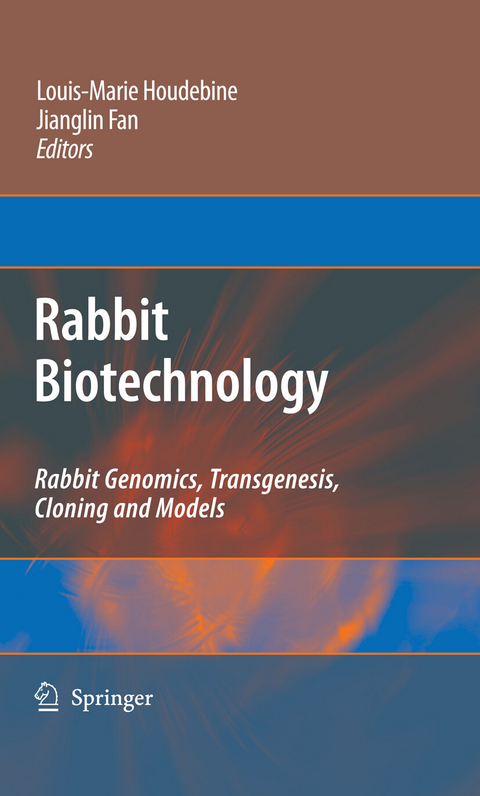
Rabbit Biotechnology (eBook)
VIII, 136 Seiten
Springer Netherland (Verlag)
978-90-481-2227-1 (ISBN)

Louis-Marie Houdebine and Jianglin Fan The study of biological functions of proteins and their possible roles in the pathogenesis of human diseases requires more and more relevant animal m- els. Although mice including genetically modified mice offer many possibilities, other non-murine species are absolutely required in some circumstances. Rabbit is one of these species, which has been widely used in biomedical studies. This animal is genetically and physiologically closer to humans including cardiov- cular system and metabolism characteristics. Rabbit is thus more appropriate than mice to study some diseases such as atherosclerosis and lipid metabolism. Because of its larger size, surgery manipulation, bleeding, and turn-over studies are much easier performed in rabbits than in mice. Furthermore, transgenic rabbits can be produced using microinjection and other methods such as lentiviral v- tors. Cloning in rabbits has been proved possible, even though still laborious and time-consuming. Hopefully, functional rabbit ES cell lines will be available in the coming years. Gene deletion or knock-out in rabbits will then become possible.
Contents 5
Chapter 1 Introduction 9
Chapter 2 Improvement of Rabbit Production 11
2.1 Introduction 11
2.2 Artificial Insemination (AI) 12
2.3 Induction of Parturition by Oxytocin 16
2.4 Nursing of Suckling Pups 16
2.5 Storage of Rabbit Semen 17
2.6 Rabbit Semen Freezing 17
References 19
Chapter 3 Basic Methods for Experimental Rabbits 21
3.1 Introduction 21
3.2 Handling and Restraint 21
3.3 Compound Administration 24
3.4 Sampling Techniques 27
3.5 Anesthesiology 29
3.6 Euthanasia 30
Reference 30
Chapter 4 Useful Information for Rabbit Genes, Proteins, and Antibodies 31
4.1 Introduction 31
4.2 Rabbit Genome, cDNA, and Protein Sequences 31
4.3 Primary Antibodies Against Rabbit Proteins 32
4.4 Other Useful Websites for Rabbit Physiology 34
Chapter 5 General Physiology of Rabbits 35
5.1 Delivering and Nursing Physiology (Tables 5.1–5.3) 35
5.2 Behavioral and Sensory Physiology 37
5.3 Urinary Physiology (Table 5.4) 37
5.4 Digestive Physiology (Table 5.5) 38
5.5 Respiratory Physiology 38
5.6 Cardiac Physiology (Table 5.6) 39
5.7 Hematologic Values 39
5.8 Serum Biochemical and Enzyme Values 39
5.9 Bleeding System for Obtaining More Correct Physiological Data and Animal Welfare 40
References 42
Chapter 6 Rabbit Transgenesis 44
6.1 Introduction 44
6.2 Pronuclear Microinjection Methods for Rabbit Transgenesis 45
6.3 Basic Technique for Microinjection 45
6.4 Other Possible Future Methods for Rabbit Transgenesis 50
References 52
Chapter 7 Rabbit as a Model for the Study of Human Diseases 55
7.1 Introduction 55
7.2 Studies Using Rabbit Models 56
7.3 Rabbit Models for Lipid Metabolism and Atherosclerosis 57
7.4 Rabbit Models for Other Human Diseases 61
7.5 Conclusions 65
References 66
Chapter 8 Transgenic Rabbits to Prepare Pharmaceutical Proteins 70
8.1 Introduction 70
8.2 Techniques to Generate Transgenic Rabbits 71
8.3 Production in Blood 72
8.4 Production in Milk 73
8.5 Quality of the Proteins Secreted in Milk 74
8.6 The Specific Properties of Rabbits as Living Fermentor 77
8.7 Conclusion and Perspectives 77
References 78
Chapter 9 Derivation and Characterization of Rabbit Embryonic Stem Cells: A Review 81
9.1 Introduction 81
9.2 Pluripotent Stem Cells of Different Origins 82
9.3 Rabbit Embryonic Stem Cells 84
9.4 Discussion 103
References 103
Chapter 10 Rabbit Cloning 109
10.1 Historical Background of Rabbit Biotechnology 109
10.2 Special Aspects of Rabbit Reproduction 110
10.3 State of Nuclear Transfer 112
10.4 Possible Applications of Rabbit Cloning 120
10.5 Appendix: Protocol for Rabbit Somatic-Cell Nuclear Transfer 122
Bibliography 124
Chapter 11 The European Rabbit Genome 133
Index 134
| Erscheint lt. Verlag | 24.4.2009 |
|---|---|
| Zusatzinfo | VIII, 136 p. |
| Verlagsort | Dordrecht |
| Sprache | englisch |
| Themenwelt | Studium ► 2. Studienabschnitt (Klinik) ► Humangenetik |
| Naturwissenschaften ► Biologie ► Genetik / Molekularbiologie | |
| Technik ► Umwelttechnik / Biotechnologie | |
| Schlagworte | biological functions • Biotechnology • cell lines • Cloning • genes • Genetic Engineering • Genome • Metabolism |
| ISBN-10 | 90-481-2227-9 / 9048122279 |
| ISBN-13 | 978-90-481-2227-1 / 9789048122271 |
| Informationen gemäß Produktsicherheitsverordnung (GPSR) | |
| Haben Sie eine Frage zum Produkt? |
 PDF (Wasserzeichen)
DRM: Digitales Wasserzeichen
Dieses eBook enthält ein digitales Wasserzeichen und ist damit für Sie personalisiert. Bei einer missbräuchlichen Weitergabe des eBooks an Dritte ist eine Rückverfolgung an die Quelle möglich.
Dateiformat: PDF (Portable Document Format)
Mit einem festen Seitenlayout eignet sich die PDF besonders für Fachbücher mit Spalten, Tabellen und Abbildungen. Eine PDF kann auf fast allen Geräten angezeigt werden, ist aber für kleine Displays (Smartphone, eReader) nur eingeschränkt geeignet.
Systemvoraussetzungen:
PC/Mac: Mit einem PC oder Mac können Sie dieses eBook lesen. Sie benötigen dafür einen PDF-Viewer - z.B. den Adobe Reader oder Adobe Digital Editions.
eReader: Dieses eBook kann mit (fast) allen eBook-Readern gelesen werden. Mit dem amazon-Kindle ist es aber nicht kompatibel.
Smartphone/Tablet: Egal ob Apple oder Android, dieses eBook können Sie lesen. Sie benötigen dafür einen PDF-Viewer - z.B. die kostenlose Adobe Digital Editions-App.
Buying eBooks from abroad
For tax law reasons we can sell eBooks just within Germany and Switzerland. Regrettably we cannot fulfill eBook-orders from other countries.
aus dem Bereich