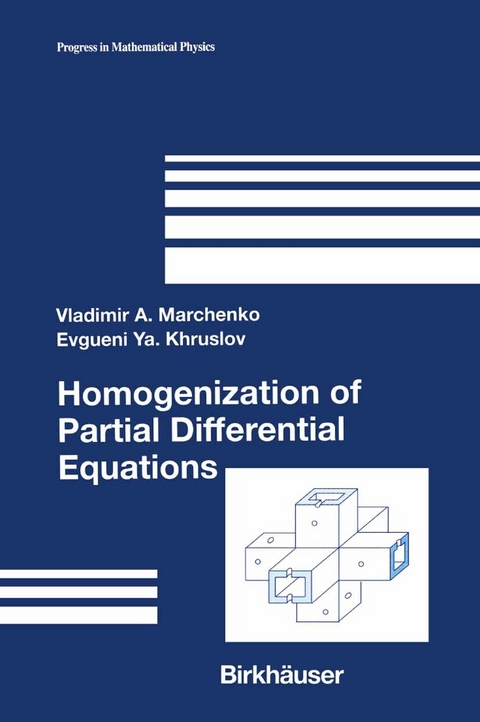
Homogenization of Partial Differential Equations (eBook)
XIV, 402 Seiten
Birkhäuser Boston (Verlag)
978-0-8176-4468-0 (ISBN)
A comprehensive study of homogenized problems, focusing on the construction of nonstandard models
Details a method for modeling processes in microinhomogeneous media (radiophysics, filtration theory, rheology, elasticity theory, and other domains)
Complete proofs of all main results, numerous examples
Classroom text or comprehensive reference for graduate students, applied mathematicians, physicists, and engineers
Homogenization is a method for modeling processes in microinhomogeneous media, which are encountered in radiophysics, filtration theory, rheology, elasticity theory, and other domains of mechanics, physics, and technology. These processes are described by PDEs with rapidly oscillating coefficients or boundary value problems in domains with complex microstructure. From the technical point of view, given the complexity of these processes, the best techniques to solve a wide variety of problems involve constructing appropriate macroscopic (homogenized) models.The present monograph is a comprehensive study of homogenized problems, based on the asymptotic analysis of boundary value problems as the characteristic scales of the microstructure decrease to zero. The work focuses on the construction of nonstandard models: non-local models, multicomponent models, and models with memory.Along with complete proofs of all main results, numerous examples of typical structures of microinhomogeneous media with their corresponding homogenized models are provided. Graduate students, applied mathematicians, physicists, and engineers will benefit from this monograph, which may be used in the classroom or as a comprehensive reference text.
* Preface * Introduction * The Dirichlet Boundary Value Problem in Strongly Perforated Domains with Fine-Grained Boundary * The Dirichlet Boundary Value Problem in Strongly Perforated Domains with Complex Boundary * Strongly Connected Domains * The Neumann Boundary Value Problems in Strongly Perforated Domains * Nonstationary Problems and Spectral Problems * Differential Equations with Rapidly Oscillating Coefficients * Homogenized Conjugation Conditions * References * Index
Preface (S. 6-7)
This book is devoted to homogenization problems for partial differential equations describing various physical phenomena in microinhomogeneous media. This direction in the theory of partial differential equations has been intensively developed for the last forty years, it finds numerous applications in radiophysics, filtration theory, rheology, elasticity theory, and many other areas of physics, mechanics, and engineering sciences.
A medium is called microinhomogeneous if its local parameters can be described by functions rapidly varying with respect to the space variables. We will always assume that the length scale of oscillations is much less than the linear sizes of the domain in which a physical process is considered but much greater than the sizes of molecules, so that the process can be described using the differential equations of the mechanics of solids. These differential equations either have rapidly oscillating coefficients (with respect to the space variables) or are considered in domains with complex microstructure, such as domains with fine-grained boundary [112] (called later by the better-known term strongly perforated domains). The microstructure is understood as the local structure of a domain or the coefficients of equations in the scale of microinhomogeneities.
Obviously, it is practically impossible to solve the corresponding boundary (initial boundary) value problems by either analytical or numerical methods. However, if the microscale is much less than the characteristic scale of the process under investigation (e.g., the wavelength), then it is possible to give a macroscopic description of the process. If it is the case, the medium usually has stable characteristics (heat conductivity, dielectric permeability, etc.), which, in general, may differ substantially from the local characteristics. Such stable characteristics are referred to as homogenized, or effective, characteristics, because they are usually determined by methods of the homogenization theory for differential equations or the relevant mean field methods, effective medium methods, etc.
The term homogenization is associated, first of all, with methods of nonlinear mechanics and ordinary differential equations developed by Poincare, Krylov, Bogolyubov, and Mitropolskii (see, e.g., [21, 123]). For partial differential equations, homogenization problems have been studied by physicists from Maxwell`s times, but they remained for a long time outside the interests of mathematicians. However, since the mid I 960s, homogenization theory for partial differential equations began to be intensively developed by mathematicians as well, which was motivated not only by numerous applications (first of all, in the theory of composite media [142]) but also by the emergence of new deep ideas and concepts important for mathematics itself.
Currently, there is a great number of publications devoted to mathematical aspects of homogenization such as asymptotic analysis, two-scale convergence, G-convergence, and r -convergence. Making no claim to cite all of the available monographs on the subject, we would like to mention the books by Allaire [3], Bakhvalov and Panasenko [9], Bensoussan, Lions, and Papanicolaou [13], Braides and Defranceschi [26], Cioranescu and Donato [42].
| Erscheint lt. Verlag | 22.12.2008 |
|---|---|
| Reihe/Serie | Progress in Mathematical Physics | Progress in Mathematical Physics |
| Zusatzinfo | XIV, 402 p. 28 illus. |
| Verlagsort | Boston |
| Sprache | englisch |
| Themenwelt | Mathematik / Informatik ► Mathematik ► Analysis |
| Naturwissenschaften ► Physik / Astronomie | |
| Technik | |
| Schlagworte | asymptotic analysis • Boundary value problem • Complexity • differential equation • Elasticity • Mechanics • Modeling • partial differential equation • Partial differential equations • standard model |
| ISBN-10 | 0-8176-4468-7 / 0817644687 |
| ISBN-13 | 978-0-8176-4468-0 / 9780817644680 |
| Informationen gemäß Produktsicherheitsverordnung (GPSR) | |
| Haben Sie eine Frage zum Produkt? |
 PDF (Wasserzeichen)
DRM: Digitales Wasserzeichen
Dieses eBook enthält ein digitales Wasserzeichen und ist damit für Sie personalisiert. Bei einer missbräuchlichen Weitergabe des eBooks an Dritte ist eine Rückverfolgung an die Quelle möglich.
Dateiformat: PDF (Portable Document Format)
Mit einem festen Seitenlayout eignet sich die PDF besonders für Fachbücher mit Spalten, Tabellen und Abbildungen. Eine PDF kann auf fast allen Geräten angezeigt werden, ist aber für kleine Displays (Smartphone, eReader) nur eingeschränkt geeignet.
Systemvoraussetzungen:
PC/Mac: Mit einem PC oder Mac können Sie dieses eBook lesen. Sie benötigen dafür einen PDF-Viewer - z.B. den Adobe Reader oder Adobe Digital Editions.
eReader: Dieses eBook kann mit (fast) allen eBook-Readern gelesen werden. Mit dem amazon-Kindle ist es aber nicht kompatibel.
Smartphone/Tablet: Egal ob Apple oder Android, dieses eBook können Sie lesen. Sie benötigen dafür einen PDF-Viewer - z.B. die kostenlose Adobe Digital Editions-App.
Buying eBooks from abroad
For tax law reasons we can sell eBooks just within Germany and Switzerland. Regrettably we cannot fulfill eBook-orders from other countries.
aus dem Bereich