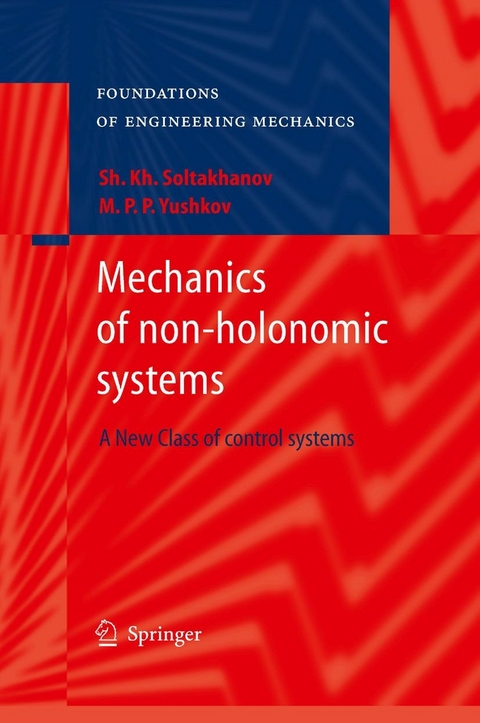
Mechanics of non-holonomic systems (eBook)
XXXII, 332 Seiten
Springer Berlin (Verlag)
978-3-540-85847-8 (ISBN)
A general approach to the derivation of equations of motion of as holonomic, as nonholonomic systems with the constraints of any order is suggested. The system of equations of motion in the generalized coordinates is regarded as a one vector relation, represented in a space tangential to a manifold of all possible positions of system at given instant. The tangential space is partitioned by the equations of constraints into two orthogonal subspaces. In one of them for the constraints up to the second order, the motion low is given by the equations of constraints and in the other one for ideal constraints, it is described by the vector equation without reactions of connections. In the whole space the motion low involves Lagrangian multipliers. It is shown that for the holonomic and nonholonomic constraints up to the second order, these multipliers can be found as the function of time, positions of system, and its velocities. The application of Lagrangian multipliers for holonomic systems permits us to construct a new method for determining the eigenfrequencies and eigenforms of oscillations of elastic systems and also to suggest a special form of equations for describing the system of motion of rigid bodies. The nonholonomic constraints, the order of which is greater than two, are regarded as programming constraints such that their validity is provided due to the existence of generalized control forces, which are determined as the functions of time. The closed system of differential equations, which makes it possible to find as these control forces, as the generalized Lagrange coordinates, is compound. The theory suggested is illustrated by the examples of a spacecraft motion. The book is primarily addressed to specialists in analytic mechanics.
Annotation 6
Preface to the English edition 7
Table of Contents 10
Introduction 14
Survey of the main stages of development of nonholonomic mechanics 20
Chapter I HOLONOMIC SYSTEMS 32
§ 1. Equations of motion for the representation point of holonomic mechanical system 32
§ 2. Lagrange’s equations of the first and second kinds 35
§ 3. The D’Alembert–Lagrange principle 43
§ 4. Longitudinal accelerated motion of a car as an example of motion of a holonomic system with a nonretaining constraint 46
Chapter II NONHOLONOMIC SYSTEMS 56
§ 1. Nonholonomic constraint reaction 56
§ 2. Equations of motion of nonholonomic systems. Maggi’s equations 59
§ 3. The generation of the most usual forms of equations of motion of nonholonomic systems from Maggi’s equations 69
§ 4. The examples of applications of different kinds equations of nonholonomic mechanics 76
§ 5. The Suslov–Jourdain principle 97
§ 6. The definitions of virtual displacements by Chetaev 105
Chapter III LINEAR TRANSFORMATION OF FORCES 108
§ 1. Some general remarks 108
§ 2. Theorem on the forces providing the satisfaction of holonomic constraints 114
§ 3. An example of the application of theorem on the forces providing the satisfaction of holonomic constraints 119
§ 4. Chetaev’s postulates and the theorem on the forces providing the satisfaction of nonholonomic constraints 123
§ 5. An example of the application of theorem on forces providing the satisfaction of nonholonomic constraints 128
§ 6. Linear transformation of forces and Gaussian principle 131
Chapter IV APPLICATION OF A TANGENT SPACE TO THE STUDY OF CONSTRAINED MOTION 135
§ 1. The partition of tangent space into two subspaces by equations of constraints. Ideality of constraints 135
§ 2. The connection of differential variational principles of mechanics 139
§ 3. Geometric interpretation of linear and nonlinear nonholonomic constraints. Generalized Gaussian principle 143
§ 4. The representation of equations of motion following from generalized Gaussian principle in Maggi’s form 149
§ 5. The representation of equations of motion following from generalized Gaussian principle in Appell’s form 151
Chapter V THE MIXED PROBLEM OF DYNAMICS. NEW CLASS OF CONTROL PROBLEMS 155
§ 1. The generalized problem of P. L. Chebyshev. A new class of control problems 155
§ 2. A generation of a closed system of differential equations in generalized coordinates and the generalized control forces 158
§ 3. The mixed problem of dynamics and Gaussian principle 161
§ 4. The motion of spacecraft with modulo constant acceleration in Earth’s gravitational field 167
§ 5. The satellite maneuver alternative to the Homann elliptic motion 174
Chapter VI APPLICATION OF THE LAGRANGE MULTIPLIERS TO THE CONSTRUCTION OF THREE NEW METHODS FOR THE STUDY OF MECHANICAL SYSTEMS 179
§ 1. Some remarks on the Lagrange multipliers 180
§ 2. Generalized Lagrangian coordinates of elastic body 182
§ 3. The application of Lagrange’s equations of the first kind to the study of normal oscillations of mechanical systems with distributed parameters 184
§ 4. Lateral vibration of a beam with immovable supports 190
§ 5. The application of Lagrange’s equations of the first kind to the determination of normal frequencies and oscillation modes of system of bars 195
§ 6. Transformation of the frequency equation to a dimensionless form and determination of minimal number of parameters governing a natural frequency spectrum of the system 203
§ 7. A special form of equations of the dynamics of system of rigid bodies 208
§ 8. The application of special form of equations of dynamics to the study of certain problems of robotics 211
§ 9. Application of the generalized Gaussian principle to the problem of suppression of mechanical systems oscillations 213
Chapter VII EQUATIONS OF MOTION IN QUASICOORDINATES 222
§ 1. The equivalence of different forms of equations of motion of nonholonomic systems 222
§ 2. The Poincar´ e–Chetaev–Rumyantsev approach to the generation of equations of motion of nonholonomic systems 230
§ 3. The approach of J. Papastavridis to the generation of equations of motion of nonholonomic systems 236
APPENDICES 241
APPENDIX A THE METHOD OF CURVILINEAR COORDINATES 241
§ 1. The curvilinear coordinates of point. Reciprocal bases 241
§ 2. The relation between a reciprocal basis and gradients of scalar functions 243
§ 3. Covariant and contravariant components of vector 244
§ 4. Covariant and contravariant components of velocity vector 245
§ 5. Christoffel symbols 246
§ 6. Covariant and contravariant components of acceleration vector. The Lagrange operator 248
§ 7. The case of cylindrical system of coordinates 250
§ 8. Covariant components of acceleration vector for nonstationary basis 253
§ 9. Covariant components of a derivative of vector 255
APPENDIX B STABILITY AND BIFURCATION OF STEADY MOTIONS OF NONHOLONOMIC SYSTEMS 257
APPENDIX C THE CONSTRUCTION OF APPROXIMATE SOLUTIONS FOR EQUATIONS OF NONLINEAR OSCILLATIONS WITH THE USAGE OF THE GAUSS PRINCIPLE 262
APPENDIX D THE MOTION OF NONHOLONOMIC SYSTEM WITH OUT REACTIONS OF NONHOLONOMIC CONSTRAINTS 265
§ 1. Existence conditions for "free motion" of nonholonomic system 265
§ 2. Free motion of the Chaplygin sledge 266
§ 3. The possibility of free motion of nonholonomic system under active forces 269
APPENDIX E THE TURNING MOVEMENT OF A CAR AS A NONHOLONOMIC PROBLEM WITH NONRETAINING CONSTRAINTS 271
§ 1. General remarks 271
§ 2. The turning movement of a car with retaining ( bilateral) constraints 272
§ 3. The turning movement of a rear-drive car with nonretaining constraints 275
§ 4. Equations of motion of a turning front- drive car with non- retaining constraints 282
§ 5. Calculation of motion of a certain car 285
§ 6. Reasonable choice of quasivelocities 287
APPENDIX F CONSIDERATION OF REACTION FORCES OF HOLONOMIC CONSTRAINTS AS GENERALIZED COORDINATES IN APPROXIMATE DETERMINATION OF LOWER FREQUENCIES OF ELASTIC SYSTEMS 289
APPENDIX G THE DUFFING EQUATION AND STRANGE ATTRACTOR 307
INDEX 351
| Erscheint lt. Verlag | 27.5.2009 |
|---|---|
| Reihe/Serie | Foundations of Engineering Mechanics | Foundations of Engineering Mechanics |
| Zusatzinfo | XXXII, 332 p. |
| Verlagsort | Berlin |
| Sprache | englisch |
| Themenwelt | Informatik ► Theorie / Studium ► Künstliche Intelligenz / Robotik |
| Mathematik / Informatik ► Mathematik ► Statistik | |
| Mathematik / Informatik ► Mathematik ► Wahrscheinlichkeit / Kombinatorik | |
| Naturwissenschaften ► Physik / Astronomie | |
| Technik ► Maschinenbau | |
| Schlagworte | Control • derivation of equations of motion • Mechanics • Non-holonomic systems • programming • vector relation |
| ISBN-10 | 3-540-85847-4 / 3540858474 |
| ISBN-13 | 978-3-540-85847-8 / 9783540858478 |
| Informationen gemäß Produktsicherheitsverordnung (GPSR) | |
| Haben Sie eine Frage zum Produkt? |
 PDF (Wasserzeichen)
DRM: Digitales Wasserzeichen
Dieses eBook enthält ein digitales Wasserzeichen und ist damit für Sie personalisiert. Bei einer missbräuchlichen Weitergabe des eBooks an Dritte ist eine Rückverfolgung an die Quelle möglich.
Dateiformat: PDF (Portable Document Format)
Mit einem festen Seitenlayout eignet sich die PDF besonders für Fachbücher mit Spalten, Tabellen und Abbildungen. Eine PDF kann auf fast allen Geräten angezeigt werden, ist aber für kleine Displays (Smartphone, eReader) nur eingeschränkt geeignet.
Systemvoraussetzungen:
PC/Mac: Mit einem PC oder Mac können Sie dieses eBook lesen. Sie benötigen dafür einen PDF-Viewer - z.B. den Adobe Reader oder Adobe Digital Editions.
eReader: Dieses eBook kann mit (fast) allen eBook-Readern gelesen werden. Mit dem amazon-Kindle ist es aber nicht kompatibel.
Smartphone/Tablet: Egal ob Apple oder Android, dieses eBook können Sie lesen. Sie benötigen dafür einen PDF-Viewer - z.B. die kostenlose Adobe Digital Editions-App.
Buying eBooks from abroad
For tax law reasons we can sell eBooks just within Germany and Switzerland. Regrettably we cannot fulfill eBook-orders from other countries.
aus dem Bereich