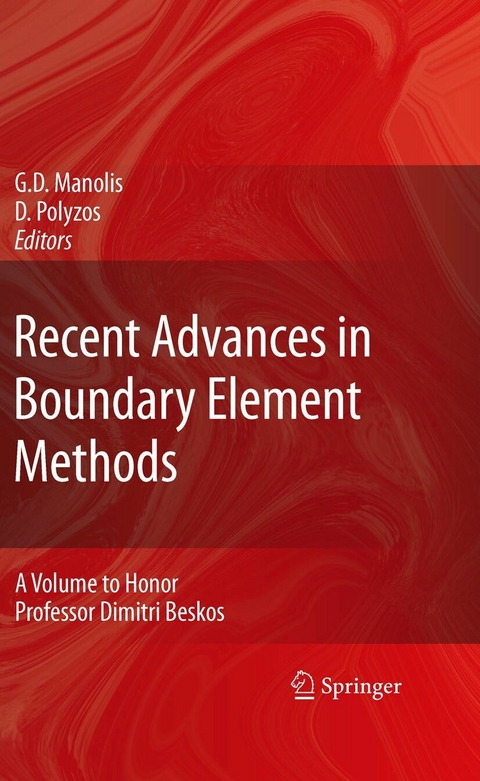
Recent Advances in Boundary Element Methods (eBook)
XXXVII, 467 Seiten
Springer Netherland (Verlag)
978-1-4020-9710-2 (ISBN)
This volume, dedicated to Professor Dimitri Beskos, contains contributions from leading researchers in Europe, the USA, Japan and elsewhere, and addresses the needs of the computational mechanics research community in terms of timely information on boundary integral equation-based methods and techniques applied to a variety of fields.
The contributors are well-known scientists, who also happen to be friends, collaborators as past students of Dimitri Beskos. Dimitri is one the BEM pioneers who started his career at the University of Minnesota in Minneapolis, USA, in the 1970s and is now with the University of Patras in Patras, Greece.
The book is essentially a collection of both original and review articles on contemporary Boundary Element Methods (BEM) as well as on the newer Mesh Reduction Methods (MRM), covering a variety of research topics. Close to forty contributions compose an over-500 page volume that is rich in detail and wide in terms of breadth of coverage of the subject of integral equation formulations and solutions in both solid and fluid mechanics.
This volume, dedicated to Professor Dimitri Beskos, contains contributions from leading researchers in Europe, the USA, Japan and elsewhere, and addresses the needs of the computational mechanics research community in terms of timely information on boundary integral equation-based methods and techniques applied to a variety of fields.The contributors are well-known scientists, who also happen to be friends, collaborators as past students of Dimitri Beskos. Dimitri is one the BEM pioneers who started his career at the University of Minnesota in Minneapolis, USA, in the 1970s and is now with the University of Patras in Patras, Greece.The book is essentially a collection of both original and review articles on contemporary Boundary Element Methods (BEM) as well as on the newer Mesh Reduction Methods (MRM), covering a variety of research topics. Close to forty contributions compose an over-500 page volume that is rich in detail and wide in terms of breadth of coverage of the subject of integral equation formulations and solutions in both solid and fluid mechanics.
Editorial 6
Contents 8
Contributors 11
Biography of Dimitri Beskos 16
Personal Information 17
Address 17
Distinctions and Honours 17
Administrative Positions 18
Societies 18
Academic Positions 19
Publication Record 19
List of Publications – Books 20
List of Publications – Guest Editorials 21
List of Publications – Book Chapters 21
List of Publications – Journal Papers 23
Doctoral Students – University of Minnesota 32
Doctoral Students – University of Patras 33
Stability Analysis of Plates 35
1 Introduction 35
2 Basic Concepts 36
3 Shear Deformable Plate Boundary Integral Equations 39
4 Classical Plate Boundary Integral Equations 41
5 Approximation of Domain Integrals 42
6 Matrix Equations 43
7 Numerical Results 44
8 Conclusions 46
References 47
Multi-Level Fast Multipole BEM for 3- D Elastodynamics 49
1 Introduction 49
2 Elastodynamic Boundary Element Method 50
3 Elastodynamic Fast Multipole Method 51
4 Numerical Examples 56
5 Conclusions 60
References 61
A Semi-Analytical Approach for Boundary Value Problems with Circular Boundaries 62
1 Introduction 62
2 Methods of Solution 64
3 Illustrative Examples 71
4 Conclusions 74
References 75
The Singular Function Boundary Integral Method for Elliptic Problems with Boundary Singularities 76
1 Introduction 76
2 The Singular Function Boundary Integral Method 77
3 Convergence Analysis 80
4 Numerical Results for Laplacian Problems 82
5 The SFBIM for Biharmonic Problems 84
6 Conclusions 89
References 89
Fast Multipole BEM and Genetic Algorithms for the Design of Foams with Functional- Graded Thermal Conductivity 90
1 Introduction 90
2 The Fast Multipole Boundary Element Method and Modeling Considerations 91
3 The Representative Volume Element 93
4 Genetic Algorithms 95
5 Examples 97
6 Conclusions 102
References 103
An Integral Equation Formulation of Three- Dimensional Inhomogeneity Problems 104
1 Introduction 104
2 Basic Formulation 105
3 Numerical Examples 107
4 Conclusions 112
References 112
Energy Flux Across a Corrugated Interface of a Basin Subjected to a Plane Harmonic SH Wave 114
1 Introduction 114
2 Statement of Problem 115
3 Numerical Results 117
4 Summary and Conclusions 124
References 124
Boundary Integral Equations and Fluid- Structure Interaction at the Micro Scale 126
1 Introduction 126
2 Quasi-Static Stokes Flow with Slip Boundary Conditions 128
3 Gas Structure Interaction in the Free Molecule Regime 134
4 Numerical Application 138
5 Conclusions 142
References 142
A 2D Time-Domain BEM for Dynamic Crack Problems in Anisotropic Solids 145
1 Introduction 145
2 Problem Statement and BIEs 147
3 Numerical Solution Procedure 148
4 Numerical Examples 153
5 Conclusions 159
References 160
Simulation of Elastic Scattering with a Coupled FMBE- FE Approach 162
1 Introduction 162
2 FE Formulation for the Structural Domain 163
3 BE Formulation for the Fluid Domain 165
4 Coupled FMBE/FE Formulation 171
5 The Spherical Scatterer 172
6 Conclusion 175
References 175
An Application of the BEM Numerical Green’s Function Procedure to Study Cracks in Reissner’s Plates 177
1 Introduction 177
2 The BEM Applied to Reissner’s Plate Theory 178
3 Numerical Green’s Function Approach 179
4 Implementation Features 183
5 Stress Intensity Factors 185
6 Examples 185
7 Conclusion 190
References 191
General Approaches on Formulating Weakly- Singular BIES for PDES 192
1 Introduction 192
2 Part I: Weakly-Singular BIEs for Elasticity 196
3 Part II: Weakly-Singular BIEs for Acoustics 209
References 219
Dynamic Inelastic Analysis with BEM: Results and Needs 221
1 Introduction 221
2 Dynamic Inelastic Analysis with Boundary Elements 222
3 Numerical Examples 229
4 Conclusions and General Criticism 233
References 234
Quantifier-Free Formulae for Inequality Constraints Inside Boundary Elements 237
1 Introduction 237
2 Quantifier Elimination for the Quadratic Polynomial 240
3 Quantifier Elimination for the Cubic Polynomial 244
4 Conclusions 250
References 250
Matrix Decomposition Algorithms Related to the MFS for Axisymmetric Problems 251
1 Introduction 251
2 Axisymmetric Potential Problems 252
3 Axisymmetric Elasticity Problems 257
4 Numerical Results 261
5 Concluding Remarks 263
Appendix 263
References 264
Boundary Element Analysis of Gradient Elastic Problems 266
1 Introduction 266
2 Simplified Gradient Elastic Model, Integral Representation of the Problem 268
3 BEM Procedure 271
4 Numerical Results 273
5 Conclusions 277
References 278
The Fractional Diffusion-Wave Equation in Bounded Inhomogeneous Anisotropic Media. An AEM Solution 281
1 Introduction 281
2 The Initial Boundary Value Problem 282
3 The AEM Solution 284
4 Solution of the Semi-Discretised Equations 287
5 Examples 293
6 Conclusions 300
Appendix Approximation of Dac u(0) 300
References 302
Efficient Solution for Composites Reinforced by Particles 303
1 Introduction 303
2 Description of the Model 305
3 Examples and Discussion 309
4 Conclusions 311
References 311
Development of the Fast Multipole Boundary Element Method for Acoustic Wave Problems 313
1 Introduction 313
2 Basic Equations for Acoustic Wave Problems 314
3 BIE Formulations 315
4 Fast Multipole Formulation for 2-D Acoustic Wave Problems 317
5 Fast Multipole Formulation for 3-D Acoustic Wave Problems 320
6 Numerical Examples 321
7 Conclusions 326
References 327
Some Issues on Formulations for Inhomogeneous Poroelastic Media 330
1 Introduction 330
2 Basic Poroelastic Formulation 332
3 Governing Equations for Inhomogeneous Poroelastic Media 333
4 The Laplace Transform 335
5 Exponential-Type Inhomogeneity 336
6 Poroelasticity Versus Themoelasticity 338
7 Conclusions 340
Appendix 1. The Algebraic Transformation 341
Appendix 2. Matrix Differential Equation for Exponential Case 341
References 343
Axisymmetric Acoustic Modelling by Time- Domain Boundary Element Techniques 344
1 Introduction 344
2 Basic Concepts 345
3 Time Integration 347
4 Space Integration 353
5 Time-Marching Scheme 357
6 Numerical Application 357
7 Conclusions 360
Appendix: Analytical Expressions for Time Integrals 360
References 362
Fluid-Structure Interaction by a Duhamel- BEM / FEM Coupling 363
1 Introduction 363
2 Fluid Modeling by the Duhamel-BEM Approach 364
3 Structure Modeling by the Newmark-FEM Approach 370
4 Fluid-Structure Coupling Procedure 371
5 Numerical Results 374
6 Conclusions 376
References 377
BEM Solution of Creep Fracture Problems Using Strain Energy Density Rate Concept 379
1 Introduction 379
2 Asymptotic Crack-Tip Fields in a Creeping Material 381
3 Boundary Integral Equations 382
4 Special Boundary Element Implementation and Solution Procedure 383
5 The Strain Energy Rate Definition 385
6 Numerical Examples 385
7 Conclusions 388
References 389
MFS with RBF for Thin Plate Bending Problems on Elastic Foundation 391
1 Introduction 391
2 Basic Equations of Thin Plate Bending 393
3 Formulation 394
4 Numerical Examples 398
5 Remarks and Conclusions 401
References 401
Time Domain B-Spline BEM Methods forWave Propagation in 3- D Solids and Fluids Including Dynamic Interaction Effects of Coupled Media 403
1 Introduction 403
2 Fundamentals 405
3 B-Spline BEM Formulations 407
4 Solution Procedures 410
5 Demonstrative Examples 417
References 419
A BEM Solution to the Nonlinear Inelastic Uniform Torsion Problem of Composite Bars 422
1 Introduction 422
2 Statement of the Problem 424
3 Incremental – Iterative Solution Algorithm 434
4 Integral Representations for the PrimaryWarping Function 434
5 Numerical Example 435
6 Conclusions 437
References 437
Time Domain BEM: Numerical Aspects of Collocation and Galerkin Formulations 438
1 Introduction 438
2 Time Domain Boundary Integral Equations 440
3 Boundary Element Formulations 445
4 Numerical Results 449
5 Conclusions 454
References 454
Some Investigations of Fast Multipole BEM in Solid Mechanics 456
1 Introduction 456
2 Application of FMBEM on Simulation of Composite Materials 457
3 Large-Scale Parallel Computation of FMBEM 460
4 Simulation of CNT Composites Using FMBEM 462
5 Simulation of Crack and Crack Growth Using FMBEM 464
6 FMBEM for 2D Elasto-Plasticity Problems 469
7 Concluding Remarks 471
References 471
Thermomechanical Interfacial Crack Closure: A BEM Approach 473
1 Introduction 473
2 Boundary Element Analysis of Thermoelastic Crack Closure 474
3 Fracture Characterization 477
4 Numerical Results 479
5 Conclusions 485
References 485
Author Index 487
Subject Index 489
| Erscheint lt. Verlag | 12.5.2009 |
|---|---|
| Zusatzinfo | XXXVII, 467 p. |
| Verlagsort | Dordrecht |
| Sprache | englisch |
| Themenwelt | Informatik ► Theorie / Studium ► Künstliche Intelligenz / Robotik |
| Mathematik / Informatik ► Mathematik ► Analysis | |
| Mathematik / Informatik ► Mathematik ► Angewandte Mathematik | |
| Naturwissenschaften ► Physik / Astronomie | |
| Technik ► Bauwesen | |
| Technik ► Maschinenbau | |
| Schlagworte | algorithm • Analysis • boundary elements • Design • Development • fluid mechanics • Genetic algorithms • Modeling • Numerical Methods • quality • Simulation • Structural Mechanics • wave equation |
| ISBN-10 | 1-4020-9710-7 / 1402097107 |
| ISBN-13 | 978-1-4020-9710-2 / 9781402097102 |
| Informationen gemäß Produktsicherheitsverordnung (GPSR) | |
| Haben Sie eine Frage zum Produkt? |
 PDF (Wasserzeichen)
DRM: Digitales Wasserzeichen
Dieses eBook enthält ein digitales Wasserzeichen und ist damit für Sie personalisiert. Bei einer missbräuchlichen Weitergabe des eBooks an Dritte ist eine Rückverfolgung an die Quelle möglich.
Dateiformat: PDF (Portable Document Format)
Mit einem festen Seitenlayout eignet sich die PDF besonders für Fachbücher mit Spalten, Tabellen und Abbildungen. Eine PDF kann auf fast allen Geräten angezeigt werden, ist aber für kleine Displays (Smartphone, eReader) nur eingeschränkt geeignet.
Systemvoraussetzungen:
PC/Mac: Mit einem PC oder Mac können Sie dieses eBook lesen. Sie benötigen dafür einen PDF-Viewer - z.B. den Adobe Reader oder Adobe Digital Editions.
eReader: Dieses eBook kann mit (fast) allen eBook-Readern gelesen werden. Mit dem amazon-Kindle ist es aber nicht kompatibel.
Smartphone/Tablet: Egal ob Apple oder Android, dieses eBook können Sie lesen. Sie benötigen dafür einen PDF-Viewer - z.B. die kostenlose Adobe Digital Editions-App.
Buying eBooks from abroad
For tax law reasons we can sell eBooks just within Germany and Switzerland. Regrettably we cannot fulfill eBook-orders from other countries.
aus dem Bereich