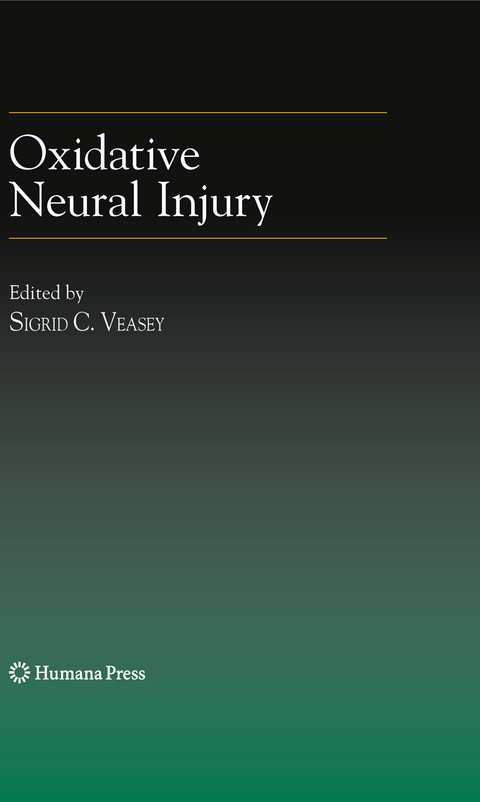
Oxidative Neural Injury (eBook)
218 Seiten
Humana Press (Verlag)
978-1-60327-342-8 (ISBN)
Twenty-five years ago, Earl R. Stadtman, PhD discovered that specific enzymes regulating metabolism can be inactivated by oxidation [1]. He later showed that age-related oxidative modification contributes, at least in part, to age-related loss of function of the enzymes [2, 3]. Dr. Stadtman broke the ground for a new field of study to discover how oxidative stress contributes in significant ways to age-related cellular dysfunction and protein accumulation and that oxidation in the aging brain influences Alzheimer's disease, ischemia-reperfusion injury, amyotrophic lateral sclerosis, and lifespan [4-6]. Today, his research and mentorship have positively influenced the work of hundreds of scientists in this field. We dedicate this book to Dr. Earl R. Stadtman (1912-2008), in celebration of his passion for science and his superior collaborative and mentorship skills. This book is comprised of three sections. The first describes the valuable roles reactive oxygen species (ROS) and reactive nitrogen species (RNS) play in cellular biology. The second section provides an overview of redox imbalance injury with effects on mitochondria, signaling, endoplasmic reticular function, and on aging in general. The third section takes these mechanisms to neurodegenerative disorders and provides a state-of-the-art look at the roles redox imbalances play in age-related susceptibility to disease and in the disease processes. In the first section we attempt to answer a question posed by Dr. Stadtman, ''Why have cells selected reactive oxygen species to regulate cell signaling events'' [7].
Preface 5
References 8
Contents 9
Contributors 11
Part I: Redox Regulation of Cell Signaling 14
Reactive Oxygen Species, Synaptic Plasticity, and Memory 14
1 Introduction 14
2 ROS Are Critical Signaling Molecules in Synaptic Plasticity 17
3 ROS Are Required for Learning and Memory 19
4 ROS Are Critical Signaling Molecules that Modulate Signaling Pathways Involved in LTP and Memory 19
5 Potential Sources of ROS Involved in LTP and Memory 24
5.1 Mitochondria 24
5.2 Monoamine Oxidase and Cyclooxygenase 25
5.3 Nitric Oxide Synthase 25
5.4 NADPH Oxidase 27
6 NADPH Oxidase Expression in the Brain 29
7 NADPH Oxidase-Mediated Signaling in the Brain 30
8 A Role for NADPH Oxidase in Hippocampal Synaptic Plasticity and Memory 30
9 Conclusions and Future Directions 31
10 List of Abbreviations 33
References 34
Nitric Oxide Biochemistry: Pathophysiology of Nitric Oxide-Mediated Protein Modifications 41
1 Introduction 41
2 NOS, NO, and the Brain 42
3 Biological Chemistry of NO 45
3.1 Metals 45
3.2 Oxides 46
3.3 Thiols 47
4 Summary 49
References 50
Part II: Pathophysiology of Redox Imbalance 57
Redox Imbalance in the Endoplasmic Reticulum 57
1 Introduction 58
2 ER Stress and Unfolded Protein Response 58
3 ER Stress and Redox Stress 60
4 Redox Environment in the ER Lumen 61
5 Influence of Cytosolic Redox Changes on the ER and Vice Versa - Transport of Redox-Active Compounds 63
6 BiP-Mediated Redox Sensing 64
7 Direct Redox Sensing 65
8 ER Redox Changes in Neurological Diseases 66
8.1 Trauma 66
8.2 Neurodegenerative Diseases 67
8.2.1 Parkinson’s Disease (PD) 67
8.2.2 Alzheimer’s Disease (AD) 67
8.2.3 Amyotrophic Lateral Sclerosis (ALS) 68
8.3 Hypoxia, Ischemia - Reperfusion 68
9 Concluding Remarks 69
References 70
Exocytosis, Mitochondrial Injury and Oxidative Stress in Neurodegenerative Diseases 77
1 Introduction 77
2 Synaptic Transmission, Oxidative Stress and Mitochondrial Dysfunction 78
2.1 Gene Responses to Normal Ageing in the Brain 78
2.2 Oxidative Injury in Normal Ageing with Impact on Synaptic Transmission 78
2.3 Redox Regulation of Exocytosis 79
2.4 Energy-Dependence of Exocytosis 79
3 Neurodegenerative Disorders 81
3.1 Alzheimer s Disease 82
3.2 Parkinson s Disease 82
3.3 Amyotrophic Lateral Sclerosis 83
3.4 Huntington s Disease 84
4 Methods Used to Study Exocytosis 84
4.1 Carbon Fibre Amperometry and Cyclic Voltammetry 84
4.2 Patch Clamp Capacitance and Postsynaptic Potential Measurement 86
4.3 Fluorescent Dyes and Live Cell Imaging 87
5 Conclusion 88
References 88
Neuronal Vulnerability to Oxidative Damage in Aging 94
1 Introduction 95
2 Aging and Oxidative Stress 95
2.1 Oxidatively Damaged Molecules Accumulate in Neurons During Aging 95
2.2 Reactive Oxygen Species Involved in Brain Aging 96
2.3 Aging Tips the Redox Balance 98
3 Oxidative Stress and Neuronal Cell Death in the Aging Brain 99
3.1 ROS and Neuronal Loss 99
3.2 Oxidative Stress, Neuronal Calcium Dysregulation, and Excitotoxicity 99
4 Mitochondrial Dysfunction 100
5 Oxidative Stress, Misfolded Proteins, and Damaged DNA 101
6 Implications for Promoting Healthy Brain Aging 102
References 103
Part III: Oxidative Injury in Neurodegenerative Processes 107
Ischemia-Reperfusion Induces ROS Production from Three Distinct Sources 107
1 Introduction 108
1.1 The Clinical Significance of Stroke 108
1.2 Stroke Pathophysiology 108
1.3 Reactive Oxygen Species Implicated in Neuronal Injury in Stroke 109
2 Sources of Reactive Oxygen Species in Stroke 110
2.1 Mitochondrial Sources of ROS 110
2.2 Xanthine Oxidase (XO) 111
2.3 NAPDH Oxidase 112
3 A More Complete Picture of ROS Production in Ischemia and Reperfusion 114
3.1 Temporally Distinct Sources of ROS in Ischemia/Reperfusion 114
4 Conclusions and Future Directions 116
References 116
Alzheimer Disease: Oxidative Stress and Compensatory Responses 119
1 Introduction 119
2 Main Sources of Oxidative Stress in Alzheimer Disease 120
2.1 Mitochondria 120
2.2 Redox-Active Metals 122
3 Alzheimer Disease Lesions: Compensatory Responses? 123
3.1 Amyloid-beta peptide 123
3.2 Hyperphosphorylated tau protein 124
4 Conclusions 126
References 126
Oxidative Stress Associated Signal Transduction Cascades in Alzheimer Disease 131
1 Introduction 132
2 Evidence of Oxidative Stress in Alzheimer Disease 133
3 Cellular Responses to Oxidative Stress 135
4 Role of Stress-Activated Protein Kinase in Oxidative Stress Signaling 136
5 Conclusions 138
References 139
Nitrated Proteins in the Progression of Alzheimer’s Disease: A Proteomics Comparison of Mild Cognitive Impairment and Alzheimer’s Disease Brain 147
1 Nitrosative Stress 147
2 Alzheimer’s Disease and Protein Nitration 148
3 Mild Cognitive Impairment and Protein Nitration 149
4 The Proteomics Approach 150
4.1 Redox Proteomics 150
4.2 Identification of Nitrated Proteins in the MCI Brain 152
4.3 Energy Dysfunction 153
4.4 Neuritic Abnormalities and Structural Dysfunction 153
4.5 Antioxidant Defense/Detoxification System Dysfunction 154
4.6 Cell Signaling Dysfunction 155
5 Identification of Nitrated Proteins in the AD Brain 155
5.1 Energy Dysfunction 156
5.2 Mitochondrial Dysfunction 157
5.3 Lipid Abnormalities and Cholinergic Dysfunction 157
5.4 pH Buffering and CO2 Transport 158
5.5 Neuritic Abnormalities and Structural Dysfunction 158
6 Implication of Nitration in the Progression from MCI to AD 159
References 160
Parkinson’s Disease: An Overview of Pathogenesis 168
1 Introduction 169
2 Pathogenesis of Parkinson’s Disease 169
2.1 Epidemiologic, Environmental, and Demographic Issues 169
3 The Role of Genetics 171
4 Neuropathologic Contributions 174
5 The Role of Animal Models 175
6 The Role of Oxidative Stress 177
7 Conclusions 180
References 181
Protein Oxidation Triggers the Unfolded Protein Response and Neuronal Injury in Chemically Induced Parkinson Disease 188
1 Introduction 188
2 ER Stress, UPR, and the Ubiquitin-Proteasome System 189
3 ER Stress, the Unfolded Protein Response, and the Ubiquitin-Proteasome System in PD 190
4 Neurotoxin Models of PD 192
5 Apoptosis in Toxin Models of PD 192
6 ROS in Toxin Models 193
7 ER Stress and UPR in Toxin Models 194
8 Possible Mechanisms of ER Stress-Mediated Activation of Apoptosis 196
9 Conclusions 198
References 198
Treating Oxidative Neural Injury: Methionine Sulfoxide Reductase Therapy for Parkinson’s Disease 202
1 Introduction 202
1.1 Parkinson’s Disease 202
1.2 alpha-Synuclein 203
2 alpha-Synuclein, Methionine Oxidation and Methionine Sulfoxide Reductase 204
3 The Fruit Fly Model of PD 206
3.1 Advantages of the Model 206
3.2 Overexpression of MSRA Alleviates the Parkinson’s Disease Phenotype 207
4 Conclusions 211
References 211
Index 216
| Erscheint lt. Verlag | 28.5.2009 |
|---|---|
| Reihe/Serie | Contemporary Clinical Neuroscience | Contemporary Clinical Neuroscience |
| Zusatzinfo | XIV, 218 p. 16 illus. |
| Verlagsort | Totowa |
| Sprache | englisch |
| Themenwelt | Medizin / Pharmazie ► Medizinische Fachgebiete ► Chirurgie |
| Medizin / Pharmazie ► Medizinische Fachgebiete ► Neurologie | |
| Studium ► 1. Studienabschnitt (Vorklinik) ► Physiologie | |
| Naturwissenschaften ► Biologie ► Biochemie | |
| Naturwissenschaften ► Biologie ► Humanbiologie | |
| Naturwissenschaften ► Biologie ► Zoologie | |
| Technik | |
| Schlagworte | biochemistry • nervous system • Neurology • neurons • Neuroscience • Oxidation • Parkinson • pathophysiology • Physiology • Proteomics • Translation |
| ISBN-10 | 1-60327-342-5 / 1603273425 |
| ISBN-13 | 978-1-60327-342-8 / 9781603273428 |
| Informationen gemäß Produktsicherheitsverordnung (GPSR) | |
| Haben Sie eine Frage zum Produkt? |
 PDF (Wasserzeichen)
Größe: 4,3 MB
DRM: Digitales Wasserzeichen
Dieses eBook enthält ein digitales Wasserzeichen und ist damit für Sie personalisiert. Bei einer missbräuchlichen Weitergabe des eBooks an Dritte ist eine Rückverfolgung an die Quelle möglich.
Dateiformat: PDF (Portable Document Format)
Mit einem festen Seitenlayout eignet sich die PDF besonders für Fachbücher mit Spalten, Tabellen und Abbildungen. Eine PDF kann auf fast allen Geräten angezeigt werden, ist aber für kleine Displays (Smartphone, eReader) nur eingeschränkt geeignet.
Systemvoraussetzungen:
PC/Mac: Mit einem PC oder Mac können Sie dieses eBook lesen. Sie benötigen dafür einen PDF-Viewer - z.B. den Adobe Reader oder Adobe Digital Editions.
eReader: Dieses eBook kann mit (fast) allen eBook-Readern gelesen werden. Mit dem amazon-Kindle ist es aber nicht kompatibel.
Smartphone/Tablet: Egal ob Apple oder Android, dieses eBook können Sie lesen. Sie benötigen dafür einen PDF-Viewer - z.B. die kostenlose Adobe Digital Editions-App.
Zusätzliches Feature: Online Lesen
Dieses eBook können Sie zusätzlich zum Download auch online im Webbrowser lesen.
Buying eBooks from abroad
For tax law reasons we can sell eBooks just within Germany and Switzerland. Regrettably we cannot fulfill eBook-orders from other countries.
aus dem Bereich