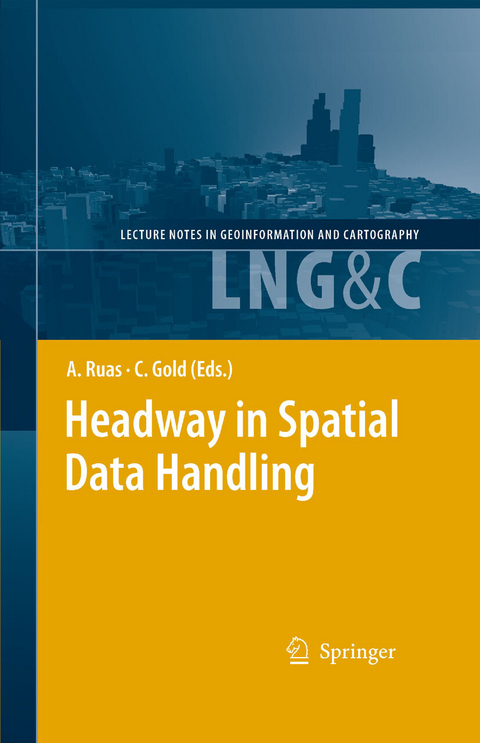
Headway in Spatial Data Handling (eBook)
XV, 650 Seiten
Springer Berlin (Verlag)
978-3-540-68566-1 (ISBN)
Foreword 5
Acknowledgements 7
Table of Contents 8
Programme Committee 13
Local Organizing Committee 13
A Study on how Humans Describe Relative Positions of Image Objects 14
Abstract 14
1 Introduction 15
2 Experiment design 17
3 Collecting descriptions and extracting spatial information 20
4 Data analysis 24
5 Conclusions 29
Acknowledgments 30
References 30
Perceptual Sketch Interpretation 32
Abstract 32
1 Introduction 32
2 Related work 34
3 Underlying principles 35
4 The perceptual sketch interpretation algorithm 38
5 Prototype 43
6. Evaluation 44
7 Conclusions and future work 47
Acknowledgments 49
References 50
The Shape Cognition and Query Supported by Fourier Transform 52
Abstract 52
1 Introduction 52
2 Shape Representation 54
3 Fourier transform and shape measure 57
4 Shape based spatial query 61
5 Conclusion 65
Acknowledgements 66
References 66
Classification of Landslide Susceptibility in the Development of Early Warning Systems 68
Abstract 68
1. Introduction 69
2. Classification 70
3 Related work 71
4 Data 72
5 Classification Methods 75
6 Results 79
7 Conclusions/ Outlook 85
Acknowledgements 86
References 86
Clusters in Aggregated Health Data 89
1 Introduction 89
2 Model 91
3 Algorithms 95
3.1 Arrangement of placements 96
3.2 Computing the optimal placement 97
3.3 Extensions 98
4 Discussion 100
References 101
Spatial Simulation of Agricultural Practices using a Robust Extension of Randomized Classification Tree Algorithms 103
1. Introduction 104
2. Methods 105
3. CASE STUDY 109
4. Results 113
5. Conclusion 118
References 118
Impact of a Change of Support on the Assessment of Biodiversity with Shannon Entropy 121
Abstract 121
1 Introduction 122
2. The Modifiable Unit Problem 123
3. Data and biodiversity indexes applied on the Ventoux Mount, Vaucluse, Southern France 125
4. A way to evaluate and to ‘prevent’ the MAUP from biodiversity assessments 130
5. Results 133
6. Conclusion 141
References 142
Implicit Spatial Information Extraction from Remote Sensing Images 144
Abstract 144
1 Introduction 145
2 Spatial Information Processing 146
3 Generating Descriptors 148
4 Spatial Information Retrieval 150
5 Non explicit information 153
6 Conclusion 154
References 155
The Application of the Concept of Indicative Neighbourhood on Landsat ETM+ Images and Orthophotos Using Circular and Annulus Kernels 158
Abstract 158
1 Introduction 159
2 Materials 162
3 Methods 165
4 Results and discussion 168
5 Conclusions 171
References 172
Sensitivity of the C-band SRTM DEM Vertical Accuracy to Terrain Characteristics and Spatial Resolution 174
1 Introduction 174
2 Site and data sets 175
3 Methods 177
4 Results 179
5 Conclusion 186
References 186
Improving the Reusability of Spatiotemporal Simulation Models: Using MDE to Implement Cellular Automata 188
Abstract 188
1 Introduction 189
2 Implementation Technologies and Approaches to Spatiotemporal Modeling 190
3 A Three-level Model Driven Engineering Approach to Spatiotemporal Modeling 192
4 A Three-level MDE Approach to Model Cellular Automata 195
5 Concluding Remarks and Outlook 204
Acknowledgements 205
References 205
Support Vector Machines for Spatiotemporal Analysis in Geosensor Networks 207
1 Introduction 208
2 Geosensor Data and Existing Event Extraction Methods 209
3 Support Vector Machines 211
3.1 Margins and the Maximum Separating Hyperplane 212
3.2 Non-Linearity and Kernel Substitution 215
3.3 Mapping the Hyperplane Solution to Input Space 216
4. The Spatiotemporal Helix 217
5. Simulation 219
6. Conclusions and Future Work 223
Acknowledgements 224
Toward a Method to Generally Describe Physical Spatial Processes 227
Abstract: 227
1 Introduction 228
2 Spatial processes and geographic information systems 229
3. What are physical spatial processes 230
4. Two models of spatial physical processes 231
5. Example: diffusion of a contaminant in water 235
6 Qualitative insights about the example process 238
7 Conclusions and future work 239
Acknowledgements 240
References 240
A Data Model for Multi-scale Topographical Data 243
Abstract 243
1. Introduction 244
2. Previous approaches for multi-scale and single data models 245
3. Scope of IMTOP 246
4. A data model for multi-scale topographical data 249
5. Results of IMTOP with respect to the requirements 259
6. Conclusions 262
References 263
An Interoperable Web Service Architecture to Provide Base Maps Empowered by Automated Generalisation 265
Abstract 265
Introduction 265
Physical Planning Maps on the Web 267
Related Literature 270
Design of the Architecture 273
Implementation of the Architecture 278
Outlook & Conclusion
Acknowledgements 283
References 283
Combining Three Multi-agent Based Generalisation Models: AGENT, CARTACOM and GAEL 286
Abstract 286
1. Introduction 287
2. Comparative presentation of AGENT, CARTACOM and GAEL 288
3 Proposed scenarios to combine AGENT, CARTACOM and GAEL 293
3.1. Scenario 1: separate use of AGENT, GAEL and CARTACOM on a spatially and/ or thematically partitioned dataset 294
3.2. Scenario 2: “interlaced” sequential use of AGENT, CARTACOM and GAEL on a set of objects 295
3.3. Scenario 3: simultaneous use of AGENT and CARTACOM data on one object 296
4. How to put the proposed scenarios into practice 298
4.1. Technical requirements underlying scenarios 1, 2 and3: summary 298
4.2. Status of the technical issues underlying scenarios 1 and 2 298
4.3. Re-engineering of constraint modelling in AGENT and CARTACOM to support scenario 3 299
5. Discussion 302
6. Conclusion and perspectives 303
Acknowledgement 304
References 304
Implementation of Building Reconstruction Algorithm Using Real World LIDAR Data 306
Abstract 306
1 Introduction 306
2 Airborne Laser Scanning (ALS) 307
3 Building Blocks Identification 308
4 Roof Planes Recognition 314
5 Building Extrusion 317
6 Implementation of Real-world Lidar Data 317
7 Conclusion 319
Acknowledgment 321
References 321
A New Approach for Mountain Areas Cartography 323
Abstract 323
Keywords: 323
1. Context 324
2. Information extraction 326
3. Cartographic representation 333
4. Conclusion 338
References 341
Processing 3D Geo-Information for Augmenting Georeferenced and Oriented Photographs with Text Labels 357
Abstract 357
1 Introduction 358
2 Related Research 359
3 Data collection and preparation 361
4 Object identification 363
5 Label Placement 365
6. Results and conclusions 369
Acknowledgements 370
References 370
Interactive Geovisualization and Geometric Modelling of 3D Data - A Case Study from the Åknes Rockslide Site, Norway 372
Abstract 372
1 Introduction 373
2 OpenSceneGraph 375
3 Design and implementation of the 3D Åknes model. 377
4 Methods used in the preparation and visualization of the 3D model 380
5 Interactive modelling of the sliding surfaces 384
6 Discussion and summary 386
Acknowledgements 388
References 388
Marine GIS: Progress in 3D Visualization for Dynamic GIS 406
Abstract. 406
1 Introduction 406
2 System requirements 408
3 System design 412
3.1 GIS 3D Graphical Engine 412
3.2 ENC Reader 413
3.3 Geo converter 413
3.4 AIS module 414
3.5 Display of 3D models 414
3.6 Display of terrain 414
3.7 Data structures 415
3.8 External data sources 416
4 Other applications 417
5 Future work and possibilities 418
6 Conclusions 419
7 References 420
The IGN-E Case: Integrating Through a Hidden Ontology 422
Abstract 422
1. Introduction 423
2. Existing catalogues 424
3. Problems and the proposed approach 428
4. Heterogeneity 430
5. From proposal to reality 432
6. Automatic ontology creation 433
6.1 Scales and coverage 433
6.2 Criteria for taxonomy creation 433
6.3 Attributes by values 435
6.4 PhenomenOntology 435
7. Automatic mapping discovery 436
7.1 Knowledge discovery 438
8. Conclusion and future work 438
Acknowledgements 439
References 439
All Roads Lead to Rome – Geospatial Modeling of Hungarian Street Names with Destination Reference 441
Abstract 441
1. Introduction 441
2. First case study: Street names of town Kaposvár ( Hungary) 444
3. Extension to whole Hungary 447
4. Conclusions 451
References 452
Where is the Terraced House? On the Use of Ontologies for Recognition of Urban Concepts in Cartographic Databases 453
Abstract 453
1 Introduction 454
2 Ontology-driven Cartographic Pattern Recognition 455
3 An ontology of terraced houses 459
4 Experiment 461
5 Discussion 465
6 Conclusions 466
Acknowledgements 467
References 468
Information Processes Produce Imperfections in Data— The Information Infrastructure Compensates for Them 471
Abstract 471
1 Introduction 471
2 Ontology 473
3 Information Processes Transform between Tiers 475
4 Compensation Improves Decisions with Imperfect GIS Data 483
5 Conclusion 486
Moving from Pixels to Parcels: the Use of Possibility Theory to Explore the Uncertainty Associated object Oriented Remote Sensing 490
Abstract 490
1. Introduction 491
2. Background 492
3. Problem 494
4. Method 496
5. Results 497
6. Discussion 500
Acknowledgements 502
References 502
Data Matching – a Matter of Belief 504
Abstract 504
1. Introduction 504
2. Geographic data matching 505
3. Matching Approach based on the Belief Theory 507
4. Experimentation 515
5. DISCUSSION AND COMPARISON 518
6. Conclusion 520
Acknowledgements 520
References 520
Deriving Topological Relationships Between Simple Regions with Holes 523
Abstract 523
1 Introduction 523
2 Related Work 525
3 Constructing topological relationships between simple regions with holes 527
4 Conclusions 533
References 533
Spatial Rules Generate Urban Patterns: Emergence of the Small- World Network 534
Abstract 534
1 Introduction 535
2 The Small-World Network 537
3 Simulation Model 540
4 Rules Validation 540
5 Determinacy of the Simulation Model 547
6 Numerical Evaluation of the Small-World Network Pattern Emergence in the Model 551
7 Conclusions 554
Acknowledgments 555
References 555
Conceptual Neighborhoods of Topological Relations Between Lines 557
Abstract 557
1. Introduction 557
2. Conceptual Neighborhood Graphs 559
3. Conceptual Neighborhood Graph For Topological Relations Between Two Undirected Lines 560
4. Conceptual Neighborhood Graph For Topological Relations Between Two Broad- Boundary Lines 566
5. Comparisons of Conceptual Neighborhood Graphs 570
7. Conclusions and Future Work 572
8. Acknowledgments 573
References 573
Spatial Support and Spatial Confidence for Spatial Association Rules 575
Abstract 575
1 Introduction 575
2 Background 577
3 Quality measures for spatial association rules 580
4 Proximity measures 583
5 Spatio-temporal support and confidence 589
6 Discussion 590
7 Conclusions 591
Acknowledgments 591
References 591
A Primer of Picture-Aided Navigation in Mobile Systems 594
Abstract 594
1. Introduction 595
2. Different modes for describing itineraries 596
3. Basic considerations for picture-based itinerary description 600
4. Main characteristics of a picture-aided navigational system 608
5. Conclusions 610
References 610
Road Network Model for Vehicle Navigation using Traffic Direction Approach 611
Abstract 611
1. Introduction 612
2 Existing modeling schemas 613
3. Traffic direction based modeling schema 619
4. Model comparison 624
5. Conclusions 625
Acknowledgement 626
References 627
Clustering Algorithm for Network Constraint Trajectories 628
Abstract. 628
1. Introduction 628
2. Related work 630
3. The Clustering Procedure 632
4. Two-stepClustering Algorithme NETSCAN 634
5. Experimental Evaluation 637
6. Conclusion 642
Acknowledgements 643
References 643
Author Index 645
| Erscheint lt. Verlag | 9.8.2008 |
|---|---|
| Reihe/Serie | Lecture Notes in Geoinformation and Cartography | Lecture Notes in Geoinformation and Cartography |
| Zusatzinfo | XV, 650 p. |
| Verlagsort | Berlin |
| Sprache | englisch |
| Themenwelt | Naturwissenschaften ► Geowissenschaften ► Geografie / Kartografie |
| Technik ► Nachrichtentechnik | |
| Schlagworte | Cartography • data integration • geographic data • Geoinformation • Geoinformationssysteme • Geospatial • Geovisualisation • GIS • Landsat • map • Remote Sensing • spatial modelling |
| ISBN-10 | 3-540-68566-9 / 3540685669 |
| ISBN-13 | 978-3-540-68566-1 / 9783540685661 |
| Informationen gemäß Produktsicherheitsverordnung (GPSR) | |
| Haben Sie eine Frage zum Produkt? |
 PDF (Wasserzeichen)
DRM: Digitales Wasserzeichen
Dieses eBook enthält ein digitales Wasserzeichen und ist damit für Sie personalisiert. Bei einer missbräuchlichen Weitergabe des eBooks an Dritte ist eine Rückverfolgung an die Quelle möglich.
Dateiformat: PDF (Portable Document Format)
Mit einem festen Seitenlayout eignet sich die PDF besonders für Fachbücher mit Spalten, Tabellen und Abbildungen. Eine PDF kann auf fast allen Geräten angezeigt werden, ist aber für kleine Displays (Smartphone, eReader) nur eingeschränkt geeignet.
Systemvoraussetzungen:
PC/Mac: Mit einem PC oder Mac können Sie dieses eBook lesen. Sie benötigen dafür einen PDF-Viewer - z.B. den Adobe Reader oder Adobe Digital Editions.
eReader: Dieses eBook kann mit (fast) allen eBook-Readern gelesen werden. Mit dem amazon-Kindle ist es aber nicht kompatibel.
Smartphone/Tablet: Egal ob Apple oder Android, dieses eBook können Sie lesen. Sie benötigen dafür einen PDF-Viewer - z.B. die kostenlose Adobe Digital Editions-App.
Buying eBooks from abroad
For tax law reasons we can sell eBooks just within Germany and Switzerland. Regrettably we cannot fulfill eBook-orders from other countries.
aus dem Bereich