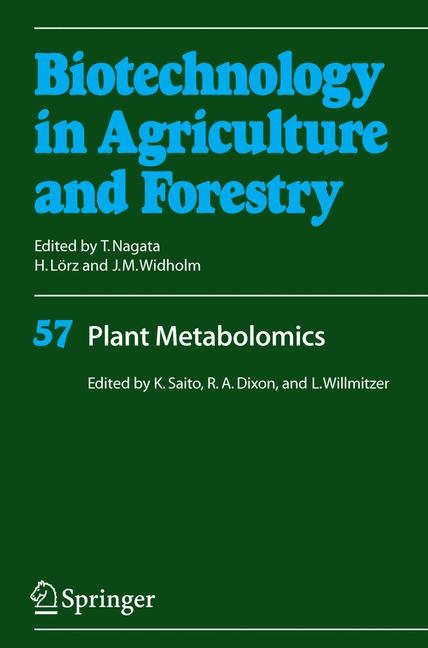
Plant Metabolomics (eBook)
XX, 350 Seiten
Springer Berlin (Verlag)
978-3-540-29782-6 (ISBN)
Metabolomics - which deals with all metabolites of an organism - is a rapidly-emerging sector of post-genome research fields. It plays significant roles in a variety of fields from medicine to agriculture and holds a fundamental position in functional genomics studies and their application in plant biotechnology.
This volume comprehensively covers plant metabolomics for the first time. The chapters offer cutting-edge information on analytical technology, bioinformatics and applications. They were all written by leading researchers who have been directly involved in plant metabolomics research throughout the world. Up-to-date information and future developments are described, thereby producing a volume which is a landmark of plant metabolomics research and a beneficial guideline to graduate students and researchers in academia, industry, and technology transfer organizations in all plant science fields.
Preface 6
Contents 7
List of Contributors 13
Section I Analytical Technology 20
I.1 Gas ChromatographyMass Spectrometry 21
1 Introduction 21
2 GC-MS Pro.ling Technology in a Nutshell 23
3 Short Excursion into Nomenclature and De.nitions 28
4 Present Challenges of GC-MS Pro.ling 31
References 35
I.2 Current Status and Forward Looking Thoughts on LC/ MSMetabolomics 39
1 Introduction 39
2 Chromatography Theory 42
3 Limitations of CurrentMetabolic Pro.ling Approaches and Proposed Solutions to AdvanceMetabolomics 43
4 Future Directions and Forward-Looking Thoughts 46
References 48
I.3 PlantMetabolomics Strategies Based upon Quadrupole Time of FlightMass Spectrometry ( QTOF- MS) 51
1 Introduction 51
2 TheTechnology 52
3 Data Analysis 55
4 Application of QTOF MS-based PlantMetabolomics Analyses 56
5 Conclusions and Future Prospects 64
References 64
I.4 Capillary HPLC 67
1 Introduction 67
2 Monolithic Silica Columns for Micro HPLC 67
3 Applications ofMonolithic Silica Columns toMetabolomics 72
4 Two-Dimensional HPLC 73
5 Combination of Reversed-Phase HPLC and Other SeparationModes 77
6 Outlook 79
References 79
I.5 Capillary HPLC Coupled to Electrospray Ionization Quadrupole Time- of- . ightMass Spectrometry 82
1 Introduction 82
2 Extraction, Chromatography andMass Spectrometry 84
3 Potential and Limitations 89
4 Conclusions and Outlook 94
References 95
I.6 NMR Spectroscopy in PlantMetabolomics 97
1 Introduction 97
2 High-throughput Screening by 1D H-NMR 98
3 Data Analysis 100
4 Two-dimensional NMR 101
5 Stable Isotope Labelling 102
6 HyphenatedNMR 103
7 Discussion: Applying NMR to PlantMetabolomics 104
References 105
I.7 Hetero-nuclear NMR-basedMetabolomics 108
1 Introduction 108
2 Historical Aspects of NMR Studies of PlantMetabolism 108
3 H-NMR-basedMetabolomics 109
4 Use of Stable Isotope Labeling Technique to Enable Monitoring of the DynamicMovement ofMetabolites 109
5 Approach for Hetero-nuclear NMR-basedMetabolomics 110
6 Prospects for the Future 113
References 114
Section II Bioinformatics 117
II.1 Bioinformatics Approaches to Integrate Metabolomics and Other Systems Biology Data 118
1 Introduction 118
2 Databases 120
3 Data Visualization 123
4 Data Analysis 124
5 Conclusion 125
References 126
II.2 Chemometrics inMetabolomics – An Introduction 129
1 Introduction 129
2 Theory andMethods 130
3 Example: Metabolomics Study on ArabidopsisMutants 137
4 Summary and Future Prospectives 138
References 139
II.3 Map Editor for the Atomic Reconstruction ofMetabolism ( ARM) 141
1 Introduction 141
2 Definition ofMetabolic Information 143
3 MetabolicMap Editor 145
4 Applications 149
5 Conclusions 151
References 151
II.4 AraCyc: Overview of an ArabidopsisMetabolism Database and its Applications for Plant Research 152
1 Introduction 152
2 DatabaseContent 153
3 Search, Browse, and Analyze Functionalities 156
4 Applications of AraCyc 160
5 Current Issues and Future Directions 163
6 Conclusions 163
References 164
II.5 KaPPA-View: A Tool for Integrating Transcriptomic andMetabolomic Data on PlantMetabolic PathwayMaps 166
1 Introduction 166
2 General Features of the KaPPA-View Tool 166
3 PlantMetabolic PathwayMaps 169
4 Integration of Transcriptomic andMetabolomic Data on PathwayMaps 170
5 Comparison with Other Databases and Tools 170
6 Limitations and Future Improvements 171
7 Conclusions 173
References 174
II.6 KNApSAcK: A Comprehensive Species-Metabolite Relationship Database 175
1 Introduction 175
2 Search Options of the KNApSAcK Database 176
3 Statistics of the Database 182
4 Classi.cation Based on CommonMetabolites 187
5 Conclusion and Remarks 189
6 Access to KNApSAcK 189
References 190
Section III Applications 192
III.1 Systems Biology: A Renaissance of the Top-down Approach for Plant Analysis 193
1 Introduction 193
2 Re-emergence of Top-down Thinking 194
3 Systems Biology in Non-plant Systems 194
4 Systems Biology in Plant Systems 196
5 Dynamic Pro.ling in Plant Cells 200
6 Conclusions and Future Perspectives 203
References 203
III.2 Systems-based Analysis of PlantMetabolism by Integration ofMetabolomics with Transcriptomics 207
1 Introduction 207
2 UnderstandingWhole PlantMetabolism – Our Aims and Strategy 207
3 Metabolome and Transcriptome Analyses 208
4 Studies on SulfurMetabolism 209
5 Studies on AnthocyaninMetabolism 214
6 Conclusions 216
References 217
III.3 Targeted Pro.ling of Fatty Acids and RelatedMetabolites 218
1 Introduction 218
2 Metabolite Pro.ling Techniques Used to Study Plant LipidMetabolism 220
3 Future Developments 230
References 231
III.4 Metabolic Pro.ling and Quanti.cation of Carotenoids and Related Isoprenoids in Crop Plants 236
1 Introduction 236
2 AnalyticalMethodologies Employed in the Analysis of Carotenoids 240
3 Examples of Carotenoid/isoprenoid Pro.ling 244
4 Conclusions 247
References 247
III.5 Metabolomics and Gene Identi.cation in Plant Natural Product Pathways 250
1 Introduction 250
2 Gene Discovery – Past and Present Strategies 250
3 Enzyme Promiscuity in Natural Product Pathways 253
4 Examples of the Use ofMetabolomics in the Elucidation of Gene Function 254
5 Single Cell or Isolated TissueMetabolomics 260
6 Concluding Remarks 263
References 263
III.6 Metabolomic Analysis of Using NMR and Principal Component Analysis 267
1 Introduction 267
2 Experimental Consideration forMetabolomics Using NMR 268
3 Application of NMR for PlantMetabolome 272
4 Principal Component Analysis 279
5 Concluding Remarks 281
References 281
III.7 Metabolomics of Plant Secondary Compounds: Pro.ling of Catharanthus Cell Cultures 283
1 Introduction 283
2 Metabolomics as a Platform to Study Plant SecondaryMetabolites 284
3 Case Study:Metabolic Profiling of Catharanthus roseus Cells 286
4 Protocol 291
5 Perspectives 292
References 293
III.8 The TaxusMetabolome and the Elucidation of the Taxol®* Biosynthetic Pathway in Cell Suspension Cultures 296
1 Introduction 296
2 Results and Discussion 299
3 Protocol 311
4 Conclusion 312
References 313
III.9 The Use of Non-targetedMetabolomics in Plant Science 315
1 Introduction 315
2 Fundamental Investigations into PlantMetabolomics 317
3 Conclusion 328
References 328
III.10 PlantMetabolite Pro.ling for Industrial Applications 330
1 Introduction 330
2 TheMetabolome 330
3 Pro.ling Technologies 331
4 High ThroughputMetabolite Pro.ling 335
5 Industrial Applications 338
6 Outlook 341
References 341
Subject Index 343
| Erscheint lt. Verlag | 29.6.2006 |
|---|---|
| Reihe/Serie | Biotechnology in Agriculture and Forestry | Biotechnology in Agriculture and Forestry |
| Zusatzinfo | XX, 350 p. |
| Verlagsort | Berlin |
| Sprache | englisch |
| Themenwelt | Naturwissenschaften ► Biologie ► Botanik |
| Technik | |
| Schlagworte | Bioinformatics • Biotechnologie • Biotechnology • Chromatography • Databases • genes • genomics • Genomik • metabolic profiling • Metabolism • Metabolit • metabolite • metabolome, plants • Metabolom, Pflanzen • Mutant • natural product |
| ISBN-10 | 3-540-29782-0 / 3540297820 |
| ISBN-13 | 978-3-540-29782-6 / 9783540297826 |
| Informationen gemäß Produktsicherheitsverordnung (GPSR) | |
| Haben Sie eine Frage zum Produkt? |
 PDF (Wasserzeichen)
DRM: Digitales Wasserzeichen
Dieses eBook enthält ein digitales Wasserzeichen und ist damit für Sie personalisiert. Bei einer missbräuchlichen Weitergabe des eBooks an Dritte ist eine Rückverfolgung an die Quelle möglich.
Dateiformat: PDF (Portable Document Format)
Mit einem festen Seitenlayout eignet sich die PDF besonders für Fachbücher mit Spalten, Tabellen und Abbildungen. Eine PDF kann auf fast allen Geräten angezeigt werden, ist aber für kleine Displays (Smartphone, eReader) nur eingeschränkt geeignet.
Systemvoraussetzungen:
PC/Mac: Mit einem PC oder Mac können Sie dieses eBook lesen. Sie benötigen dafür einen PDF-Viewer - z.B. den Adobe Reader oder Adobe Digital Editions.
eReader: Dieses eBook kann mit (fast) allen eBook-Readern gelesen werden. Mit dem amazon-Kindle ist es aber nicht kompatibel.
Smartphone/Tablet: Egal ob Apple oder Android, dieses eBook können Sie lesen. Sie benötigen dafür einen PDF-Viewer - z.B. die kostenlose Adobe Digital Editions-App.
Buying eBooks from abroad
For tax law reasons we can sell eBooks just within Germany and Switzerland. Regrettably we cannot fulfill eBook-orders from other countries.
aus dem Bereich