



Astrobiology
A Brief Introduction
Seiten
2011
|
second edition
Johns Hopkins University Press (Verlag)
978-1-4214-0095-2 (ISBN)
Johns Hopkins University Press (Verlag)
978-1-4214-0095-2 (ISBN)
- Titel erscheint in neuer Auflage
- Artikel merken
Zu diesem Artikel existiert eine Nachauflage
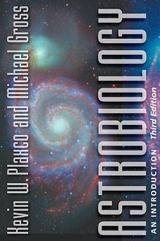
New to this edition is a glossary of terms and an epilogue recapping the key unanswered questions, making Astrobiology an ideal primer for students and, indeed, for anyone curious about life and the Universe.
Informed by new planetary discoveries and the findings from recent robotic missions to Mars, Jupiter, and Saturn, scientists are rapidly replacing centuries of speculation about potential extraterrestrial habitats with real knowledge about the possibility of life outside our own biosphere-if it exists, and where. This second edition of Kevin W. Plaxco and Michael Gross's widely acclaimed text incorporates the latest research in astrobiology to bring readers the most comprehensive, up-to-date, and engaging introduction to the field available. Plaxco and Gross expand their examination of the origin of chemical elements, the developments that made the Universe habitable, and how life continues to be sustained. They discuss in great detail the formation of the first galaxies and stars, the diverse chemistry of the primordial planet, the origins of metabolism, the evolution of complex organisms, and the feedback regulation of Earth's climate. They also explore life in extreme habitats, potential extraterrestrial habitats, and the current status of the search for extraterrestrial life.
Weaving together the relevant threads of astronomy, geology, chemistry, biophysics, and microbiology, this broadly accessible introductory text captures the excitement, controversy, and progress of the dynamic young field of astrobiology. New to this edition is a glossary of terms and an epilogue recapping the key unanswered questions, making Astrobiology an ideal primer for students and, indeed, for anyone curious about life and the Universe.
Informed by new planetary discoveries and the findings from recent robotic missions to Mars, Jupiter, and Saturn, scientists are rapidly replacing centuries of speculation about potential extraterrestrial habitats with real knowledge about the possibility of life outside our own biosphere-if it exists, and where. This second edition of Kevin W. Plaxco and Michael Gross's widely acclaimed text incorporates the latest research in astrobiology to bring readers the most comprehensive, up-to-date, and engaging introduction to the field available. Plaxco and Gross expand their examination of the origin of chemical elements, the developments that made the Universe habitable, and how life continues to be sustained. They discuss in great detail the formation of the first galaxies and stars, the diverse chemistry of the primordial planet, the origins of metabolism, the evolution of complex organisms, and the feedback regulation of Earth's climate. They also explore life in extreme habitats, potential extraterrestrial habitats, and the current status of the search for extraterrestrial life.
Weaving together the relevant threads of astronomy, geology, chemistry, biophysics, and microbiology, this broadly accessible introductory text captures the excitement, controversy, and progress of the dynamic young field of astrobiology. New to this edition is a glossary of terms and an epilogue recapping the key unanswered questions, making Astrobiology an ideal primer for students and, indeed, for anyone curious about life and the Universe.
Kevin W. Plaxco is a professor of chemistry at the University of California, Santa Barbara. Michael Gross is a science writer based in Oxford.
Preface
Acknowledgments
1. What Is Life?
2. Origins of a Habitable Universe
3. Origins of a Habitable Planet
4. Primordial Soup
5. The Spark of Life
6. From Molecules to Cells
7. A Concise History of Life on Earth
8. Life on the Edge
9. Habitable Worlds in the Solar System and Beyond
10. The Search for ET
Epilogue
Glossary
Index
| Erscheint lt. Verlag | 27.10.2011 |
|---|---|
| Zusatzinfo | 29 Halftones, black and white; 52 Line drawings, black and white |
| Verlagsort | Baltimore, MD |
| Sprache | englisch |
| Maße | 152 x 229 mm |
| Gewicht | 658 g |
| Themenwelt | Naturwissenschaften ► Biologie |
| Naturwissenschaften ► Physik / Astronomie ► Astronomie / Astrophysik | |
| ISBN-10 | 1-4214-0095-2 / 1421400952 |
| ISBN-13 | 978-1-4214-0095-2 / 9781421400952 |
| Zustand | Neuware |
| Informationen gemäß Produktsicherheitsverordnung (GPSR) | |
| Haben Sie eine Frage zum Produkt? |
Mehr entdecken
aus dem Bereich


aus dem Bereich
Kompendium & Nachschlagewerk in 3 Bänden
Buch | Hardcover (2025)
Eigenverlag Dr. Erik Wischnewski
CHF 179,95


