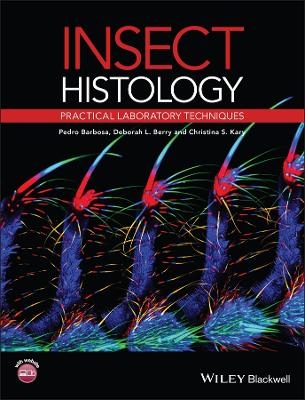
Insect Histology
Wiley-Blackwell (Verlag)
978-1-4443-3696-2 (ISBN)
This helpful guide is self-contained, holding all of the information you will need for the preparation of histological slides of all types of insect tissues. It explains the essential procedures for their preparation, providing step-by-step information on each phase, for example, on fixation, dehydrating, clearing, embedding, and staining.
The laboratory manual explains the cutting-edge methodology carried out today, and provides a thorough collection of both historically established and modern insect histology techniques side-by-side. It is the first book to present these various techniques appropriate to insects.
Key issues covered include:
the use of genetic markers in insect histology;
important approaches for the preparation of tissues and organs for SEM and TEM Fluorescence;
new immunohistochemical techniques;
histological problems encountered in insect tissues such as sclerotized chitin, yolk-laden eggs, chromosomes, genitalia, etc., and how to deal with them.
Photographs show the likely results of procedures, components of the process, and advantages of the use of particular approaches or compounds. As a comprehensive resource, this book is for students and researchers in entomology, systematics, developmental biology, insect cell biology, and morphology, wanting a clear introduction to the procedures for the histological display of insect tissues.
Dr. Pedro Barbosa is a Professor Emeritus at the Department of Entomology of the University of Maryland, College Park. He has been a professor at Rutgers University, the University of Massachusetts at Amherst and at the University of Maryland. Although his research focused on the ecology of insects and insect-plant interactions, he also has an interest in insect histology. Since his retirement in 2010 he has written several books on insects. Dr. Deborah L. Berry is Co-Director for the Histopathology and Tissue Shared Resource at the Lombardi Comprehensive Cancer Center, Georgetown University, which provides research pathology support for translational cancer research. She has over 20 years’ experience in histology with a specialty in the histology of the fruit fly Drosophila melanogaster. Dr. Christina S. Kary is a scientific editor with the journal Genes & Development at Cold Spring Harbor Laboratory Press, New York. Before becoming an editor, she earned a PhD with Dr. Eric Baehrecke at the University of Maryland and was a Jane Coffin Childs post-doctoral fellow with Dr. Susan Mango at Harvard University.
Preface ix Acknowledgements xi
Introduction xiii
About the companion website xiv
1 Problems of sclerotized chitin: Softening insect cuticle 1
1.1 Introduction 1
1.2 General Methods 3
1.3 Preparations of insect eggs 14
1.4 Double Embedding Techniques 16
References 19
2 Fixation 21
2.1 Introduction 21
2.2 Aldehyde based fixatives 21
2.3 Protein denaturing 30
2.4 Picric acid based 33
2.5 Mercuric chloride based 37
2.6 SEM/TEM 40
2.7 Other 46
References 51
3 Dehydrating, clearing, and embedding 54
3.1 Dehydration 54
3.2 Clearing 60
3.3 Embedding General 65
3.4 Embedding – Ester Wax 73
3.5 Embedding – Methacrylate 74
References 77
4 Staining 79
4.1 Single-contrast staining – Carmines 81
4.2 Single contrast staining – Nuclear Stains 83
4.3 Single contrast staining – General Stains 86
4.4 Single contrast staining – Golgi 89
4.5 Single contrast staining – Eggs 89
4.6 Single contrast staining – Silver Stains 90
4.7 Polychrome staining techniques – General 92
4.8 Polychrome staining – Brain/Nerve 102
4.9 Polychrome staining – blood 103
4.10 Single contrast procedures for chitinous material 105
4.11 Polychrome staining procedures for chitinous material 106
4.12 Polychrome staining for chitinous material – KOH 110
4.13 Polychrome staining for chitinous material – Differential staining of Individual Organs 111
4.14 Staining of specific tissues 113
4.15 Two dye combinations 114
References 117
5 Immunohistochemical techniques 119
5.1 Introduction 119
5.2 General immunostaining techniques 127
5.3 Immunolabeling of samples for Transmission Electron Microscopy (TEM) 135
5.4 Proliferation assays 140
5.5 Methods to detect specific proteins 142
References 144
6 Use of genetic markers in insect histology 146
6.1 Introduction 146
6.2 Inducible genetic markers 149
6.3 Mosaic gene expression 156
6.4 Fluorescent markers for live imaging and kinetic microscopy 165
References 169
7 Fluorescence 171
7.1 Introduction 171
References 192
8 Mounting 194
8.1 Introduction 194
References 206
9 Preparation of whole mounts 208
9.1 Introduction 208
References 229
10 Preparation of whole mounts for staining 231
10.1 Introduction 231
10.2 Detection of NAPDHd 237
10.3 SEM 238
10.4 In situ hybridization 240
References 244
11 Preparation of genitalia, mouthparts and other body parts 246
References 256
12 Preparation of chromosomes 258
References 288
13 Preparation of other specific insect organs and tissues 290
13.1 Introduction 290
References 323
Appendix Dissecting fluids and saline solutions 325
Index 333
| Erscheint lt. Verlag | 21.11.2014 |
|---|---|
| Verlagsort | Hoboken |
| Sprache | englisch |
| Maße | 185 x 244 mm |
| Gewicht | 862 g |
| Themenwelt | Naturwissenschaften ► Biologie ► Zoologie |
| ISBN-10 | 1-4443-3696-7 / 1444336967 |
| ISBN-13 | 978-1-4443-3696-2 / 9781444336962 |
| Zustand | Neuware |
| Informationen gemäß Produktsicherheitsverordnung (GPSR) | |
| Haben Sie eine Frage zum Produkt? |
aus dem Bereich