


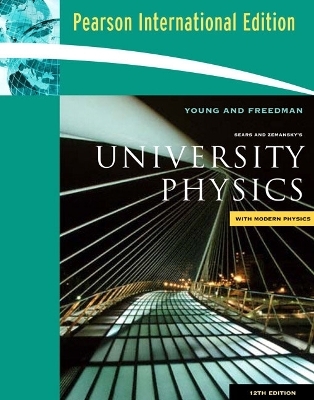
University Physics with Modern Physics with Mastering Physics
Pearson
978-0-321-50131-8 (ISBN)
- Titel erscheint in neuer Auflage
- Artikel merken
Using Young & Freedman's research-based ISEE (Identify, Set Up, Execute, Evaluate) problem-solving strategy, students develop the physical intuition and problem-solving skills required to tackle the text's extensive high-quality problem sets, which have been developed and refined over the past five decades. Incorporating proven techniques from educational research that have been shown to improve student learning, the figures have been streamlined in color and detail to focus on the key physics and integrate 'chalkboard-style' guiding commentary. Critically acclaimed `visual’ chapter summaries help students to consolidate their understanding by presenting each concept in words, math, and figures.
Renowned for its superior problems, the Twelfth Edition goes further. Unprecedented analysis of national student metadata has allowed every problem to be systematically enhanced for educational effectiveness, and to ensure problem sets of ideal topic coverage, balance of qualitative and quantitative problems, and range of difficulty and duration.
If a professor adopts MasteringPhysicsTM, every new copy of the text includes access to it — the most widely used, educationally proven, and technically advanced tutorial and homework system in the world. Uniquely able to tutor each student individually with feedback specific to their errors and simpler subproblems upon demand, MasteringPhysics™ now incorporates free-hand graphs, free-body diagrams, ray-tracing diagrams, even ranking-task activities. MasteringPhysics™ provides all the problems from the text as well as tutorials specific to the Problem-Solving Strategies and Test Your Understanding questions in each chapter.
Hugh D. Young is Emeritus Professor of Physics at Carnegie Mellon University in Pittsburgh, PA. He attended Carnegie Mellon for both undergraduate and graduate study and earned his Ph.D. in fundamental particle theory under the direction of the late Richard Cutkosky. He joined the faculty of Carnegie Mellon in 1956 and has also spent two years as a Visiting Professor at the University of California at Berkeley. Prof. Young’s career has centered entirely around undergraduate education. He has written several undergraduate-level textbooks, and in 1973 he became a co-author with Francis Sears and Mark Zemansky for their well-known introductory texts. With their deaths, he assumed full responsibility for new editions of these books until joined by Prof. Freedman for University Physics. Prof. Young is an enthusiastic skier, climber, and hiker. He also served for several years as Associate Organist at St. Paul’s Cathedral in Pittsburgh, and has played numerous organ recitals in the Pittsburgh area. Prof. Young and his wife Alice usually travel extensively in the summer, especially in Europe and in the desert canyon country of southern Utah. Roger A. Freedman is a Lecturer in Physics at the University of California, Santa Barbara. Dr. Freedman was an undergraduate at the University of California campuses in San Diego and Los Angeles, and did his doctoral research in nuclear theory at Stanford University under the direction of Professor J. Dirk Walecka. He came to UCSB in 1981 after three years teaching and doing research at the University of Washington. At UCSB, Dr. Freedman has taught in both the Department of Physics and the College of Creative Studies, a branch of the university intended for highly gifted and motivated undergraduates. He has published research in nuclear physics, elementary particle physics, and laser physics. In recent years, he has helped to develop computer-based tools for learning introductory physics and astronomy. When not in the classroom or slaving over a computer, Dr. Freedman can be found either flying (he holds a commercial pilot’s license) or driving with his wife, Caroline, in their 1960 Nash Metropolitan convertible. A. Lewis Ford is Professor of Physics at Texas A&M University. He received a B.A. from Rice University in 1968 and a Ph.D. in chemical physics from the University of Texas at Austin in 1972. After a one-year postdoc at Harvard University, he joined the Texas A&M physics faculty in 1973 and has been there ever since. Professor Ford’s research area is theoretical atomic physics, with a specialization in atomic collisions. At Texas A&M he has taught a variety of undergraduate and graduate courses, but primarily introductory physics.
Mechanics
Units, Physical Quantities, and Vectors
Motion Along a Straight Line
Motion in Two or Three Dimensions
Newton's Laws of Motion
Applying Newton's Laws
Work and Kinetic Energy
Potential Energy and Energy Conservation
Momentum, Impulse, and Collisions
Rotation of Rigid Bodies
Dynamics of Rotational Motion
Equilibrium and Elasticity
Gravitation
Periodic Motion
Fluid Mechanics
Waves/Acoustics
Mechanical Waves
Sound and Hearing
Thermodynamics
Temperature and Heat
Thermal Properties of Matter
The First Law of Thermodynamics
The Second Law of Thermodynamics
Electromagnetism
Electric Charge and Electric Field
Gauss's Law
Electric Potential
Capacitance and Dielectrics
Current, Resistance, and Electromotive Force
Direct-Current Circuits
Magnetic Field and Magnetic Forces
Sources of Magnetic Field
Electromagnetic Induction
Inductance
Alternating Current
Electromagnetic Waves
Optics
The Nature and Propagation of Light
Geometric Optics and Optical Instruments
Interference
Diffraction
Modern Physics
Relativity
Photons, Electrons, and Atoms
The Wave Nature of Particles
Quantum Mechanics
Atomic Structure
Molecules and Condensed Matter
Nuclear Physics
Particle Physics and Cosmology
| Sprache | englisch |
|---|---|
| Maße | 278 x 215 mm |
| Gewicht | 3222 g |
| Themenwelt | Naturwissenschaften ► Physik / Astronomie ► Allgemeines / Lexika |
| Schlagworte | Physik; Handbuch/Lehrbuch |
| ISBN-10 | 0-321-50131-4 / 0321501314 |
| ISBN-13 | 978-0-321-50131-8 / 9780321501318 |
| Zustand | Neuware |
| Informationen gemäß Produktsicherheitsverordnung (GPSR) | |
| Haben Sie eine Frage zum Produkt? |


