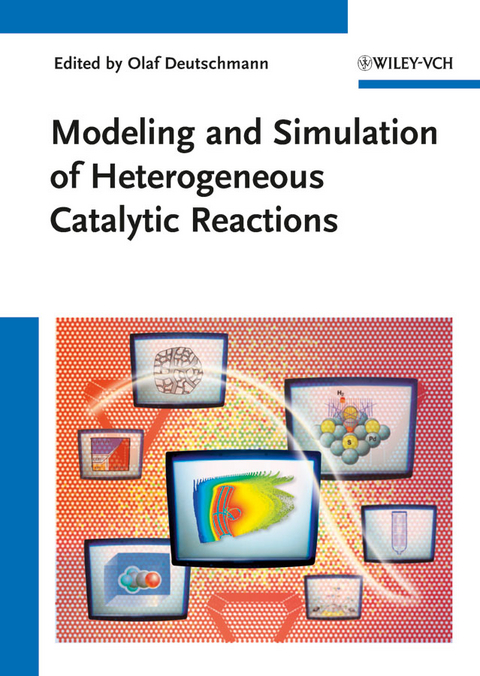
Modeling and Simulation of Heterogeneous Catalytic Reactions
Wiley-VCH (Verlag)
9783527321209 (ISBN)
The Nobel Prize in Chemistry 2007 awarded to Gerhard Ertl for his groundbreaking studies in surface chemistry highlighted the importanceof heterogeneous catalysis not only for modern chemical industry but also for environmental protection. Heterogeneous catalysis is seen asone of the key technologies which could solve the challenges associated with the increasing diversification of raw materials and energy sources. It is the decisive step in most chemical industry processes, a major method of reducing pollutant emissions from mobile sources and is present in fuel cells to produce electricity. The increasing power of computers over the last decades has led to modeling and numericalsimulation becoming valuable tools in heterogeneous catalysis.This book covers many aspects, from the state-of-the-art in modeling and simulations of heterogeneous catalytic reactions on a molecular level to heterogeneous catalytic reactions from an engineering perspective. This first book on the topic conveys expert knowledge from surfacescience to both chemists and engineers interested in heterogeneous catalysis. The well-known and international authors comprehensivelypresent many aspects of the wide bridge between surface science and catalytic technologies, including DFT calculations, reaction dynamicson surfaces, Monte Carlo simulations, heterogeneous reaction rates, reactions in porous media, electro-catalytic reactions, technical reactors,and perspectives of chemical and automobile industry on modeling heterogeneous catalysis. The result is a one-stop reference for theoreticaland physical chemists, catalysis researchers, materials scientists, chemical engineers, and chemists in industry who would like to broadentheir horizon and get a substantial overview on the different aspects of modeling and simulation of heterogeneous catalytic reactions.
Olaf Deutschmann studied physics in Magdeburg and Berlin. In 1996, he obtained his doctoral degree (chemistry) from Heidelberg University supervised by Jürgen Warnatz. He then worked on high-temperature catalysis at the University of Minnesota with Lanny D. Schmidt and at the Los Alamos National Laboratory. After receiving the venia legendi in Physical Chemistry at Heidelberg University he joined the University of Karlsruhe in 2003. Today, he holds the Chair in Chemical Technology at the Karlsruhe Institute of Technology (KIT), Germany, and is speaker of the Helmholtz Research School Energy-Related Catalysis. His group works on heterogeneous reactions for the synthesis of chemicals and materials, reduction of pollutant emissions, and energy conversion. He is recipient of the DECHEMA Award of the Max Buchner Research Foundation and of the Hermann-Oberth-Medal in Silver.
Preface
MODELING CATALYTIC REACTIONS ON SURFACES WITH DENSITY FUNCTIONAL THEORY
Introduction
Theoretical Background
The Electrocatalytic Oxygen Reduction Reaction on Pt(111)
Conclusions
DYNAMICS OF REACTIONS AT SURFACES
Introduction
Theoretical and Computational Foundations of Dynamical Simulations
Interpolation of Potential Energy Surfaces
Quantum Dynamics of Reactions at Surfaces
Nondissociative Molecular Adsorption Dynamics
Adsorption Dynamics on Precovered Surfaces
Relaxation Dynamics of Dissociated H2 Molecules
Electronically Nonadiabatic Reaction Dynamics
Conclusions
FIRST-PRINCIPLES KINETIC MONTE CARLO SIMULATIONS FOR HETEROGENEOUS CATALYSIS: CONCEPTS, STATUS, AND FRONTIERS
Introduction
Concepts and Methodology
A Showcase
Frontiers
Conclusions
MODELING THE RATE OF HETEROGENEOUS REACTIONS
Introduction
Modeling the Rates of Chemical Reactions in the Gas Phase
Computation of Surface Reaction Rates on a Molecular Basis
Models Applicable for Numerical Simulation of Technical Catalytic Reactors
Simplifying Complex Kinetic Schemes
Summary and Outlook
MODELING REACTIONS IN POROUS MEDIA
Introduction
Modeling Porous Structures and Surface Roughness
Diffusion
Diffusion and Reaction
Pore Structure Optimization: Synthesis
Conclusion
MODELING POROUS MEDIA TRANSPORT, HETEROGENEOUS THERMAL CHEMISTRY, AND ELECTROCHEMICAL CHARGE TRANSFER
Introduction
Qualitative Illustration
Gas-Phase Conservation Equations
Ion and Electron Transport
Charge Conservation
Thermal Energy
Chemical Kinetics
Computational Algorithm
Button Cell Example
Summary and Conclusions
EVALUATION OF MODELS FOR HETEROGENEOUS CATALYSIS
Introduction
Surface and Gas-Phase Diagnostic Methods
Evaluation of Hetero/Homogeneous Chemical Reaction Schemes
Evaluation of Transport
Conclusions
COMPUTATIONAL FLUID DYNAMICS OF CATALYTIC REACTORS
Introduction
Modeling of Reactive Flows
Coupling of the Flow Field with Heterogeneous Chemical Reactions
Numerical Methods and Computational Tools
Reactor Simulations
Summary and Outlook
PERSPECTIVE OF INDUSTRY ON MODELING CATALYSIS
The Industrial Challenge
The Dual Approach
The Role of Modeling
Examples of Modeling and Scale-Up of Industrial Processes
Conclusions
PERSPECTIVES OF THE AUTOMOTIVE INDUSTRY ON THE MODELING OF EXHAUST GAS AFTERTREATMENT CATALYSTS
Introduction
Emission Legislation
Exhaust Gas Aftertreatment Technologies
Modeling of Catalytic Monoliths
Modeling of Diesel Particulate Filters
Selective Catalytic Reduction by NH3 (Urea-SCR) Modeling
Diesel Oxidation Catalyst, Three-Way Catalyst, and NOx Storage and Reduction Catalyst Modeling
Modeling Catalytic Effects in Diesel Particulate Filters
Determination of Global Kinetic Parameters
Challenges for Global Kinetic Models
System Modeling of Combined Exhaust Aftertreatment Systems
Conclusion
"Overall the book is a good attempt to tackle a research topic that is very current. Indeed the book is up-to-date and there are very recent citations, many of which concern pgm applications in catalysis. In summary the book is a good introduction to the rapidly changing and wide reaching field of multiscale computational research." ( Platinum Metals Review , 2012)
| Erscheint lt. Verlag | 23.11.2011 |
|---|---|
| Verlagsort | Weinheim |
| Sprache | englisch |
| Maße | 170 x 240 mm |
| Gewicht | 850 g |
| Themenwelt | Naturwissenschaften ► Chemie ► Physikalische Chemie |
| Schlagworte | catalysis • Chemie • Chemistry • Computational Chemistry & Molecular Modeling • Computational Chemistry & Molecular Modeling • Computational Chemistry u. Molecular Modeling • Festkörperchemie • Heterogene Katalyse • Industrial Chemistry • Katalyse • Physical Chemistry • Physikalische Chemie • solid state chemistry • Technische u. Industrielle Chemie |
| ISBN-13 | 9783527321209 / 9783527321209 |
| Zustand | Neuware |
| Informationen gemäß Produktsicherheitsverordnung (GPSR) | |
| Haben Sie eine Frage zum Produkt? |
aus dem Bereich