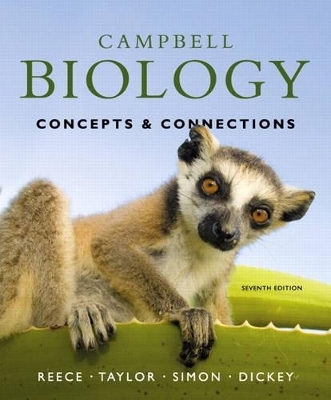
Campbell Biology
Benjamin-Cummings Publishing Company, Subs of Addison Wesley Longman, Inc
978-0-321-69648-9 (ISBN)
- Titel erscheint in neuer Auflage
- Artikel merken
0321696816 / 9780321696816 Campbell Biology: Concepts &
0321709187 / 9780321709189 MasteringBiology with Pearson eText -- Valuepack Access Card -- for Campbell Biology: Concepts & Connections
Jane B. Reece has worked in biology publishing since 1978, when she joined the editorial staff of Benjamin Cummings. Her education includes an A.B. in biology from Harvard University (where she was initially a philosophy major), an M.S. in microbiology from Rutgers University, and a Ph.D. in bacteriology from the University of California, Berkeley. At UC Berkeley and later as a postdoctoral fellow in genetics at Stanford University, her research focused on genetic recombination in bacteria. Dr. Reece taught biology at Middlesex County College (New Jersey) and Queensborough Community College (New York). During her 12 years as an editor at Benjamin Cummings, she played a major role in a number of successful textbooks. She is lead author of Campbell Biology and co-author of Campbell Essential Biology and Campbell Essential Biology with Physiology. Martha R. Taylor has been teaching biology for over 35 years. She earned her B.A. in biology from Gettysburg College and her M.S. and Ph.D. in science education from Cornell University. She was assistant director of the Office of Instructional Support at Cornell for seven years. She has taught introductory biology for both majors and non-majors at Cornell University and is currently a lecturer in the Learning Strategies Center teaching supplemental biology courses. Based on her experiences working with students in classrooms, laboratories, and tutorials, Dr. Taylor is committed to helping students create their own knowledge of and appreciation for biology. She has been the author of the Student Study Guide for all nine editions of Campbell Biology. Eric J. Simon is an associate professor in the Department of Biology and Health Science at New England College in Henniker, New Hampshire. He teaches introductory biology to science majors and non-science majors, as well as upper-level courses in genetics, microbiology, tropical marine biology, and molecular biology. Dr. Simon received a B.A. in biology and computer science and an M.A. in biology from Wesleyan University and a Ph.D. in biochemistry from Harvard University. His research focuses on innovative ways to use technology to improve teaching and learning in the science classroom, particularly for non-science majors. Dr. Simon is the lead author of Campbell Essential Biology and Campbell Essential Biology with Physiology. Jean L. Dickey is a professor of biology at Clemson University. She had no idea that science was interesting until her senior year in high school, when a scheduling problem landed her in an advanced biology course. Abandoning plans to study English or foreign languages, she enrolled in Kent State University as a biology major. After receiving her B.S. in biology, she went on to earn a Ph.D. in ecology and evolution from Purdue University. Since joining the faculty at Clemson in 1984, Dr. Dickey has specialized in teaching non-science majors, including a course designed for pre-service elementary teachers and workshops for in-service teachers. She also developed an investigative laboratory curriculum for general biology. Dr. Dickey is author of Laboratory Investigations for Biology and co-author of Campbell Essential Biology and Campbell Essential Biology with Physiology.
1. Biology: Exploring Life
I. THE LIFE OF THE CELL
2. The Chemical Basis of Life
3. The Molecules of Cells
4. A Tour of the Cell
5. The Working Cell
6. How Cells Harvest Chemical Energy
7. Photosynthesis: Using Light to Make Food
II. CELLULAR REPRODUCTION AND GENETICS
8. The Cellular Basis of Reproduction and Inheritance
9. Patterns of Inheritance
10. Molecular Biology of the Gene
11. How Genes Are Controlled
12. DNA Technology and Genomics
III. CONCEPTS OF EVOLUTION
13. How Populations Evolve
14. The Origin of Species
15. Tracing Evolutionary History
IV. THE EVOLUTION OF BIOLOGICAL DIVERSITY
16. Microbial Life: Prokaryotes and Protists
17. The Evolution of Plant and Fungal Diversity
18. The Evolution of Invertebrate Diversity
19. The Evolution of Vertebrate Diversity
V. ANIMALS: FORM AND FUNCTION
20. Unifying Concepts of Animal Structure and Function
21. Nutrition and Digestion
22. Gas Exchange
23. Circulation
24. The Immune System
25. Control of Body Temperature and Water Balance
26. Hormones and the Endocrine System
27. Reproduction and Embryonic Development
28. Nervous Systems
29. The Senses
30. How Animals Move
VI. PLANTS: FORM AND FUNCTION
31. Plant Structure, Growth, and Reproduction
32. Plant Nutrition and Transport
33. Control Systems in Plants
VII. ECOLOGY
34. The Biosphere: An Introduction to Earth's Diverse Environments
35. Behavioral Adaptations to the Environment
36. Population Ecology
37. Communities and Ecosystems
38. Conservation Biology
| Erscheint lt. Verlag | 7.4.2011 |
|---|---|
| Verlagsort | San Francisco |
| Sprache | englisch |
| Maße | 10 x 10 mm |
| Gewicht | 2030 g |
| Themenwelt | Naturwissenschaften ► Biologie |
| ISBN-10 | 0-321-69648-4 / 0321696484 |
| ISBN-13 | 978-0-321-69648-9 / 9780321696489 |
| Zustand | Neuware |
| Informationen gemäß Produktsicherheitsverordnung (GPSR) | |
| Haben Sie eine Frage zum Produkt? |
aus dem Bereich