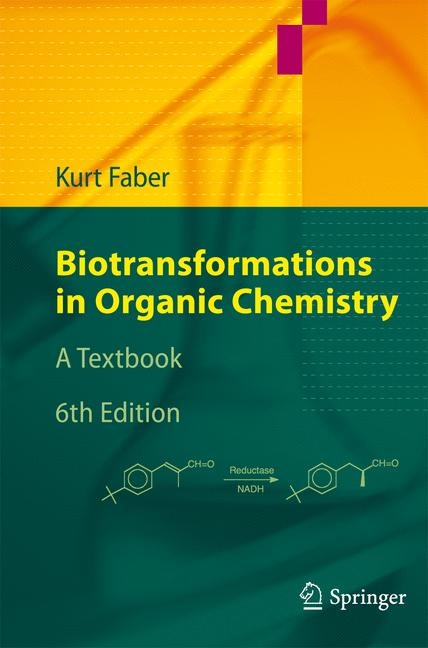
Biotransformations in Organic Chemistry
Springer Berlin (Verlag)
978-3-642-17392-9 (ISBN)
- Titel erscheint in neuer Auflage
- Artikel merken
This well-established textbook on biocatalysis provides a basis for undergraduate and graduate courses in modern organic chemistry, as well as a condensed introduction into this field. After a basic introduction into the use of biocatalysts-principles of stereoselective transformations, enzyme properties and kinetics-the different types of reactions are explained according to the 'reaction principle', such as hydrolysis, reduction, oxidation, C-C bond formation, etc. Special techniques, such as the use of enzymes in organic solvents, immobilization techniques and modified or artificial enzymes, are treated in a separate section. A final chapter deals with thebasic rules for the safe and practical handling of biocatalysts.
In this completely revised 6th edition, emphasis has been given to an improved didactic style including colored graphics in order to facilitate a deeper understanding of the underlying principles. New developments, such as transamination, enzyme promiscuity and applications on industrial scale within the field of 'white biotechnology' are included.
1 Introduction and Background Information
1.1 Introduction..........................................................................................
1.2 Common Prejudices Against Enzymes...............................................
1.3 Advantages and Disadvantages of Biocatalysts..................................
1.3.1 Advantages of Biocatalysts........................................................
1.3.2 Disadvantages of Biocatalysts...................................................
1.3.3 Isolated Enzymes Versus Whole Cell Systems.........................
1.4 Enzyme Properties and Nomenclature...............................................
1.4.1 Structural Biology in a Nutshell..............................
1.4.2 Mechanistic Aspects of Enzyme Catalysis...........................
1.4.3 Classification and Nomenclature............................................
1.4.4 Coenzymes.......................................................................
1.4.5 Enzyme Sources..............................................................
References..... ...................................................................................
2 Biocatalytic Applications
2.1 Hydrolytic Reactions..........................................................................
2.1.1 Mechanistic and Kinetic Aspects.............................................
2.1.2 Hydrolysis of the Amide Bond................................................
2.1.3 Ester Hydrolysis.......................................................................
2.1.3.1 Esterases and Proteases.............................................
2.1.3.2 Lipases.......................................................................
2.1.4 Hydrolysis and Formation of Phosphate Esters......................
2.1.5 Hydrolysis of Epoxides...........................................................
2.1.6 Hydrolysis of Nitriles..............................................................
References........................................................................................
2.2 Reduction Reactions..........................................................................
2.2.1 Recycling of Cofactors............................................................
2.2.2 Reduction of Aldehydes and Ketones Using Isolated Enzymes...................................................................
2.2.3 Reduction of Aldehydes and Ketones Using Whole Cells....
2.2.4 Reduction of C=C-Bonds .......................
References........................................................................................
2.3 Oxidation Reactions..........................................................................
2.3.1 Oxidation of Alcohols and Aldehydes...................................
2.3.2 Oxygenation Reactions...........................................................
2.3.2.1 Hydroxylation of Alkanes........................................
2.3.2.2 Hydroxylation of Aromatic Compounds.................
2.3.2.3 Epoxidation of Alkenes............................................
2.3.2.4 Sulfoxidation Reactions............................................
2.3.2.5 Baeyer-Villiger Reactions.........................................
2.3.2.6 Formation of Peroxides.............................................
2.3.2.7 Dihydroxylation of Aromatic Compounds...............
2.3.3 Peroxidation Reactions............................................................
References.... ...................................................................................
2.4 Formation of Carbon-Carbon Bonds.................................................
2.4.1 Aldol Reactions.......................................................................
2.4.2 Thiamine-Dependent Acyloin- and Benzoin Reactions.........
2.4.3 Michael-Type Additions.........................................................
R
| Zusatzinfo | XI, 423 p. 347 illus., 335 illus. in color. |
|---|---|
| Verlagsort | Berlin |
| Sprache | englisch |
| Maße | 155 x 235 mm |
| Gewicht | 760 g |
| Themenwelt | Naturwissenschaften ► Chemie ► Organische Chemie |
| Schlagworte | Biocatalysis • Biotechnology • Biotransformation • enzymes • Organic Chemistry • Organische Chemie • Organische Synthese • Whole Cells |
| ISBN-10 | 3-642-17392-6 / 3642173926 |
| ISBN-13 | 978-3-642-17392-9 / 9783642173929 |
| Zustand | Neuware |
| Informationen gemäß Produktsicherheitsverordnung (GPSR) | |
| Haben Sie eine Frage zum Produkt? |
aus dem Bereich