


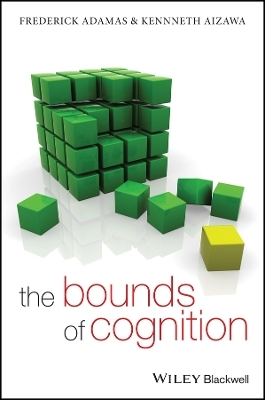
Bounds of Cognition
Wiley-Blackwell (an imprint of John Wiley & Sons Ltd) (Hersteller)
978-1-4443-9171-8 (ISBN)
- Keine Verlagsinformationen verfügbar
- Artikel merken
An alarming number of philosophers and cognitive scientists have argued that mind extends beyond the brain and body. This book evaluates these arguments and suggests that, typically, it does not. A timely and relevant study that exposes the need to develop a more sophisticated theory of cognition, while pointing to a bold new direction in exploring the nature of cognition Articulates and defends the "mark of the cognitive", a common sense theory used to distinguish between cognitive and non-cognitive processes Challenges the current popularity of extended cognition theory through critical analysis and by pointing out fallacies and shortcoming in the literature Stimulates discussions that will advance debate about the nature of cognition in the cognitive sciences
Frederick Adams is Professor of Cognitive Science & Philosophy and Chair of Linguistics and Cognitive Science at the University of Delaware. He is also director of the Delaware Program in Cognitive Science. He publishes in epistemology, philosophy of language, philosophy of mind, and philosophy of science. Kenneth Aizawa is Charles T. Beaird Professor of Philosophy in the Department of Philosophy at Centenary College of Louisiana and is the author of The Systematicity Arguments (2003).
Preface. Acknowledgments. 1 Introduction. 2 Refining the Issues. 2.1 What are the Boundaries? 2.2 What is Cognition? 2.3 The Possibility of Extended Cognition. 2.4 Conclusion. 3 Original Content. 3.1 Part of the Mark of the Cognitive: Non-Derived Content. 3.2 The Basics on Derived and Underived Content. 3.3 Dennett's Critique of Original Content. 3.4 Clark's Critique of Original Content. 3.5 Anti-Representationalism in Dynamical Systems and Mobile Robotics. 3.6 Conclusion. 4 Cognitive Processes. 4.1 Individuating Process Types in Science. 4.2 Individuating Processes in Cognitive Psychology. 4.3 A Broader Category of Cognition. 4.4 Conclusion. 5 The Mark of the Cognitive, Extended Cognition Style. 5.1 Cognition as Information Processing, as Computation, and as Abiding in the Meaningful. 5.2 Operationalism. 5.3 Is This Merely a Terminological Issue? 5.4 Conclusion. 6 The Coupling-Constitution Fallacy. 6.1 Some Examples of the Coupling-Constitution Fallacy. 6.2 Replies to the Coupling-Constitution Fallacy. 6.3 Conclusion. 7 Extended Cognitive Systems and Extended Cognitive Processes. 7.1 Dynamical Systems Theory and Coupling. 7.2 Haugeland's Theory of Systems and the Coupling of Components. 7.3 Clark's Theories of Systems and Coupling. 7.4 Conclusion. 8 Cognitive Equivalence, Complementarity, and Evolution. 8.1 Cognitive Equivalence. 8.2 The Complementarity Argument. 8.3 Evolutionary Arguments. 8.4 Conclusion: The Importance of the Mark of the Cognitive. 9 Inference to the Best Explanation and Extended Cognition. 9.1 What is the Theory of Enactive Perception? 9.2 Noe's Evidence for Enactive Perception. 9.3 The Case against Enactive Perception: Paralysis. 9.4 Conclusion. 10 Future Directions. Bibliography. Index.
| Erscheint lt. Verlag | 13.8.2010 |
|---|---|
| Verlagsort | Chicester |
| Sprache | englisch |
| Maße | 155 x 228 mm |
| Gewicht | 326 g |
| Themenwelt | Geisteswissenschaften ► Philosophie |
| Geisteswissenschaften ► Psychologie ► Allgemeine Psychologie | |
| Geisteswissenschaften ► Psychologie ► Verhaltenstherapie | |
| Naturwissenschaften | |
| ISBN-10 | 1-4443-9171-2 / 1444391712 |
| ISBN-13 | 978-1-4443-9171-8 / 9781444391718 |
| Zustand | Neuware |
| Informationen gemäß Produktsicherheitsverordnung (GPSR) | |
| Haben Sie eine Frage zum Produkt? |


