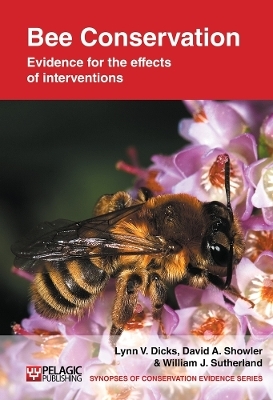
Bee Conservation
Pelagic Publishing (Verlag)
978-1-907807-00-8 (ISBN)
This book brings together scientific evidence and experience relevant to the practical conservation of wild bees. The authors worked with an international group of bee experts and conservationists to develop a global list of interventions that could benefit wild bees. They range from protecting natural habitat to controlling disease in commercial bumblebee colonies.
For each intervention, the book summarises studies captured by the Conservation Evidence project, where that intervention has been tested and its effects on bees quantified. The result is a thorough guide to what is known, or not known, about the effectiveness of bee conservation actions throughout the world. Bee Conservation is the first in a series of synopses that will cover different species groups and habitats, gradually building into a comprehensive summary of evidence on the effects of conservation interventions for all biodiversity throughout the world.
By making evidence accessible in this way, we hope to enable a change in the practice of conservation, so it can become more evidence-based. We also aim to highlight where there are gaps in knowledge.
Evidence from all around the world is included. If there appears to be a bias towards evidence from northern European or North American temperate environments, this reflects a current bias in the published research that is available to us. Conservation interventions are grouped primarily according to the relevant direct threats, as defined in the International Union for the Conservation of Nature (IUCN)’s Unified Classification of Direct Threats.
Lynn Dicks is a Research Fellow at the Department of Zoology, University of Cambridge. She has been a NERC Knowledge Exchange Fellow, linked to the Insect Pollinators Initiative(2011-2014) and a Co-ordinating Lead Author of the IPBES Thematic assessment of pollinators, pollination and food production. She has a degree from Oxford University in Biological Sciences (1995) and a PhD from Cambridge University (2002) on the ecology of flower-visiting insects. Bill Sutherland is Miriam Rothschild Professor of Conservation Biology at the University of Cambridge and President of the British Ecological Society. He is known for his research on integrating science and policy particularly in the field of evidence-based conservation. Two of his key contributions have been the horizon-scanning exercises to identify future priority issues and the 100 important questions in various disciplines (ecology, poverty prevention, global agriculture and food amongst others). He has also worked extensively on bird population ecology and the biodiversity impacts of agriculture.
Introduction
Threat: residential and commercial development
Threat: land use change due to agriculture
Threat: pollution - agricultural and forestry effluents
Threat: transportation and service corridors
Threat: biological resource use
Threat: natural system modification
Threat: invasive non-native species
Threat: problematic native species
Providing artificial nest sites for bees
Education and awareness-raising
Index
| Reihe/Serie | Synopses of Conservation Evidence |
|---|---|
| Verlagsort | Exeter |
| Sprache | englisch |
| Maße | 156 x 234 mm |
| Gewicht | 235 g |
| Themenwelt | Naturwissenschaften ► Biologie ► Ökologie / Naturschutz |
| Naturwissenschaften ► Biologie ► Zoologie | |
| ISBN-10 | 1-907807-00-4 / 1907807004 |
| ISBN-13 | 978-1-907807-00-8 / 9781907807008 |
| Zustand | Neuware |
| Informationen gemäß Produktsicherheitsverordnung (GPSR) | |
| Haben Sie eine Frage zum Produkt? |
aus dem Bereich