


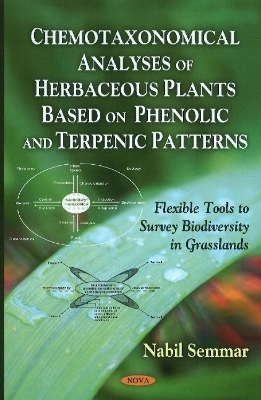
Chemotaxonomical Analyses of Herbacaceous Plants Based on Phenolic & Terpenic Patterns
Flexible Tools to Survey Biodiversity in Grasslands
Seiten
2011
Nova Science Publishers Inc (Verlag)
9781616687892 (ISBN)
Nova Science Publishers Inc (Verlag)
9781616687892 (ISBN)
- Titel ist leider vergriffen;
keine Neuauflage - Artikel merken
Analysis of plant diversity aims to understand the organisation and the variability of biological populations within ecosystems. This book provides illustrations on different chemotaxonomical criteria helping to understand complex structures of plant diversity.
Analysis of plant diversity aims to understand the organisation and the variability of biological populations within ecosystems. In classical analysis, individual plants are firstly identified on the basis of morphological/cytological parameters, then biodiversity is evaluated tacking into account presences/absences, abundances and densities of plants. Although morphological parameters are easily accessible, they provide limited precision on the differentiation between individuals that share a high similarity. This book provides illustrations on different chemotaxonomical criteria helping to understand complex structures of plant diversity. It focuses particularly on the chemotaxonomic usefulness of phenolic compounds (phenylpropanoids, flavonoids, etc.) and sesquiterpenes in analysis of plant chemical polymorphisms at different systematic levels (from family to variety and chemotype via genus and species).
Analysis of plant diversity aims to understand the organisation and the variability of biological populations within ecosystems. In classical analysis, individual plants are firstly identified on the basis of morphological/cytological parameters, then biodiversity is evaluated tacking into account presences/absences, abundances and densities of plants. Although morphological parameters are easily accessible, they provide limited precision on the differentiation between individuals that share a high similarity. This book provides illustrations on different chemotaxonomical criteria helping to understand complex structures of plant diversity. It focuses particularly on the chemotaxonomic usefulness of phenolic compounds (phenylpropanoids, flavonoids, etc.) and sesquiterpenes in analysis of plant chemical polymorphisms at different systematic levels (from family to variety and chemotype via genus and species).
Introduction; Chemical diversity of plants: concepts, parameters & interests; Chemical diversity, biosynthesis & diversification processes of phenolic derivatives; Chemical diversity, biosynthesis & diversification processes of terpenoids; General chemotaxonomical lines on presented herbaceous plant families; Chemotaxonomical analyses based on phenolic derivatives: the monocotyledons; Chemotaxonomical analyses based on phenolic derivatives: the dicotyledons; Chemotaxonomical analyses based on sesquiterpenes: the asteraceae family; Index.
| Erscheint lt. Verlag | 8.2.2011 |
|---|---|
| Zusatzinfo | Illustrations |
| Verlagsort | New York |
| Sprache | englisch |
| Maße | 260 x 180 mm |
| Gewicht | 642 g |
| Themenwelt | Naturwissenschaften ► Biologie ► Botanik |
| ISBN-13 | 9781616687892 / 9781616687892 |
| Zustand | Neuware |
| Informationen gemäß Produktsicherheitsverordnung (GPSR) | |
| Haben Sie eine Frage zum Produkt? |
Mehr entdecken
aus dem Bereich

aus dem Bereich
Gefäßpflanzen: Grundband
Buch | Hardcover (2021)
Springer Spektrum (Verlag)
CHF 62,95


