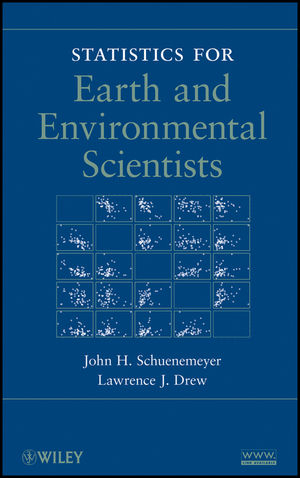
Statistics for Earth and Environmental Scientists
John Wiley & Sons Inc (Verlag)
978-0-470-58469-9 (ISBN)
- Titel z.Zt. nicht lieferbar
- Versandkostenfrei
- Auch auf Rechnung
- Artikel merken
A comprehensive treatment of statistical applications for solving real-world environmental problems
A host of complex problems face today's earth science community, such as evaluating the supply of remaining non-renewable energy resources, assessing the impact of people on the environment, understanding climate change, and managing the use of water. Proper collection and analysis of data using statistical techniques contributes significantly toward the solution of these problems. Statistics for Earth and Environmental Scientists presents important statistical concepts through data analytic tools and shows readers how to apply them to real-world problems.
The authors present several different statistical approaches to the environmental sciences, including Bayesian and nonparametric methodologies. The book begins with an introduction to types of data, evaluation of data, modeling and estimation, random variation, and sampling—all of which are explored through case studies that use real data from earth science applications. Subsequent chapters focus on principles of modeling and the key methods and techniques for analyzing scientific data, including:
Interval estimation and Methods for analyzinghypothesis testing of means time series data
Spatial statistics
Multivariate analysis
Discrete distributions
Experimental design
Most statistical models are introduced by concept and application, given as equations, and then accompanied by heuristic justification rather than a formal proof. Data analysis, model building, and statistical inference are stressed throughout, and readers are encouraged to collect their own data to incorporate into the exercises at the end of each chapter. Most data sets, graphs, and analyses are computed using R, but can be worked with using any statistical computing software. A related website features additional data sets, answers to selected exercises, and R code for the book's examples.
Statistics for Earth and Environmental Scientists is an excellent book for courses on quantitative methods in geology, geography, natural resources, and environmental sciences at the upper-undergraduate and graduate levels. It is also a valuable reference for earth scientists, geologists, hydrologists, and environmental statisticians who collect and analyze data in their everyday work.
John H. Schuenemeyer, PhD, is President of Southwest Statistical Consulting, LLC and Professor Emeritus of Statistics, Geography, and Geology at the University of Delaware. A Fellow of the American Statistical Association, Dr. Schuenemeyer has more than thirty years of academic and consulting experience and was the recipient of the 2004 John Cedric Griffiths Teaching Award, awarded by the International Association for Mathematical Geosciences. Lawrence J. Drew, PhD, is Research Scientist at the U.S. Geological Survey. Dr. Drew has published more than 200 scientific papers on the role of quantitative methods in petroleum and mineral resource assessment, and he is currently is working on an analysis of environmental data. Dr. Drew is the winner of the 2005 Krumbein Medal, awarded by the International Association for Mathematical Geosciences.
Preface ix
1 Role of Statistics and Data Analysis 1
1.1 Introduction 1
1.2 Case Studies 1
1.3 Data 2
1.4 Samples Versus the Population: Some Notation 3
1.5 Vector and Matrix Notation 4
1.6 Frequency Distributions and Histograms 5
1.7 Distribution as a Model 6
1.8 Sample Moments 9
1.9 Normal (Gaussian) Distribution 12
1.10 Exploratory Data Analysis 13
1.11 Estimation 17
1.12 Bias 18
1.13 Causes of Variance 21
1.14 About Data 21
1.15 Reasons to Conduct Statistically Based Studies 24
1.16 Data Mining 25
1.17 Modeling 25
1.18 Transformations 27
1.19 Statistical Concepts 28
1.20 Statistics Paradigms 30
1.21 Summary 33
Exercises 34
2 Modeling Concepts 37
2.1 Introduction 37
2.2 Why Construct a Model? 37
2.3 What Does a Statistical Model Do? 38
2.4 Steps in Modeling 39
2.5 Is a Model a Unique Solution to a Problem? 44
2.6 Model Assumptions 45
2.7 Designed Experiments 47
2.8 Replication 49
2.9 Summary 49
Exercises 49
3 Estimation and Hypothesis Testing on Means and Other Statistics 51
3.1 Introduction 51
3.2 Independence of Observations 51
3.3 Central Limit Theorem 52
3.4 Sampling Distributions 53
3.5 Confidence Interval Estimate on a Mean 59
3.6 Confidence Interval on the Difference Between Means 64
3.7 Hypothesis Testing on Means 70
3.8 Bayesian Hypothesis Testing 79
3.9 Nonparametric Hypothesis Testing 82
3.10 Bootstrap Hypothesis Testing on Means 83
3.11 Testing Multiple Means via Analysis of Variance 85
3.12 Multiple Comparisons of Means 87
3.13 Nonparametric ANOVA 90
3.14 Paired Data 91
3.15 Kolmogorov–Smirnov Goodness-of-Fit Test 92
3.16 Comments on Hypothesis Testing 94
3.17 Summary 95
Exercises 97
4 Regression 99
4.1 Introduction 99
4.2 Pittsburgh Coal Quality Case Study 99
4.3 Correlation and Covariance 100
4.4 Simple Linear Regression 105
4.5 Multiple Regression 125
4.6 Other Regression Procedures 139
4.7 Nonlinear Models 143
4.8 Summary 146
Exercises 147
5 Time Series 151
5.1 Introduction 151
5.2 Time Domain 152
5.3 Frequency Domain 181
5.4 Wavelets 189
Contents vii
5.5 Summary 189
Exercises 190
6 Spatial Statistics 193
6.1 Introduction 193
6.2 Data 193
6.3 Three-Dimensional Data Visualization 196
6.4 Spatial Association 199
6.5 Effect of Trend 208
6.6 Semivariogram Models 210
6.7 Kriging 218
6.8 Space–Time Models 237
6.9 Summary 239
Exercises 240
7 Multivariate Analysis 243
7.1 Introduction 243
7.2 Multivariate Graphics 244
7.3 Principal Components Analysis 246
7.4 Factor Analysis 257
7.5 Cluster Analysis 263
7.6 Multidimensional Scaling 276
7.7 Discriminant Analysis 276
7.8 Tree-Based Modeling 286
7.9 Summary 289
Exercises 290
8 Discrete Data Analysis and Point Processes 293
8.1 Introduction 293
8.2 Discrete Process and Distributions 293
8.3 Point Processes 301
8.4 Lattice Data and Models 308
8.5 Proportions 309
8.6 Contingency Tables 312
8.7 Generalized Linear Models 318
8.8 Summary 329
Exercises 330
9 Design of Experiments 335
9.1 Introduction 335
9.2 Sampling Designs 335
9.3 Design of Experiments 347
9.4 Comments on Field Studies and Design 364
9.5 Missing Data 366
9.6 Summary 367
Exercises 368
10 Directional Data 371
10.1 Introduction 371
10.2 Circular Data 371
10.3 Spherical Data 379
10.4 Summary 386
Exercises 387
References 389
Index 399
| Erscheint lt. Verlag | 2.2.2011 |
|---|---|
| Zusatzinfo | Charts: 19 B&W, 0 Color; Photos: 1 B&W, 0 Color; Drawings: 9 B&W, 0 Color; Graphs: 151 B&W, 0 Color |
| Verlagsort | New York |
| Sprache | englisch |
| Maße | 166 x 244 mm |
| Gewicht | 730 g |
| Themenwelt | Mathematik / Informatik ► Mathematik ► Statistik |
| Mathematik / Informatik ► Mathematik ► Wahrscheinlichkeit / Kombinatorik | |
| Naturwissenschaften ► Biologie ► Ökologie / Naturschutz | |
| Naturwissenschaften ► Geowissenschaften ► Geologie | |
| ISBN-10 | 0-470-58469-6 / 0470584696 |
| ISBN-13 | 978-0-470-58469-9 / 9780470584699 |
| Zustand | Neuware |
| Informationen gemäß Produktsicherheitsverordnung (GPSR) | |
| Haben Sie eine Frage zum Produkt? |
aus dem Bereich