


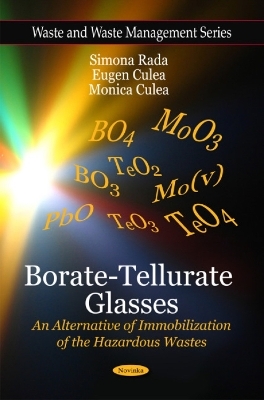
Borate-Tellurate Glasses
An Alternative of Immobilization of the Hazardous Wastes
Seiten
2010
Nova Science Publishers Inc (Verlag)
978-1-61668-263-7 (ISBN)
Nova Science Publishers Inc (Verlag)
978-1-61668-263-7 (ISBN)
A suitable glass host is used to dissolve the high level nuclear waste to form a glassy (vitreous) homogeneous product that can be cast into suitable forms, including large glass blocks. This book analyzes the immobilisation of high level toxic wastes through the use of an appropriate glass host.
Immobilisation of high level toxic wastes by vitrification is a well established process that has been studied extensively over last 40 years. A suitable glass host is used to dissolve the high level nuclear waste to form a glassy (vitreous) homogeneous product that can be cast into suitable forms, including large glass blocks. The main advantages of the vitrification route include the fact glass is a good solvent for waste, glasses can be processed at reasonably low temperatures, glass is very tolerant of variations in waste composition, glass exhibits reasonable chemical durability, glass is radiation resistant and can accommodate changes occurring during decay of high level nuclear waste constituents. This book analyses the immobilisation of high level toxic wastes through the use of an appropriate glass host.
Immobilisation of high level toxic wastes by vitrification is a well established process that has been studied extensively over last 40 years. A suitable glass host is used to dissolve the high level nuclear waste to form a glassy (vitreous) homogeneous product that can be cast into suitable forms, including large glass blocks. The main advantages of the vitrification route include the fact glass is a good solvent for waste, glasses can be processed at reasonably low temperatures, glass is very tolerant of variations in waste composition, glass exhibits reasonable chemical durability, glass is radiation resistant and can accommodate changes occurring during decay of high level nuclear waste constituents. This book analyses the immobilisation of high level toxic wastes through the use of an appropriate glass host.
Summary: Immobilization as a Vitreous Waste Form; Immobilization of Lead Ions in Borate-Molibdate Glasses & Glass Ceramics; Immobilization of Lead Ions in Borate-Tellurate Glasses & Glass Ceramics; Plumbate Glasses & Glass Ceramics; Borate-Tellurate Glasses an Alternative of Immobilization; Conclusions; Index.
| Erscheint lt. Verlag | 18.5.2010 |
|---|---|
| Zusatzinfo | Illustrations |
| Verlagsort | New York |
| Sprache | englisch |
| Maße | 230 x 155 mm |
| Gewicht | 174 g |
| Themenwelt | Naturwissenschaften ► Biologie ► Ökologie / Naturschutz |
| Technik ► Elektrotechnik / Energietechnik | |
| Technik ► Umwelttechnik / Biotechnologie | |
| ISBN-10 | 1-61668-263-9 / 1616682639 |
| ISBN-13 | 978-1-61668-263-7 / 9781616682637 |
| Zustand | Neuware |
| Informationen gemäß Produktsicherheitsverordnung (GPSR) | |
| Haben Sie eine Frage zum Produkt? |
Mehr entdecken
aus dem Bereich


aus dem Bereich
Methoden – Lösungen – Anwendungen
Buch | Hardcover (2025)
Hanser (Verlag)
CHF 69,95


