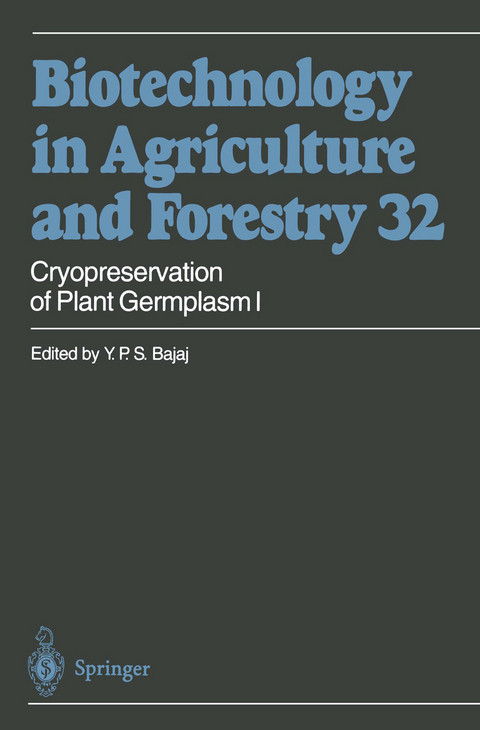
Cryopreservation of Plant Germplasm I
Springer Berlin (Verlag)
978-3-540-57451-4 (ISBN)

Numerous experts have contributed to this volume, which is divided into the following sections:
General introduction into the cryopreservation of plant cells, tissues, organs and seeds; trees; cereals and grasses; legumes and oilseed crops; fruits, vegetables, tuber and root crops; medicinal, aromatic and ornamental plants.
The germ plasm of numerous plant species, especially those of forest trees, some agricultural crops, and medicinal plants, is endangered and threatened with extinction. This depletion of germplasm pools and the shrinkage of naturally occurring genetic resources have caused international concern. Conventionally, the germplasm of plants is conserved through seeds, tubers, roots, corms, rhizomes, bulbs, cuttings, etc. However, the germ plasm of a number of trees and plantation crops (such as coconut, cocao, coffee, oil palm, rubber, mango, horse chestnut, etc. ) cannot be preserved since their seed are short-lived (recalcitrant). Likewise, germplasm of vegetatively propagated crops (such as potato and cassava) cannot be stored on a long term basis and has to be grown and multiplied periodically in nurseries and fields. The plants are thus exposed to unpredictable weather conditions and diseases, with the result that instances are known where entire genetic stocks are lost. Therefore, unconventional methods are being developed for the storage and international exchange of germplasm. For this purpose in vitro cultures have been employed, but they can only enable short-to medium term preservation; moreover, cell cultures upon repeated subculture undergo genetic erosion. In view of the recent developments in the in vitro induction of genetic variability through somaclonal variation, somatic hybridization, recombinant DNA technology, etc. , new methods need to be employed for the storage of desirable cultures. In this regard freeze preservation of cells in liquid nitrogen (-196 0q, like that of semen, enables long-term storage, theoretically, for an indefinite period of time.
I.1 Cryopreservation of Plant Cell, Tissue, and Organ Culture for the Conservation of Germplasm and Biodiversity.- I.2 Cryopreservation of Recalcitrant Seeds.- II.1 Cryopreservation of Germplasm of Woody Plants.- II.2 Cryoconservation of Germplasm of Citrus.- II.3 Cryopreservation of Apple (Malus Species) Genetic Resources.- II.4 Cryopreservation of Germplasm of Mulberry (Morus Species).- I1.5 Cryopreservation and Minimum Growth Storage of Pear (Pyrus Species).- II.6 Cryopreservation of Germplasm of Walnut (Juglans Species).- II.7 Cryopreservation of Date Palm, Oil Palm, and Coconut.- II.8 Cryopreservation of Germplasm of Ornamental Palms (Veitchia, Howea, and Calamus Species).- II.9 Cryopreservation of Germplasm of Rubber (Hevea brasiliensis).- II.10 Cryopreservation of Germplasm of Larix and Picea Species.- II.11 Cryopreservation of Scots Pine (Pinus sylvestris L.).- III.1 Cryopreservation of Germplasm of Cereals (Wheat, Rice, and Maize).- III.2 Cryopreservation of Foxtail Millet (Setaria italica L.).- III.3 Cryopreservation of Some Halophyte Grasses (Puccinellia Species).- III.4 Cryopreservation of Germplasm of Sugarcane (Saccharum Species).- IV.1 Cryopreservation of Peanut (Arachis hypogaea L.) and Chickpea (Cicer arietinum L.).- IV.2 Cryopreservation of Alfalfa (Medicago sativa L.) and Clovers (Trifolium Species).- IV.3 Cryostorage of Pea (Pisum sativum L.).- IV.4 Cryopreservation of Brassica Species.- V.1 Conservation of Germplasm of Kiwifruit (Actinidia Species).- V.2 Cryopreservation of Asparagus.- V.3 Cryopreservation of Germplasm of Sugarbeet (Beta vulgaris L.).- V.4 Conservation of Germplasm of Strawberry (Fragaria Species).- V.5 Cryopreservation of Germplasm of Tomato.- V.6 Cryopreservation of Germplasm of Banana and Plantain (Musa Species).- V.7 Cryopreservation of Germplasm of Potato (Solanum tuberosum L.) and Cassava (Manihot esculenta Crantz).- VI.1 Cryopreservation of Germplasm of Medicinal and Aromatic Plants.- VI.2 Cryopreservation of Anisodus Species.- VI.3 Cryopreservation of Germplasm of Chrysanthemums.- VI.4 Cryopreservation of Germplasm of Carnation (Dianthus caryophyllus L.).- VI.5 Cryopreservation Studies on Digitalis lanata (Foxglove).- VI.6 Cryopreservation of Germplasm of Dioscorea deltoidea (Medicinal Yam).- VI.7 Preservation of Cell Cultures of Lavandula vera (Lavender).
| Erscheint lt. Verlag | 29.9.1995 |
|---|---|
| Reihe/Serie | Biotechnology in Agriculture and Forestry |
| Zusatzinfo | XXII, 514 p. |
| Verlagsort | Berlin |
| Sprache | englisch |
| Maße | 155 x 235 mm |
| Gewicht | 1016 g |
| Themenwelt | Naturwissenschaften ► Biologie ► Botanik |
| Weitere Fachgebiete ► Land- / Forstwirtschaft / Fischerei | |
| Schlagworte | biodiversity • Biotechnologie • biotechnology, plants • cryopreservation, plants • Gefrierkonservierung • Gefrierkonservierung, Pflanzen • germplasm, plants • Gewebekultur, Pflanzen • Keimplasma, Pflanzen • Kryopräservation, Pflanzen • nitrogen • Ornamental Plant • Pflanzen • pisum sativum l. • tissue culture, plant • tissue culture, plants |
| ISBN-10 | 3-540-57451-4 / 3540574514 |
| ISBN-13 | 978-3-540-57451-4 / 9783540574514 |
| Zustand | Neuware |
| Informationen gemäß Produktsicherheitsverordnung (GPSR) | |
| Haben Sie eine Frage zum Produkt? |
aus dem Bereich