


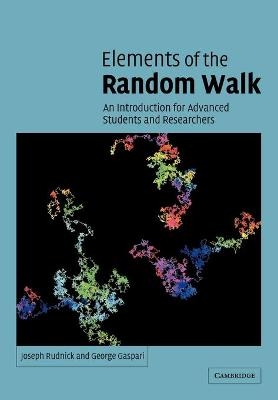
Elements of the Random Walk
An introduction for Advanced Students and Researchers
Seiten
2010
Cambridge University Press (Verlag)
978-0-521-53583-0 (ISBN)
Cambridge University Press (Verlag)
978-0-521-53583-0 (ISBN)
Random walks have proven to be a useful model in understanding processes across a wide spectrum of scientific disciplines. This self-contained text will appeal to graduate students who need to understand the applications of random walk techniques, as well as to established researchers.
Random walks have proven to be a useful model in understanding processes across a wide spectrum of scientific disciplines. Elements of the Random Walk is an introduction to some of the most powerful and general techniques used in the application of these ideas. The mathematical construct that runs through the analysis of the topics covered in this book, unifying the mathematical treatment, is the generating function. Although the reader is introduced to analytical tools, such as path-integrals and field-theoretical formalism, the book is self-contained in that basic concepts are developed and relevant fundamental findings fully discussed. Mathematical background is provided in supplements at the end of each chapter, when appropriate. This text will appeal to graduate students across science, engineering and mathematics who need to understand the applications of random walk techniques, as well as to established researchers.
Random walks have proven to be a useful model in understanding processes across a wide spectrum of scientific disciplines. Elements of the Random Walk is an introduction to some of the most powerful and general techniques used in the application of these ideas. The mathematical construct that runs through the analysis of the topics covered in this book, unifying the mathematical treatment, is the generating function. Although the reader is introduced to analytical tools, such as path-integrals and field-theoretical formalism, the book is self-contained in that basic concepts are developed and relevant fundamental findings fully discussed. Mathematical background is provided in supplements at the end of each chapter, when appropriate. This text will appeal to graduate students across science, engineering and mathematics who need to understand the applications of random walk techniques, as well as to established researchers.
Preface; 1. Introduction to techniques; 2. Generating functions I; 3. Generating functions II: recurrence, sites visited, and the role of dimensionality; 4. Boundary conditions, steady state, and the electrostatic analogy; 5. Variations on the random walk; 6. The shape of a random walk; 7. Path integrals and self-avoidance; 8. Properties of the random walk: introduction to scaling; 9. Scaling of walks and critical phenomena; 10. Walks and the O(n) model: mean field theory and spin waves; 11. Scaling, fractals, and renormalization; 12. More on the renormalization group; References; Index.
| Erscheint lt. Verlag | 25.3.2010 |
|---|---|
| Zusatzinfo | Worked examples or Exercises |
| Verlagsort | Cambridge |
| Sprache | englisch |
| Maße | 170 x 244 mm |
| Gewicht | 550 g |
| Themenwelt | Naturwissenschaften ► Physik / Astronomie |
| ISBN-10 | 0-521-53583-2 / 0521535832 |
| ISBN-13 | 978-0-521-53583-0 / 9780521535830 |
| Zustand | Neuware |
| Informationen gemäß Produktsicherheitsverordnung (GPSR) | |
| Haben Sie eine Frage zum Produkt? |
Mehr entdecken
aus dem Bereich

aus dem Bereich
Problem Solving with Python
Buch | Softcover (2024)
Wiley-VCH (Verlag)
CHF 149,95


