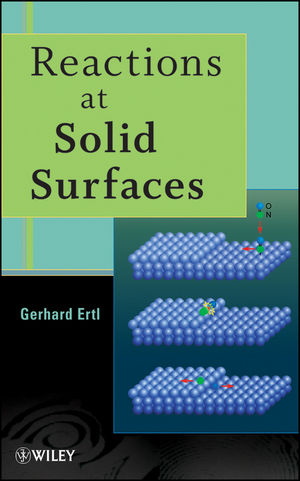
Reactions at Solid Surfaces
John Wiley & Sons Inc (Verlag)
9780470261019 (ISBN)
- Titel z.Zt. nicht lieferbar
- Versandkostenfrei
- Auch auf Rechnung
- Artikel merken
Expanding on the ideas first presented in Gerhard Ertl's acclaimed Baker Lectures at Cornell University, Reactions at Solid Surfaces comprises an authoritative, self-contained, book-length introduction to surface reactions for both professional chemists and students alike. Outlining our present understanding of the fundamental processes underlying reactions at solid surfaces, the book provides the reader with a complete view of how chemistry works at surfaces, and how to understand and probe the dynamics of surface reactions.
Comparing traditional surface probes with more modern ones, and bringing together various disciplines in a cohesive manner, Gerhard Ertl's Reactions at Solid Surfaces serves well as a primary text for graduate students in introductory surface science or chemistry, as well as a self-teaching resource for professionals in surface science, chemical engineering, or nanoscience.
Gerhard Ertl received his PhD in physical chemistry in 1965 from the Technical University of Munich. He is currently Professor Emeritus at Fritz Haber Institute of the Max Planck Society, Germany, where he was also the Director of the Department of Physical Chemistry from 1986–2004. In addition to winning the 2007 Nobel Prize in Chemistry for his studies of chemical processes on solid surfaces, his many awards received over the years include the Wolf Prize in Chemistry, the Karl Ziegler Prize, the Otto Hahn Prize, and the Japan Prize. He is an acknowledged leader in the field of surface science.
Preface ix
1. Basic principles 1
1.1. Introduction: The surface science approach 1
1.2. Energetics of chemisorption 4
1.3. Kinetics of chemisorption 11
1.4. Surface diffusion 13
References 17
2. Surface structure and reactivity 21
2.1. Influence of the surface structure on reactivity 21
2.2. Growth of two-dimensional phases 24
2.3. Electrochemical modification of surface structure 29
2.4. Surface reconstruction and transformation 33
2.5. Subsurface species and compound formation 42
2.6. Epitaxy 44
References 47
3. Dynamics of molecule/surface interactions 51
3.1. Introduction 51
3.2. Scattering at surfaces 52
3.3. Dissociative adsorption 54
3.4. Collision-induced surface reactions 59
3.5. ‘‘Hot’’ adparticles 60
3.6. Particles coming off the surface 64
3.7. Energy exchange between adsorbate and surface 69
References 75
4. Electronic excitations and surface chemistry 79
4.1. Introduction 79
4.2. Exoelectron emission 81
4.3. Internal electron excitation: ‘‘chemicurrents’’ 86
4.4. Electron-stimulated desorption 88
4.5. Surface photochemistry 94
References 98
5. Principles of heterogeneous catalysis 103
5.1. Introduction 103
5.2. Active sites 105
5.3. Langmuir–Hinshelwood versus Eley–Rideal mechanism 109
5.4. Coadsorption 111
5.5. Kinetics of catalytic reactions 113
5.6. Selectivity 117
References 120
6. Mechanisms of heterogeneous catalysis 123
6.1. Synthesis of ammonia on iron 123
6.2. Synthesis of ammonia on ruthenium 134
6.3. Oxidation of carbon monoxide 139
6.4. Oxidation of hydrogen on platinum 149
References 154
7. Oscillatory kinetics and nonlinear dynamics 159
7.1. Introduction 159
7.2. Oscillatory kinetics in the catalytic CO oxidation on Pt(110) 163
7.3. Forced oscillations in CO oxidation on Pt(110) 169
References 172
Contents vii
8. Spatiotemporal self-organization in surface reactions 175
8.1. Introduction 175
8.2. Turing patterns and electrochemical systems 178
8.3. Isothermal wave patterns 183
8.4. Modification and control of spatiotemporal patterns 189
8.5. Thermokinetic effects 195
8.6. Pattern formation on microscopic scale 198
References 200
Index 205
| Reihe/Serie | Baker Lecture Series |
|---|---|
| Verlagsort | New York |
| Sprache | englisch |
| Maße | 164 x 239 mm |
| Gewicht | 508 g |
| Themenwelt | Naturwissenschaften ► Chemie ► Physikalische Chemie |
| ISBN-13 | 9780470261019 / 9780470261019 |
| Zustand | Neuware |
| Informationen gemäß Produktsicherheitsverordnung (GPSR) | |
| Haben Sie eine Frage zum Produkt? |
aus dem Bereich