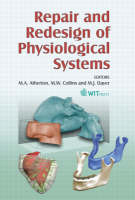
Repair and Redesign of Physiological Systems
WIT Press (Verlag)
978-1-84564-096-5 (ISBN)
- Keine Verlagsinformationen verfügbar
- Artikel merken
Mark ATHERTON (PhD, City University, London; MSc, Imperial College, London; BSc(Hons), Aston University, Birmingham) is a reader in mechanical engineering design at Brunel University. His research interests include the robustness of mechanical/mechatronic devices, natural and complex systems. In the medical field his research focuses on modelling blood flow through vascular stents subject to geometric risk factors; and reducing the unpleasant noise of dental drills using digital filtering and anti-noise techniques. Michael COLLINS,after graduating from Oxford University in Engineering Science, worked in the UK nuclear industry for three years in the field of fuel element heat transfer. He spentover thirty yearsat City University:his research involved computational thermofluids, for which he was awarded both PhD and DSc degrees. His interests broadened into novel optical measurement methods and the application of Computational Fluid Dynamics to medical flow problems.International recognition includes the award of the PolishOrder of Merit and he is an Honorary Fellow of the Italian Union of Thermofluiddynamics.He is currently a Visiting Professor in the School of Engineering and Design at Brunel University, working in advanced industrial applications of CFD, micro & nanofluid dynamics,and medical flow modelling withDr Atherton. He is a Fellow of six engineering, mathematical and other professional group and the Founding Editor of this book Series.
Preface 1 Vascular reconstruction: CFD predictions of bypass graft haemodynamics Introduction; Conventional femorodistal bypass; Anastomotic angle; Graft/artery diameter ratio; Taylor patch; Cuffed anastomoses; Conclusions; References 2 Clinical applications of Physiome Project models Introduction; Modelling the gastro-oesophageal junction; Modelling musculo-skeletal system mechanics; Modelling the lymphatic system and melanoma; Interpretation of cardiac ultrasound measurements with physiome models; Summary; Acknowledgements; References 3 Computational modelling of left ventricular haemodynamics based on magnetic resonance imaging data Introduction; Methods; Results; Discussion; Conclusions; Acknowledgments; References 4 A mathematical model of left ventricular contraction and its application in heart disease Introduction; The hypotheses; Methods; Results; Conclusions; References 5 Cardiac resynchronisation therapy for heart failure Introduction; Basic concepts and techniques; Conventional pacing and cardiac resynchronisation therapy; Dyssynchrony; The theoretical basis for CRT; The evidence for dual-chamber pacemakers and CRT in heart failure; Echocardiographic measures of dyssynchrony and response to CRT; Other reasons for non-response; Conclusions; References 6 Ventricular assist devices Introduction; Intra aortic balloon pump; Flexible diaphragm pumps; General conclusions; References 7 Computational fl uid dynamics in the investigation and treatment of nasal obstruction Introduction; Overview of nasal anatomy and physiology; Literature review; Methodology and methodological considerations; Numerically predicted nasal airflow characteristics; Virtual nasal surgery; Discussion; Conclusions; References 8 Review of dental repair concepts and methods Introduction; Dealing with tooth decay; Restoration of teeth; Others forms of loss of tooth substance; Tooth replacement; Cosmetic dentistry; Repair concepts and philosophy; References 9 Biomechanical aspects in dental replacements Introduction; Various kinds of tooth replacements; Jaw solid modelling; Various methods of stress analysis; Stress analysis results; Biological aspects; References 10 Needle-free immunotherapeutics delivered to the skin Introduction; The importance of targeting skin and mucosal cells; Engineering of physical approaches for the targeting of skin and mucosal cells; Biolistics micro-particle delivery
| Erscheint lt. Verlag | 15.7.2008 |
|---|---|
| Reihe/Serie | Design & Nature S. ; v. 9 |
| Zusatzinfo | Illustrations |
| Verlagsort | Southampton |
| Sprache | englisch |
| Maße | 165 x 242 mm |
| Themenwelt | Studium ► 1. Studienabschnitt (Vorklinik) ► Physiologie |
| Naturwissenschaften ► Biologie ► Zoologie | |
| ISBN-10 | 1-84564-096-9 / 1845640969 |
| ISBN-13 | 978-1-84564-096-5 / 9781845640965 |
| Zustand | Neuware |
| Informationen gemäß Produktsicherheitsverordnung (GPSR) | |
| Haben Sie eine Frage zum Produkt? |
aus dem Bereich