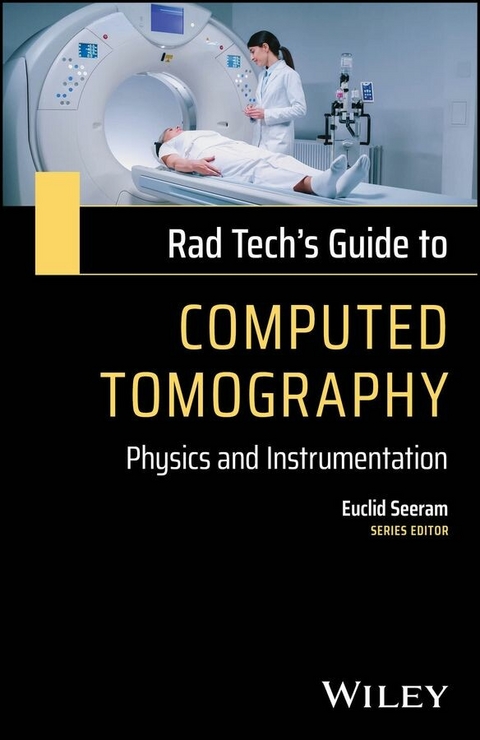
Rad Tech's Guide to Computed Tomography (eBook)
150 Seiten
Wiley (Verlag)
978-1-394-31261-0 (ISBN)
An up-to-date guide to CT that offers a comprehensive discussion of the technology and science of computed tomography and instructions for applying that knowledge to real-world practice
Rad Tech's Guide to Computed Tomography: Physics and Instrumentation is a comprehensive and accessible approach to learning the physics and instrumentation of CT. The text offers an intuitively organized treatment of the history of CT development, data acquisition, image reconstruction, and the relationship between image quality and radiation dose.
Using clear language, hands-on examples and useful diagrams, the book is written to demystify complex topics like Hounsfield units, attenuation coefficients, and interpolation algorithms, without compromising technical accuracy. This is an educational resource that shows readers how to perform imaging that generates diagnostically useful results that keep patients safe.
Readers will find:
- An up-to-date exploration of the use of artificial intelligence in medical imaging
- Concise explorations of the physics of state-of-the-art CT scanners, relevant to the day-to-day work of practicing RTs
- Practical discussions of relevant, selected topics, including multi-slice CT, the basics of image postprocessing, and quality control fundamentals
- Guidance on how to ensure consistent diagnostic performance without compromising patient safety
- Complete treatments of data acquisition, including slice-by-slice and volume data acquisition
Perfect for students preparing to take professional certification examinations in CT, Rad Tech's Guide to Computed Tomography will also benefit practicing technologists interested in advancing their understanding, refining their technique, and expanding their professional skillset.
Euclid Seeram, PhD, FCAMRT, is Senior Lecturer in X-Ray Imaging Sciences; Computed Tomography Physics and Technology at VCA Education Solutions for Health Professionals, Toronto, Ontario, Canada. He is Adjunct Associate Professor, Medical Imaging and Radiation Sciences, Monash University, Australia, and Adjunct Professor, Medical Imaging, Faculty of Health, University of Canberra, Australia.
1
The Invention of the CT Scanner and the Nobel Prize
Chapter at a glance
- Computed Tomography: A Definition
- Three Major Stages of CT Imaging
- Invention of the CT Scanner: The Nobel Prize for Pioneers Godfrey Hounsfield and Alan Cormack
- Evolution of CT Scanners Leading to Present‐Day Multi‐Slice CT Imaging
- References
Computed Tomography: A Definition
Computed Tomography (CT) is an x‐ray imaging modality that is based on tomographic principles, image reconstruction mathematics, and computer processing of the data acquired from the patient. This data consists of radiation attenuation values which are subsequently converted into electrical signals by the CT scanner detector electronics and sent to the computer for processing. The results of this processing are cross‐sectional images (“slices”) of the patient's anatomy displayed on a monitor for viewing and interpretation by an observer. A cross‐sectional image is an image of a transverse axial slice of the patient, defined as a slice that is perpendicular to the longitudinal axis of the body, as shown in Figure 1.1.
Current CT scanners have computer processing capabilities that use these two‐dimensional (2D) transverse axial images to generate fully three‐dimensional (3D) images, as illustrated in Figure 1.2. Since the image reconstruction requires intensive computer processing, CT is often referred to as “Computer‐Assisted Tomography,” a term used by the Nobel Prize organization when awarding the Nobel Prize to the CT pioneers [1].
Figure 1.1 CT imaging produces images of transverse axial sections of the patient. Such a section is perpendicular to the longitudinal axis of the body.
Figure 1.2 Current CT scanners have the processing capabilities to use two‐dimensional (2D) transverse axial images to generate fully three‐dimensional (3D) images.
Source: Generated with AI using Craiyon LLC.
Three Major Stages of CT Imaging
Three major stages of CT imaging include data acquisition, image reconstruction, and image management and processing, the sequence of which is illustrated in Figure 1.3. While data acquisition refers to collecting x‐ray attenuation values (attenuation coefficients) from the patient as the x‐ray tube and detectors rotate around the patient, image reconstruction involves the use of extensive mathematics coded in the form of computer programs referred to as algorithms to create and build up cross‐sectional images of the patient. The third stage of CT imaging involves the display, management, and processing of images obtained from scanning. The latter is now referred to as Medical Image Management and Processing System (MIMPS), which replaces the former technology referred to as Picture Archiving and Communication System (PACS). A further elaboration of Figure 1.3 is illustrated in Figure 1.4.
Data Acquisition System
The main components of the data acquisition system include the x‐ray tube, which is coupled to x‐ray detectors and detector electronics, that rotate 360° around the patient to collect x‐ray attenuation values referred to as linear attenuation coefficients (μs), as shown in Figure 1.4a. These coefficients are used to compute integers (zero, positive, and negative numbers) called CT numbers that represent the sectional anatomy of the patient. CT numbers are now referred to as Hounsfield Units (HU) in honor of Sir Godfrey Hounsfield, who shared the Nobel Prize with Professor Alan Cormack for their development of Computer‐Assisted Tomography [2]. While the essential physics of radiation attenuation will be discussed in Chapter 2, data acquisition will be described in detail in Chapter 3.
Figure 1.3 The three major stages of CT imaging, namely data acquisition, image reconstruction, and image management and processing.
Figure 1.4 An elaboration of the three stages noted in Figure 1.3.
Image Reconstruction
The second stage of CT imaging is image reconstruction, which is considered the heart of the CT scanner (Figure 1.4b). Image reconstruction uses mathematics to build up images from the attenuation data acquired from the patient. The mathematics can be coded in the form of computer algorithms, which describe a set of rules for solving a problem. The problem in CT is to calculate the attenuation values obtained from the slices of tissues during data acquisition. These algorithms are complex and have evolved from the filtered back projection algorithm, which was used in CT for about five decades, and iterative reconstruction algorithms [3–5] developed to reduce noise (hence the dose) in CT images, to reconstruction algorithms based on artificial intelligence (AI). AI uses computers to mimic the human cognition system, whereby they are trained to think and solve problems like humans [6, 7]. One such AI‐based algorithm is deep learning reconstruction algorithm, designed to further reduce the image noise (improved image quality with reduced dose) inherent in iterative algorithms [8, 9]. Essential details of CT image reconstruction will be described in Chapter 4.
Medical Image Management and Processing System (MIMPS)
The third stage of CT imaging includes the image display of the reconstructed image for viewing and interpretation, along with postprocessing to suit the needs of the interpreting radiologist. Furthermore, images are sent to the MIMPS for archiving, storage, and communication to virtual data centers for retrospective image analysis. The Food and Drug Administration (FDA) made this change in 2021 in the Cures Act enacted (Pub. L. 114–255) [10] and noted that radiologists pay careful attention to three modifications, namely medical image storage devices, picture archiving and communication systems, and medical image communication devices. More detailed information can be obtained from the FDA document [10]. An important consideration in making this change is that a major feature of MIMPS is image processing operations, including image manipulation, quantification, and three‐dimensional (3D) image visualization techniques such as surface rendering and volume rendering [11].
More recently, AI is being integrated into these image management and processing systems, as illustrated in Figure 1.5, which shows the essential features of the PACS‐AI platform. As noted by the authors, “the main objective of the platform is to enable automated, near real‐time application of AI models on clinical images for use at the point of care. It offers a web application interface that clinicians can use to search for an imaging study stored on the hospital PACS and select a compatible AI model to be applied to the associated images” [12].
Figure 1.5 Essential features of the PACS‐AI platform.
Source: Theriault‐Lauzier et al. [12] / Elsevier / CC BY 4.0.
This integration will not be discussed further in this book, and therefore, the interested reader should refer to the original article by Theriault‐Lauzier et al. [12].
Invention of the CT Scanner: The Nobel Prize for Pioneers Godfrey Hounsfield and Alan Cormack
The invention of the CT scanner is based on the work of several individuals, most notably Sir Godfrey Newbold Hounsfield and Professor Allan MacLeod Cormack. For their work, Hounsfield and Cormack shared the 1979 Nobel Prize in Medicine or Physiology [1]. The literature is replete with information on this invention, and a detailed paper on the invention and development of CT through the years, covering notable milestones, is that of McCollough and Rajiah [13]. Furthermore, the Nobel Prize Organization (http://www.nobelprize.org) features remarkable details on the contributions of both these CT pioneers.
Hounsfield's Contribution
After studying electronics, electrical, and mechanical engineering, he gained employment in 1951 as an engineer at Electronic and Musical Industries (EMI) Limited in the United Kingdom, where he initially worked on radar systems and later on computer technology. In 1967, Hounsfield was investigating pattern recognition and reconstruction techniques by using the computer. Sometime later, he explored imaging an object by x‐rays passing an x‐ray beam through an object at different angles while collecting x‐ray transmission readings, and processing these measurements using the computer. His initial experiments used an americium gamma radiation source coupled with a sodium iodide crystal detector. Data...
| Erscheint lt. Verlag | 5.1.2026 |
|---|---|
| Reihe/Serie | Rad Tech's Guides' |
| Sprache | englisch |
| Themenwelt | Medizin / Pharmazie |
| Schlagworte | ct book • ct certification • ct certification guide • ct certification help • ct certification test • ct exams • ct guide • ct instrumentation • ct physics • ct technology • ct test • ct text • ct textbook • ct tips • science of ct |
| ISBN-10 | 1-394-31261-X / 139431261X |
| ISBN-13 | 978-1-394-31261-0 / 9781394312610 |
| Informationen gemäß Produktsicherheitsverordnung (GPSR) | |
| Haben Sie eine Frage zum Produkt? |
 EPUB (Adobe DRM)
Kopierschutz: Adobe-DRM
Adobe-DRM ist ein Kopierschutz, der das eBook vor Mißbrauch schützen soll. Dabei wird das eBook bereits beim Download auf Ihre persönliche Adobe-ID autorisiert. Lesen können Sie das eBook dann nur auf den Geräten, welche ebenfalls auf Ihre Adobe-ID registriert sind.
Details zum Adobe-DRM
Dateiformat: EPUB (Electronic Publication)
EPUB ist ein offener Standard für eBooks und eignet sich besonders zur Darstellung von Belletristik und Sachbüchern. Der Fließtext wird dynamisch an die Display- und Schriftgröße angepasst. Auch für mobile Lesegeräte ist EPUB daher gut geeignet.
Systemvoraussetzungen:
PC/Mac: Mit einem PC oder Mac können Sie dieses eBook lesen. Sie benötigen eine
eReader: Dieses eBook kann mit (fast) allen eBook-Readern gelesen werden. Mit dem amazon-Kindle ist es aber nicht kompatibel.
Smartphone/Tablet: Egal ob Apple oder Android, dieses eBook können Sie lesen. Sie benötigen eine
Geräteliste und zusätzliche Hinweise
Buying eBooks from abroad
For tax law reasons we can sell eBooks just within Germany and Switzerland. Regrettably we cannot fulfill eBook-orders from other countries.
aus dem Bereich