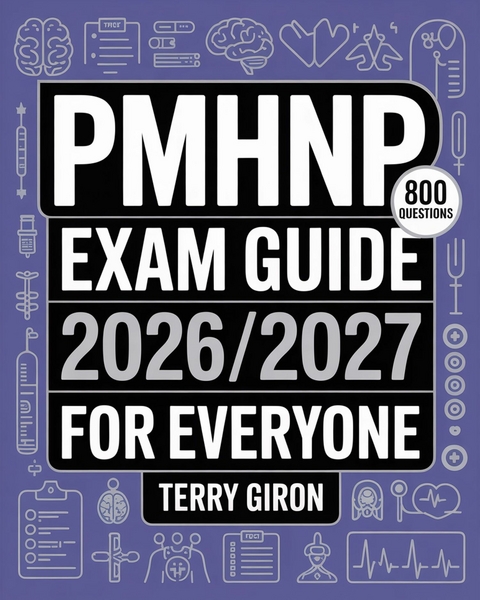
PMHNP Exam Guide 2026/2027 for Everyone (eBook)
192 Seiten
Publishdrive (Verlag)
978-0-00-112937-5 (ISBN)
The PMHNP Exam Guide 2026/2027 for Everyone is a structured learning resource developed to support candidates preparing for the Psychiatric-Mental Health Nurse Practitioner (PMHNP) certification examination. This guide presents core psychiatric nursing and mental health concepts in a clear, organized format aligned with commonly tested exam content areas.
The guide focuses on helping readers understand and apply key principles related to psychiatric assessment, diagnosis, and treatment across the lifespan. Content areas include psychopharmacology, psychotherapy modalities, neurobiology, psychiatric disorders, crisis intervention, ethical and legal considerations, cultural competence, and professional practice. Explanations emphasize clinical reasoning and application of evidence-informed principles within mental health care settings.
Designed for Everyone-including graduate nursing students, nurse practitioners, and mental health professionals seeking certification-this guide supports structured study, reinforces foundational and advanced knowledge, and helps learners approach the PMHNP exam with clarity and confidence.
Disclaimer: This exam guide is an independent educational resource created for general exam preparation purposes. It is not affiliated with, endorsed by, or sponsored by ANCC, AANP, or any official PMHNP certifying organization. All terminology and references are used solely for educational purposes.
Chapter 2 — Assessment & Diagnostic Reasoning (Exam Topic Area)
Comprehensive psychiatric assessment across the lifespan, mental status examination, and diagnostic formulation
- Describe, in detail, the physical and biological principles that determine whether a sterilization method (e.g., moist heat, dry heat, EO, hydrogen peroxide plasma) will reliably inactivate bacterial spores on a mixed-material clinical instrument load.
- Explain how you would design and document a validation protocol for a gravity-displacement steam sterilizer in an outpatient psychiatric clinic that processes mixed loads (textile, metal, and polymer components), including acceptance criteria and frequency of revalidation.
- Compare the mechanisms of action, spectrum of activity, and appropriate clinical uses of high-level disinfectants (e.g., glutaraldehyde, ortho-phthalaldehyde, peracetic acid) for semi-critical equipment that cannot tolerate steam.
- Critically evaluate the limitations of chemical indicator strips and biological indicators for routine sterility assurance, and propose an evidence-based monitoring schedule for a medium-volume office.
- Outline an advanced protocol for decontamination and sterilization of reusable transcranial magnetic stimulation (TMS) coil accessories that are heat-sensitive and frequently contacted by patient skin.
- Describe how organic load, instrument design (lumens, hinges), and water quality influence the efficacy of disinfection and sterilization; propose mitigation strategies for each factor in a small outpatient practice.
- Develop a step-by-step infection-control policy for processing and storing sterile trays (e.g., suturing/cutaneous procedure trays) in an office with intermittent procedures, addressing packaging, shelf-life, and handling.
- Explain the scientific rationale, indications, and limitations for using low-temperature sterilization technologies (hydrogen peroxide vapor, vaporized peracetic acid) in ambulatory settings.
- Given a hypothetical outbreak of Pseudomonas aeruginosa linked to a clinic’s nebulizer use, describe an investigation plan including environmental sampling, sterilization/disinfection review, and corrective actions.
- Discuss the evidence and ethical considerations surrounding single-use versus reusable device decisions in outpatient behavioral health clinics that perform minor procedures.
- Present a detailed protocol for selecting, donning, and doffing PPE for aerosol-generating procedures in a non-hospital outpatient setting, emphasizing steps that minimize self-contamination.
- Explain how surgical masks, N95 respirators, elastomeric respirators, and powered air-purifying respirators differ in filtration performance, fit requirements, and reuse/cleaning protocols.
- For a staff member with an N95 shortage, propose and justify an evidence-based extended use and limited reuse plan that includes decontamination options, fit testing, and performance monitoring.
- Describe how you would assess the competency of clinical staff in instrument reprocessing, PPE donning/doffing, and environmental cleaning — include objective measures and remediation steps.
- Analyze the role of environmental surface disinfection (frequency, agents, contact time) in preventing healthcare-associated infections in psychiatric inpatient units versus outpatient offices.
- Create a comprehensive bloodborne pathogen exposure control plan for an outpatient clinic, including initial response, post-exposure prophylaxis pathways, documentation, and staff education metrics.
- Explain the processes and validation steps for reprocessing semi-critical devices with long narrow lumens (e.g., flexible suction catheters), including flushing, leak testing, and sterilization monitoring.
- Discuss the pros and cons of using automated washer-disinfectors versus manual cleaning for complex reusable instruments in a low throughput office, and propose criteria for choosing one over the other.
- Devise an evidence-based cleaning and disinfection schedule for patient rooms, staff workstations, and shared equipment in a mixed medical-behavioral outpatient clinic; justify the frequency and agent choices.
- Explain how biofilms form on clinical surfaces and instruments, how biofilm presence changes disinfectant susceptibility, and strategies to prevent and remove biofilms in practice.
- Provide a decision algorithm for selecting the appropriate level of reprocessing (sterilization vs high-level disinfection) for a range of instruments and devices commonly encountered in outpatient psychiatric practice.
- Discuss the regulatory and accreditation implications (OSHA, CDC, local health department) of failing to maintain sterilization logs and biological indicator records in an ambulatory clinic.
- Create a protocol for management of a positive biological indicator result from a sterilizer load that included reusable critical instruments intended for immediate patient use.
- Analyze the infection-control implications of laundering staff uniforms and scrubs in a clinic with limited onsite laundry facilities; include transport, storage, and temperature/detergent recommendations.
- Describe the impact of waterborne pathogens on instrument reprocessing and environmental disinfection, and explain how you would test and remediate an office’s potable water system when implicated.
- Explain the role of ATP bioluminescence assays in surface cleaning verification, including interpretation limits and how to integrate ATP testing into quality improvement programs.
- Draft a detailed written procedure for sterilization cycle selection (temperature, time, jacket pressure) based on load types and packaging in a gravity-displacement steam sterilizer.
- Discuss the mechanisms by which sporicidal agents inactivate spores and the operational considerations (contact time, pH, organic load) that affect real-world sporicidal activity.
- Propose an evidence-based policy for handling, transport, and processing of contaminated sharps and regulated medical waste in a small clinic, minimizing exposure and meeting regulatory requirements.
- Design a training module outline (objectives, hands-on activities, assessment) to teach correct use of powered air-purifying respirators (PAPRs) to behavioral health clinic staff who rarely use them.
- Evaluate different sterilization packaging materials (wrapped cloth, sterilization pouches, rigid containers) for routine and complex instrument sets, including pros/cons for integrity, reprocessing cycle impact, and cost.
- Explain the concept of sterility assurance level (SAL), how it is determined, and how it should influence clinical decision making when reprocessing critical instruments.
- Given a clinic that occasionally processes surgical instruments, create an audit tool to monitor instrument cleaning efficacy, sterilizer performance, PPE compliance, and documentation quality.
- Discuss how to incorporate point-of-care testing for infectious diseases (rapid antigen tests) into an infection-control program, addressing specimen handling, PPE, waste, and reporting.
- Present a stepwise protocol for decontaminating a clinical exam room after an uncontained vomiting incident by a patient known to have norovirus, including which disinfectant chemistries to use and why.
- Explain the microbiological and practical reasons for differentiating between low-, intermediate-, and high-level disinfection in policy documents, and give three clinical examples where misclassification would increase risk.
- Describe how sterilizer load configurations and instrument packing patterns influence heat penetration and steam contact; provide three specific packing errors and their consequences.
- Create a robust corrective action plan for repeated high chemical indicator failures in a sterilization process, including equipment troubleshooting, staff retraining, and validation steps.
- Explain the evidence and rationale for using biological indicators versus process challenge devices for monitoring sterilization in different sterilizer technologies.
- For a hypothetical contaminated laundry spill with blood, outline the response steps, PPE, transport, and terminal cleaning to protect staff and other patients.
- Describe a risk-based approach to assigning reprocessing responsibilities (who does which tasks) in a multi-disciplinary ambulatory clinic, ensuring competency and minimizing cross-contamination.
- Explain the ways in which emergent infectious agents (novel respiratory viruses) should alter PPE selection and office workflows; propose a scalable tiered plan for rising community transmission.
- Design an effective audit and feedback cycle to improve staff compliance with hand hygiene, including measurement methods, frequency, and behavior change strategies.
- Discuss the compatibility issues between common disinfectant chemistries and various medical materials (e.g., aluminum, silicone, polyurethane) and propose mitigation to avoid device damage.
- Draft a clinic policy describing the circumstances and procedures under which reusable respiratory protection (elastomeric respirators) may be issued rather than N95s.
- Explain the microbiological basis for the recommended contact times on disinfectant labels and how a clinic should reconcile label instructions with manufacturer instrument cleaning recommendations.
- For a patient with suspected tuberculosis undergoing behavioral health intake in a clinic with a single small waiting room, propose an infection-control triage and environmental plan to...
| Erscheint lt. Verlag | 24.12.2025 |
|---|---|
| Sprache | englisch |
| Themenwelt | Medizin / Pharmazie ► Pflege |
| ISBN-10 | 0-00-112937-6 / 0001129376 |
| ISBN-13 | 978-0-00-112937-5 / 9780001129375 |
| Informationen gemäß Produktsicherheitsverordnung (GPSR) | |
| Haben Sie eine Frage zum Produkt? |
 EPUB (Adobe DRM)
Größe: 990 KB
Kopierschutz: Adobe-DRM
Adobe-DRM ist ein Kopierschutz, der das eBook vor Mißbrauch schützen soll. Dabei wird das eBook bereits beim Download auf Ihre persönliche Adobe-ID autorisiert. Lesen können Sie das eBook dann nur auf den Geräten, welche ebenfalls auf Ihre Adobe-ID registriert sind.
Details zum Adobe-DRM
Dateiformat: EPUB (Electronic Publication)
EPUB ist ein offener Standard für eBooks und eignet sich besonders zur Darstellung von Belletristik und Sachbüchern. Der Fließtext wird dynamisch an die Display- und Schriftgröße angepasst. Auch für mobile Lesegeräte ist EPUB daher gut geeignet.
Systemvoraussetzungen:
PC/Mac: Mit einem PC oder Mac können Sie dieses eBook lesen. Sie benötigen eine
eReader: Dieses eBook kann mit (fast) allen eBook-Readern gelesen werden. Mit dem amazon-Kindle ist es aber nicht kompatibel.
Smartphone/Tablet: Egal ob Apple oder Android, dieses eBook können Sie lesen. Sie benötigen eine
Geräteliste und zusätzliche Hinweise
Buying eBooks from abroad
For tax law reasons we can sell eBooks just within Germany and Switzerland. Regrettably we cannot fulfill eBook-orders from other countries.
aus dem Bereich