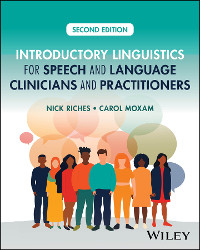
Introductory Linguistics for Speech and Language Clinicians and Practitioners (eBook)
356 Seiten
Wiley (Verlag)
978-1-394-20999-6 (ISBN)
A practical introduction to linguistics for speech and language therapy practice
In the newly revised second edition of Introductory Linguistics for Speech and Language Clinicians and Practitioners, a team of distinguished speech researchers and clinicians deliver a practical introduction to linguistics. As a highly focused text designed to teach those aspects of linguistics that are most important in clinical practice, the book covers key concepts in morphology, syntax, semantics, discourse, and pragmatics.
Each chapter demonstrates its relevance to practising speech language therapists and offers an integrated approach that incorporates relevant clinical resources. These include hands-on exercises that test the reader's understanding of foundational principles and assist in the application of this knowledge to other areas of study and practice.
Readers will also find:
- A thorough introduction to linguistic concepts that speech and language therapists rely on every day
- A 'sandwich approach' to bridging theory and practice, involving the combination of clinical case examples with clear explanations of theory and concluding with a discussion of clinical relevance
- Reinforcement exercises that help consolidate key terms, concepts, and theories
Perfect for pre-registration speech and language sciences students and newly qualified practitioners, Introductory Linguistics for Speech and Language Clinicians and Practitioners will also benefit experienced speech and language therapists seeking a refresher on important concepts, and students of linguistic theory.
Nick Riches is a Senior Lecturer in Speech and Language Pathology at Newcastle University. He teaches Linguistics and Psycholinguistics courses and lectures on specific language impairments, autism, Williams syndrome, modularity, and genetics.
Carol Moxam is Senior Lecturer in Speech and Language Pathology at Newcastle University. She serves as the Co-Degree Programme Director for the undergraduate programmes and is the Director of The Children's Speech and Language Clinic. In addition to her academic roles, she offers clinical services for children and adolescents with speech, language, and communication difficulties and disorders.
CHAPTER 1
You Say Tom‐mah‐dah and I say To‐may‐dah
1.1 CLINICAL ORIENTATION
You observe a 12‐year‐old girl called Amy in her classroom working on a task with a small group of her peers. You notice she is consistently leaving endings off words, such as because he ride his bike to school. She refers to her friends as youse and uses verb forms such as his mother grew him up.
(adapted from Easton & Verdon, 2021)1
As a trainee or practising Speech and Language Therapist (SLT) you are likely to come across many clients like Amy. Her sentence he ride his bike is unusual, with the verb ride lacking an ‐s. Such a linguistic form in a relatively old child is a potential marker of language impairment. To be confident in your diagnosis you will need to exploit your linguistic knowledge to categorise her error, and your knowledge of language development to determine whether this is age appropriate. He ride his bike is often described as an ‘optional infinitive error’ which involves using an infinitive form (ride) where a non‐infinitive form (rides) is required. This type of error is made by young children, but will, in standard British and American English, typically disappear by around the age of 4. For a 12‐year‐old to be making this kind of error is unusual. Consequently, you may at first suspect a language impairment of some sort, for example, Developmental Language Disorder (DLD).
Notice that we would not even begin to get the diagnostic process off the ground without using our linguistic knowledge to categorise the error. Consequently, SLTs need a good knowledge of grammar and grammatical terminology to do this. A primary aim of this book is to equip you with this knowledge.
However, before we become too confident in our diagnosis, how would we categorise youse? This is, to many, a non‐standard form, but appears in many dialects or varieties of English, including Liverpool English. And the use of grow up as a transitive verb, i.e. taking the direct object me, is also a characteristic of certain dialects or varieties including Australian Aboriginal English. Finally, returning to the omission of ‐s on the verb rides, the very linguistic feature which led us to suspect a language impairment, this is, in fact, common in many English dialects or varieties, including East Anglian English in the United Kingdom and African American English in the United States. Consequently, to diagnose language impairment on the basis of a missing ‐s risks the accidental mis‐diagnosis of literally millions of children.
Though linguistics provides powerful tools for describing and categorising language, with great power comes great responsibility. In addition to describing language structure, you must also recognise the huge amount of variation which exists between speakers2 who do not have a diagnosable language disorder. Moreover, you will need a strong ability to resist powerful ideologies. Early in our childhoods we are implanted with the idea that there is a right way to speak. This is further drummed into us at school, where, if we are a speaker of a non‐standard English dialect, we are instructed on how to speak and write ‘correctly’. If Amy's infinitive he ride his bike.., etc. rather than he rides his bike…. etc. is a characteristic of her dialect then she has managed to resist a decade of being told that hers is the wrong way to speak.
The ideology that tells us that there is a right way to speak and write is often called linguistic prescriptivism, as it prescribes a standard way of using language, in the same way that a chemist prescribes us drugs to combat an ailment. Though it claims to be doing this for our own good, to help us express ourselves clearly, and sound ‘natural’, its apparent concern belies some extremely deep prejudices. Though none of us have completely escaped this indoctrination, SLTs need to be aware of their own linguistic prejudices to be effective practitioners. For example, if all of Amy's non‐standard linguistic features are consistent with her dialect, then no matter how unusual we find them when filtered through our own dialect, we must resist using them to judge an individual's linguistic competence and arrive at a diagnosis.
The role of prescriptivism, or linguistic bias, in Speech and Language Therapy was, in fact, the main aim of Easton and Verdon's study which is the source of the adapted vignette. They presented therapists with a number of similar vignettes, which were likewise ambiguous in their inclusion of non‐standard linguistic forms which may or may not result from a client's dialect. Therapists with greater experience were less likely to propose a diagnosis on the basis of non‐standard English, and more likely to advocate seeking further information. There is thus a clear relationship between sensitivity to dialect and clinical effectiveness.
An awareness of prescriptivism, or linguistic bias, is also important when analysing and scoring data obtained from clinical assessments. An extremely widely used clinical assessment is sentence repetition, sometimes called sentence recall or elicited imitation. Individuals with language impairment, both developmental and acquired, find this task exceptionally difficulty and test batteries such as the Clinical Evaluation of Language Fundamentals (CELF) include versions of this task. Intriguingly, when clients repeat sentences they will alter the sentence to conform to their dialect. So, if Amy is asked to repeat the sentence he rides his bike, and Amy's dialect lacks third person ‐s, she will repeat this sentence as he ride his bike.
Though superficially, the ‘intrusion’ of a client's dialect during a sentence repetition task looks like a stubborn refusal to conform to the dialect of the person who is testing, it is widely observed in both clinical and non‐clinical populations, whether or not the individual's dialect is the standard dialect. This suggests that the task involves more than just ‘parroting’, and unconsciously engages mechanisms we exploit in genuine day‐to‐day linguistic interaction. As a result of this phenomenon, when therapists score sentence repetition tests, they must be highly attuned to changes which reflect an individual's dialect. Otherwise, they would score a dialect‐consistent alteration as a grammatical error. In fact, the CELF instruction manual explicitly requests coders to ignore alterations which are consistent with the child's dialect. Clearly, a sensitivity to dialect, combined with a knowledge of a wide range of dialects, is helpful to the goals of Speech and Language Therapy.
Whilst dialect awareness is a key aspect to becoming a good therapist, it also gives us a better insight into some of the prejudices facing individuals with speech language and communication needs. The child who is victimised because of a stammer or speech sound disorder and the adult who is victimised due to their minority dialect are at the receiving end of societal beliefs or attitudes that put down those who do not conform or fit certain ‘norms’ or expectations. Moreover, as we shall see later, therapists may also find themselves working in an environment where prescriptivist approaches are explicitly encouraged. If so, they will need to actively combat these harmful societal beliefs or attitudes.
Finally, cultural awareness and acceptance of difference in relation to dialect are essential to developing a deeper understanding of language. Shedding our assumptions that certain languages or dialects are superior to others is an important first step in our development as linguists. There is, in fact, no other topic which more perfectly combines the twin goals of becoming an SLT and developing a deeper understanding of linguistics. This is why the first chapter of this book is dedicated to dialect and linguistic prescriptivism. The following sections explore the origins of linguistic biases, and explain how they are misguided, and at the end of this chapter we will present a model of language called the communicative view of language. Only once you have developed an understanding that there is no such thing as a superior dialect, will you be ready to continue your journey into linguistics, and how it can support SLTs in the clinic.
1.2 LINGUISTIC PRESCRIPTIVISM
If someone told you that there was a linguistic form which would instantly generate the opposite of the meaning you intend, you would probably avoid it entirely. The form we are referring to is the double negative, exemplified below in the famous Rolling Stones song lyric.
- I can't got no satisfaction
Both can't and no are negative forms, and it is often argued that they cancel each other out. Consequently, according to this logic, the literal meaning of (1) is I can get satisfaction (I am satisfied). A brief internet search will bring up literally hundreds of websites or videos exhorting you to avoid this form. They tell you that if you persist in using double negatives, it will result in confusion, and that you will be judged as common, uneducated and even untrustworthy. Given the extremely negative attitudes towards the double negative, who in their right mind would continue to use this form?
In fact over 700 million people living in Portugal,...
| Erscheint lt. Verlag | 30.12.2025 |
|---|---|
| Sprache | englisch |
| Themenwelt | Medizin / Pharmazie |
| Schlagworte | basic linguistics • beginning linguistics book • introduction to linguistics • language therapy examples • linguistics book • linguistics examples • linguistics textbook • linguistics theory • speech language therapy • speech therapy examples |
| ISBN-10 | 1-394-20999-1 / 1394209991 |
| ISBN-13 | 978-1-394-20999-6 / 9781394209996 |
| Informationen gemäß Produktsicherheitsverordnung (GPSR) | |
| Haben Sie eine Frage zum Produkt? |
 EPUB (Adobe DRM)
Kopierschutz: Adobe-DRM
Adobe-DRM ist ein Kopierschutz, der das eBook vor Mißbrauch schützen soll. Dabei wird das eBook bereits beim Download auf Ihre persönliche Adobe-ID autorisiert. Lesen können Sie das eBook dann nur auf den Geräten, welche ebenfalls auf Ihre Adobe-ID registriert sind.
Details zum Adobe-DRM
Dateiformat: EPUB (Electronic Publication)
EPUB ist ein offener Standard für eBooks und eignet sich besonders zur Darstellung von Belletristik und Sachbüchern. Der Fließtext wird dynamisch an die Display- und Schriftgröße angepasst. Auch für mobile Lesegeräte ist EPUB daher gut geeignet.
Systemvoraussetzungen:
PC/Mac: Mit einem PC oder Mac können Sie dieses eBook lesen. Sie benötigen eine
eReader: Dieses eBook kann mit (fast) allen eBook-Readern gelesen werden. Mit dem amazon-Kindle ist es aber nicht kompatibel.
Smartphone/Tablet: Egal ob Apple oder Android, dieses eBook können Sie lesen. Sie benötigen eine
Geräteliste und zusätzliche Hinweise
Buying eBooks from abroad
For tax law reasons we can sell eBooks just within Germany and Switzerland. Regrettably we cannot fulfill eBook-orders from other countries.
aus dem Bereich