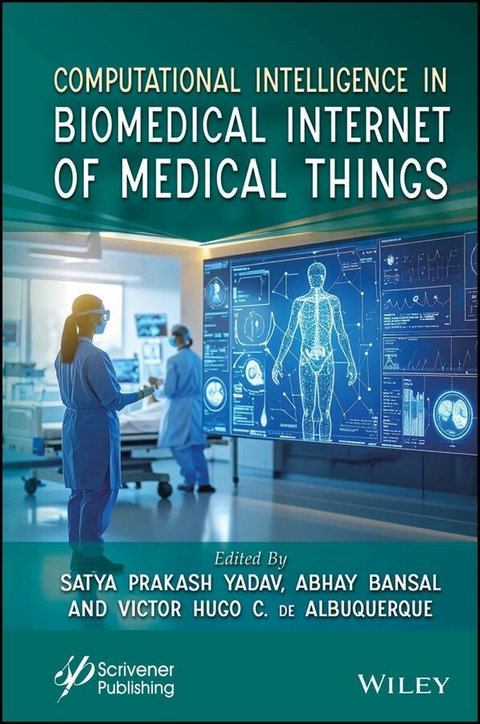
Computational Intelligence in Biomedical Internet of Medical Things (eBook)
535 Seiten
Wiley-Scrivener (Verlag)
978-1-394-38663-5 (ISBN)
Through comprehensive insights and real-world case studies, this book features in-depth knowledge of key concepts relating to optimizing biomedical IoMT systems.
Biomedical Internet of Medical Things is a technological paradigm encompassing a range of technologies that enable machines to mimic human intelligence. Machine and deep learning algorithms facilitate self-learning for the discovery of hidden patterns, associations, and risks from voluminous datasets. Computer vision and natural language processing are prominent applications of AI, allowing machines to see and understand the world in ways previously only possible for humans. In healthcare, generative techniques can analyze large and complex datasets from wearable sensors, identifying patterns and trends that can aid in detecting, diagnosing, and monitoring chronic diseases. This book comprehensively consolidates the latest technologies, groundbreaking research, and practical applications of computational intelligence in biomedical IoMT, with a strong emphasis on optimizing healthcare information systems.
Readers will find the volume:
- Explores the transformative role of computational intelligence in the Internet of Medical Things (IoMT), demonstrating how intelligent systems enhance healthcare efficiency, accuracy, and patient-centric solutions at various scales;
- Examines key computational intelligence techniques and algorithms used in modern biomedical IoMT applications, emphasizing their impact on real-time diagnostics, personalized treatment, and remote patient monitoring;
- Highlights the evolution of AI-driven paradigms in biomedical IoMT, showcasing their role in predictive analytics, automated decision-making, and adaptive healthcare systems;
- Investigates the integration of trust management and advanced cybersecurity frameworks in intelligent healthcare networks.
Audience
Academics, research scholars, and industry professionals in the fields of mathematics, computer science, information technology, and health science.
Satya Prakash Yadav, PhD is an Associate Professor in the Department of Computer Science and Engineering, Madan Mohan Malaviya University of Technology, Gorakhpur, U.P., India with more than 17 years of experience. He has published four books, two patents, and many research articles in international journals and conferences. His research focuses on image processing, information retrieval, and feature extraction and programming.
Abhay Bansal, PhD is a Professor and the Dean of the School of Computer Science Engineering and Technology and the Dean of International Affairs and Corporate Outreach, Bennett University, Greater Noida , UP, India with more than 29 years of research and teaching experience. He has published more than 130 papers in various international journals and conferences of repute. His research interests include data science, data analytics, cloud computing, and data structure.
Victor Hugo C. de Albuquerque, PhD is a Professor and Senior Researcher in the Department of Teleinformatics Engineering, Federal University of Ceará, Brazil. He is a full member of the Brazilian Society of Biomedical Engineering and serves as an editor for several international journals and conferences. He has experience in biomedical science and engineering, mainly in the fields of applied computing, intelligent systems, and visualization and interaction.
1
Introduction to Computational Biomedical Intelligence
G. Padma Priya1, Anima Nanda2*, Nimisha Ghosh3, E. Sakthivel4, Devendra Parmar5 and Rakesh Kumar Yadav6
1Department of Chemistry and Biochemistry, Jain (Deemed-to-be University), Bangalore, Karnataka, India
2Department of Biomedical, Sathyabama Institute of Science and Technology, Chennai, Tamil Nadu, India
3Centre for Internet of Things, Siksha ‘O’ Anusandhan (Deemed to be University), Bhubaneswar, Odisha, India
4Department of Computer Science and Engineering, Presidency University, Bangalore, Karnataka, India
5Computer Science and Engineering, Parul Institute of Technology, Parul University, Vadodara, Gujarat, India
6Department of Computer Science, Maharishi School of Engineering & Technology, Maharishi University of Information Technology, Uttar Pradesh, India
Abstract
Computational biomedical intelligence (CBI) is an interdisciplinary field that integrates artificial intelligence (AI), machine learning (ML), and computational tools to solve complex problems in healthcare, from disorder prognosis to personalized medicinal drugs. However, the scope of this study is limited to data availability, AI approach interpretability, and regulatory limitations in healthcare applications. The objective of this article is to discover the function of CBI in advancing precision medicine, improving early detection, and improving healthcare decision-making through AI-driven insights. This study examines various components, which include AI applications in disease diagnosis, personalized medicinal drugs, drug discovery, and scientific imaging. It also explores demanding situations, including data privacy, model transparency, and healthcare. The advantages of medical practitioners and researchers lie in offering complete information on how CBI can transform healthcare, optimize patient outcomes, and inform future study directions.
Keywords: Computational biomedical intelligence, AI, machine learning, precision medicine
1.1 Introduction
The field of computational biomedical intelligence (CBI) is at the intersection of computer technology, artificial intelligence (AI), and biomedical sciences. It leverages computational tools, algorithms, and data evaluation strategies to address complex challenges in healthcare, biology, and medicine. The Internet of Medical Things (IoMT) is an aspect of the Internet-of-Things (IoT) technique that includes interconnected equipment for medicine for healthcare surveillance. The IoMT components, sometimes referred to as IoT for healthcare, integrate technology, interface detectors, and machine learning (ML)-based AI to allow individuals to have intervention-free monitoring of healthcare. The IoMT software connects patients to physicians’ medical equipment, enabling remote data collection, processing, and transmission via a secure connection. The IoMT technology helps to cut unnecessary hospitalizations and associated medical costs by allowing remote monitoring of health metrics. The IoMT medical technology category includes portable, in-home individual health surveillance devices, as well as medical or point-of-care (POC) devices based on clinical systems [1]. The IoMT portable technology can also detect accidental tumbles in elderly persons. Injuries in the elderly are unavoidable, but conditions should be observed and managed to minimize long-term harm. The IoMT technologies that enable remote surveillance of indicators of health assist in lowering unnecessary hospital stays and associated medical costs [2].
Artificial intelligence and technological advances are transforming several industries, including healthcare. This is largely due to the potential benefits of AI technology for patients. Advancements in technology and financing have led to the widespread use of machinery in healthcare, including next-generation sequencing, computerized data collection and storage, diagnosis, and recommendations [3]. Advanced medical technology has extended to major start-ups globally, improving patient safety and longevity. Initially, advances in the health industry were driven by software and accessibility, which enabled digitization of formerly paper-based operations [4].
The term AI describes computer techniques that simulate human cognitive functions, for instance, deep learning (DL), cognition, involvement, flexibility, and perception. Certain systems can perform activities that often need the judgment and intelligence of individuals. These approaches are interdisciplinary and relevant to many domains, such as medical care and health [5]. Artificial intelligence has a big impact on the healthcare industry, with implementations spanning several phases. Artificial intelligence has a significant impact on pharmaceutical product development, including medication discovery and management. The AI technologies are utilized in discovering drugs, including screening and design [6]. Computational intelligence (CI) is an emerging topic at the forefront of bioinformatics and biomedical systems. To address the most difficult difficulties in disease knowledge and healthcare, cutting-edge CI combines biological disciplines. Bioinformatics has made significant advances in predicting the study of genetics, protein structures, and deciphering complex cell networks [7]. Computational biomedical intelligence is shown in Figure 1.1.
Figure 1.1 Computational biomedical intelligence.
(Source: Own elaboration).
Data analysis, mathematical modeling, and simulations are included in using computational tools in biology, biotechnology, biomedical research, medical care, and medical procedures. These tools enable and benefit insight into complicated structures of biology and understanding the structural underpinnings of illness. The combination of biological science, bioinformatics, and computing methods is aimed at improving the understanding of biological processes and increasing the accuracy in healthcare decision-making [8]. The functions of ML in the biological materials’ domain concentrate on the effects, problems, and future possibilities. It facilitates the creation of innovative systems for delivering drugs, biological frameworks, and surgical instruments; biological materials are essential to medicine. A thorough understanding of nanoparticles’ characteristics is necessary due to the complex connection they have with biological tissues, functions, and interconnections.
Machine learning offers a way to advance this knowledge, as well as to develop and optimize the [9]. Nanoscience in healthcare provides important advances in diagnostic and therapeutic imaging, biosensing, tailored drug delivery structures, and so on. Artificial intelligence has the potential to expand applications in biomedical engineering by analyzing and interpreting biological information, accelerating drug development, and identifying selected tiny molecules or distinctive substances with predictive behavior [10].
1.2 Emergence of Computational Biomedical Intelligence
The rapid development of biomedical information, coupled with the advancements in computational power has necessitated the development of sophisticated tools for information evaluation. Computational biomedical intelligence emerged as a reaction to this demand, integrating AI, ML, and computational biology to cope with complicated biomedical challenges. Advanced technology, such as modifying genes, AI, and huge amounts of data, have introduced new ethical hazards to medical research, and the capacity to safeguard patients has become more insufficient [11]. The epidemic acted as an accelerator, and the broad adoption of remote medicine was accelerated to its highest point. As a result, the role of telemedicine in modern healthcare has increased, irrevocably transforming the landscape of medical practice. Telecommuting characterized using digital communication, as well as technology to deliver distant medical treatments, has been established for several decades [12].
Biosensor development is receiving a lot of interest in bioscience and healthcare because of its extensive usage in therapeutic sessions, healthcare, and food preparation. Biosensors are used for illness detection, diagnosis, therapy, patient health observations, and human health control [13]. The emergence of CBI is shown in Figure 1.2.
The area of medical services has entered the big data era due to significant advancements in medical technology and biomedical data expansion. In this environment, computerized medicine became a brand-new area. The multidisciplinary discipline of computing healthcare blends biology, arithmetic technology, and the domain of medicine to analyze large amounts of biological data with computers [14]. The IoMT consists of biological instruments and systems that interface with healthcare infrastructures to handle data [15]. The rising cost of medical care may impede corporate growth. Chronic problems are also becoming more prevalent, which is exacerbated by the global population’s aging in diverse parts of the world. Indeed, there is a greater likelihood that the current population is more prone to chronic illnesses.
As a result, healthcare accessibility will inevitably become costly for most people. The IoMT has improved biopharmaceutical and healthcare processes while also allowing virtual patient treatment [16]. Machine learning and other strong computational technologies with great...
| Erscheint lt. Verlag | 24.12.2025 |
|---|---|
| Sprache | englisch |
| Themenwelt | Medizin / Pharmazie |
| ISBN-10 | 1-394-38663-X / 139438663X |
| ISBN-13 | 978-1-394-38663-5 / 9781394386635 |
| Informationen gemäß Produktsicherheitsverordnung (GPSR) | |
| Haben Sie eine Frage zum Produkt? |
 EPUB (Adobe DRM)
Kopierschutz: Adobe-DRM
Adobe-DRM ist ein Kopierschutz, der das eBook vor Mißbrauch schützen soll. Dabei wird das eBook bereits beim Download auf Ihre persönliche Adobe-ID autorisiert. Lesen können Sie das eBook dann nur auf den Geräten, welche ebenfalls auf Ihre Adobe-ID registriert sind.
Details zum Adobe-DRM
Dateiformat: EPUB (Electronic Publication)
EPUB ist ein offener Standard für eBooks und eignet sich besonders zur Darstellung von Belletristik und Sachbüchern. Der Fließtext wird dynamisch an die Display- und Schriftgröße angepasst. Auch für mobile Lesegeräte ist EPUB daher gut geeignet.
Systemvoraussetzungen:
PC/Mac: Mit einem PC oder Mac können Sie dieses eBook lesen. Sie benötigen eine
eReader: Dieses eBook kann mit (fast) allen eBook-Readern gelesen werden. Mit dem amazon-Kindle ist es aber nicht kompatibel.
Smartphone/Tablet: Egal ob Apple oder Android, dieses eBook können Sie lesen. Sie benötigen eine
Geräteliste und zusätzliche Hinweise
Buying eBooks from abroad
For tax law reasons we can sell eBooks just within Germany and Switzerland. Regrettably we cannot fulfill eBook-orders from other countries.
aus dem Bereich