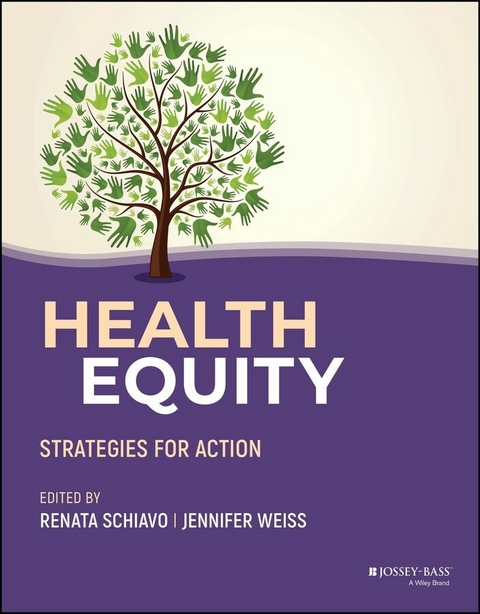
Health Equity (eBook)
580 Seiten
Jossey-Bass (Verlag)
978-1-394-24330-3 (ISBN)
In Health Equity: Strategies for Action, an array of pioneering health equity-focused researchers, educators, practitioners, and policy specialists from multiple sectors and disciplines deliver an incisive guide to health equity: why it matters, how to achieve it, and the state of the health equity movement across national and global settings.
Grounded in a multisectoral and community-driven approach to health equity solutions, this book walks you through key principles and practical approaches to advancing health equity and overcoming commonly encountered barriers to people's health and well-being, including key social, structural and political determinants of health. The book features effective action areas and strategiies to address health inequities across issues of racism, gender, immigration, poverty, age, and other socially-determined factors, and highlights relevant case studies and lessons learned.
Health Equity: Strategies for Action is an essential resource for graduate and undergraduate courses on the topic. Professionals in fields as broad as public health, architecture and urban planning, social work, medicine, technology, early childhood, healthcare, community development, human rights, philanthropy, vital statistics, and disability advocacy who seek to integrate a health equity lens in their work, will also find this to be a vital guidebook in furthering their health equity goals. Policymakers and elected officials can also use this book enhance their knowledge on health equity, an approach to improve health for all, whose importance will only continue to grow.
EDITORS
Renata Schiavo, PhD, MA, CCL is a global health practitioner and a public health/ sociomedical sciences academic with a deep commitment to public service, health equity, community engagement, and systems-driven solutions. She is a Senior Lecturer at Columbia University Mailman School of Public Health, Department of Sociomedical Sciences, Editor-in-Chief of the Journal of Communication in Healthcare: Strategies, Media, and Engagement in Global Health, and a principal at Strategies for Equity and Communication Impact (SECI), a global consultancy. She is the founder and board president of Health Equity Initiative, a nonprofit volunteer organization, and serves as Senior Editor of the Journal of Health Equity, and on the editorial board of Health Equity. She also leads an international summer professional development program at The American University of Rome. She is a well-recognized expert in health equity, health and risk communication, and global health/public health, and works, writes and speaks on these topics in a variety of settings.
Jennifer Weiss, MA, has been in the field of public health for over 20 years, and consults for New York-based nonprofits on public health policy, advocacy and education. She has worked on projects relating to workplace wellness, palliative care, health literacy, early childhood development, behavioral health, chronic disease management, nutrition, and the health consequences of loneliness and social isolation. She is also the co-author of two books of nonfiction, and two books of humor and has had Op Eds and articles published in the New York Times, the Washington Post, the New York Post, the San Francisco Chronicle, and the Denver Post.
PREFACE
Health equity is more than just an idea … it’s a global goal and a movement!
#ActforHealthEquity
Health equity is a foundational human right. The quest for health equity has been shaping health, social, and political environments over the last several decades, and we have witnessed the rise and flourishing of a modern health equity movement. This book invites everyone to join this movement—across professional sectors, disciplines, and communities around the world. This is a movement whose commitment to health and well‐being for all can frame the twenty‐first century and ultimately determine the future of our children, grandchildren, and all future generations—a movement that MUST continue now and always in spite of any kind of challenge or setback.
The idea of this book was initiated by one of its editors, Renata Schiavo, in late 2019. This was just a few months before a once‐in‐a‐century pandemic provided undeniable proof of the global impact of health, racial, and social inequities. Unfortunately, this was not surprising for the many people who had already committed their professional and personal efforts to advancing health equity. We knew that pandemics have a way of showing “the magnitude of social and racial inequities too many people experience, and ultimately their impact on people's ability to lead healthy and productive lives and/or to protect themselves from the threat of public health emergencies and natural disasters” [1]. We knew that “the pandemic would be adding more tragedy to the lives of groups and communities whose lives had already been unfairly affected by discriminatory policies and unequal distribution of public resources” [2].
The pandemic made it clear that health is social, health is political, and that we are all interconnected. We did not need a pandemic to demonstrate in such dramatic ways that health equity is a key priority of our time, and that “being our brother's and sister's keeper is not only an important human rights issue …, but something that can positively affect everyone's health and well‐being” [1]. We should know by now that inequities lead to more inequities and that they have a profoundly negative impact on human lives, including hardship, stress, suffering, and loss.
Of course, this book project was on hold for a long while so that we could respond to the professional and personal demands caused by the pandemic. Yet, we knew we would push forward as soon as the COVID‐19 crisis subsided. We had committed to creating a resource that would double as a textbook for graduate and undergraduate courses on the topic, as well as a guidebook for professionals, policymakers, community leaders, and decision‐makers from fields as broad as public health, architecture and urban planning, social work, medicine, technology, early childhood, healthcare, community development, human rights, philanthropy, communication, vital statistics, and disability advocacy who seek to integrate a health equity lens in their work and/or social and political platforms. It took a village and lot of perseverance, but we made it!
We are grateful to the array of pioneering health equity colleagues—from multiple professional sectors, communities, and disciplines—who joined us in this journey and contributed their experience, passion, and insights to different chapters in this book. Across chapters, we were able to frame all topics around a community‐centered, multisectoral, collaborative, and systems‐driven approach to health equity solutions, which we consider essential to promoting health equity in local, national, and global settings. We ultimately hope that this resource will contribute to building capacity for action and motivating professionals, leaders, and communities to prioritize health equity in their professional, volunteer, and personal efforts.
Finally, this book is dedicated to the millions of people, including many frontline workers, who unfortunately lost their lives to the pandemic, and to the many communities around the world most affected by health inequities. May their lives and memory inspire our actions, give us wisdom, and provide new impetus to our commitment to advancing health equity. May our resolve stay unwavering even in challenging times and in the face of any social or political threats to health equity!
Organization of This Book
We designed the book with the intention of sharing comprehensive and evidence‐based analyses and resources on a range of social, political, structural, and informational determinants of health, health equity topics, theoretical frameworks, lessons learned, case studies, strategies, and promising solutions as well as perspectives on the state and future of the health equity movement. The book’s interdisciplinary approach is reflected in the diverse backgrounds and work experiences of its contributors, and accounts for its in‐depth exploration of health equity issues and strategies at the community, national, and global levels and across a variety of groups and populations. We also wanted the book to be useful and accessible to a variety of groups, including those we mentioned above, those who are already working to achieve health equity, and those who want to integrate or prioritize health equity in their current or future work.
The organization of the book reflects the above objectives and includes the following sections:
- Introduction and Background on Health Equity (Part 1)
- Key Principles and Approaches in Advancing Health Equity (Part 2)
- Addressing Barriers to Health Equity: Promising Practices, Select Strategies and Case Studies (Part 3)
- Future Directions and the Role of Different Types of Organizations (Part 4)
Two introductory chapters are included in Part 1 and set the stage for the rest of the book. These chapters define health equity, its many determinants, and theoretical foundations, and include an overview on the history and state of the health equity movement in local, national, and global settings.
Part 2 consists of six foundational chapters on models, theories, practical approaches, and frameworks that are key to advancing health equity. Topics covered in this section include multidisciplinary and cross‐sectoral approaches and frameworks for the design, implementation, and evaluation of health equity‐driven interventions, policies, and research efforts; social and behavior change models to communicate for health equity impact; strategies for community participation and engagement; theoretical and practical approaches for policy design and implementation; and the use of technology to advance health equity and promote civic engagement on health equity issues. As for the framing of the book, great emphasis is placed on multisectoral, community‐centered, and systems‐driven solutions to health equity issues.
Six additional chapters are included in Part 3 and feature promising practices, lessons learned, strategies, and case studies to address barriers to health equity, including inequities in early childhood development; inadequate urban design; racism, xenophobia, and other forms of social discrimination; poverty; climate change; and gender, aging, or LGBTQI+ inequities, among other topics.
Building upon previous sections of the book, Part 4 features three chapters that focus on the role of different professions and sectors in advancing health equity, with references to strategies for multisectoral collaboration and partnerships and/or sector‐ or profession‐specific engagement. The section ends with a chapter summarizing future directions and recommendations for action that emerged across different topics in this book and beyond.
Across all sections, each chapter includes examples, case studies, lessons learned, and recommendations that are designed to help readers implement the models, approaches, and strategies being featured. Examples and case studies draw upon experiences relating to multiple health equity issues and community, population, and country settings. Learning objectives are featured at the beginning of each chapter to help readers easily identify the focus and scope of the chapter. Additionally, each chapter includes a list of key terms and review questions. These questions are designed to help readers discuss, practice and reflect on key concepts and strategies covered in the chapter, either individually or in groups. A summary section can be found at the end of each chapter alongside the chapter’s references.
Finally, two Appendices complement and integrate the 17 chapters in the book. Appendix 1, Voices from the Field: Stories of Community Engagement and Resilience, and the Role of Community Sectors, features field experiences, personal stories, and community‐based narratives contributed by community leaders from several countries. Appendix 2, Youth Voices on Health Equity, includes quotes from youth interviews on the significance and meaning of health equity and key health equity issues that are on the minds of young people. These interviews and other youth‐centered resources in Appendix 2 provide insights that we hope will be helpful in engaging young people in the health equity movement...
| Erscheint lt. Verlag | 24.12.2025 |
|---|---|
| Sprache | englisch |
| Themenwelt | Medizin / Pharmazie |
| Sozialwissenschaften ► Politik / Verwaltung | |
| Schlagworte | community health equity • costs of health inequality • health equity definition • health equity frameworks • health equity in the us • health equity movement • Health equity strategies • Health inequality • health inequity • united states health equity |
| ISBN-10 | 1-394-24330-8 / 1394243308 |
| ISBN-13 | 978-1-394-24330-3 / 9781394243303 |
| Informationen gemäß Produktsicherheitsverordnung (GPSR) | |
| Haben Sie eine Frage zum Produkt? |
 EPUB (Adobe DRM)
Kopierschutz: Adobe-DRM
Adobe-DRM ist ein Kopierschutz, der das eBook vor Mißbrauch schützen soll. Dabei wird das eBook bereits beim Download auf Ihre persönliche Adobe-ID autorisiert. Lesen können Sie das eBook dann nur auf den Geräten, welche ebenfalls auf Ihre Adobe-ID registriert sind.
Details zum Adobe-DRM
Dateiformat: EPUB (Electronic Publication)
EPUB ist ein offener Standard für eBooks und eignet sich besonders zur Darstellung von Belletristik und Sachbüchern. Der Fließtext wird dynamisch an die Display- und Schriftgröße angepasst. Auch für mobile Lesegeräte ist EPUB daher gut geeignet.
Systemvoraussetzungen:
PC/Mac: Mit einem PC oder Mac können Sie dieses eBook lesen. Sie benötigen eine
eReader: Dieses eBook kann mit (fast) allen eBook-Readern gelesen werden. Mit dem amazon-Kindle ist es aber nicht kompatibel.
Smartphone/Tablet: Egal ob Apple oder Android, dieses eBook können Sie lesen. Sie benötigen eine
Geräteliste und zusätzliche Hinweise
Buying eBooks from abroad
For tax law reasons we can sell eBooks just within Germany and Switzerland. Regrettably we cannot fulfill eBook-orders from other countries.
aus dem Bereich