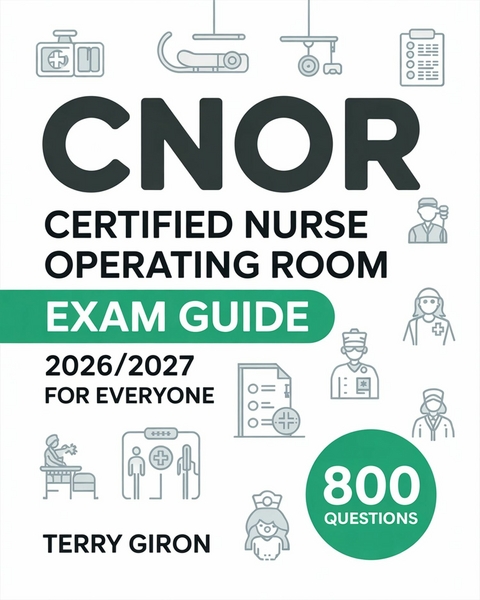
CNOR Exam Guide 2026/2027 for Everyone (eBook)
186 Seiten
Publishdrive (Verlag)
978-0-00-112825-5 (ISBN)
The CNOR Exam Guide 2026/2027 for Everyone is a structured and accessible learning resource developed to support perioperative nurses preparing for the Certified Nurse Operating Room (CNOR) certification exam. This guide presents core perioperative nursing principles and exam-relevant content in a clear, organized format aligned with commonly tested knowledge areas.
The guide covers essential topics such as perioperative patient assessment, infection prevention and control, sterile technique, surgical instrumentation, anesthesia considerations, patient safety, emergency situations, ethical and legal responsibilities, and professional practice. Emphasis is placed on understanding concepts, applying clinical judgment, and recognizing best practices within the operating room environment.
Designed for Everyone-including perioperative nurses, surgical nurses, and professionals seeking certification-this guide supports structured study, reinforces foundational knowledge, and helps learners approach exam preparation with confidence and clarity.
Disclaimer: This exam guide is an independent educational resource created for general exam preparation purposes. It is not affiliated with, endorsed by, or sponsored by CCI, AORN, or any official CNOR certifying organization. All terminology and references are used solely for educational purposes.
Chapter 2 — Preoperative & Postoperative Assessment and Plan of Care (Exam Topic Area)
Preoperative and postoperative patient assessment, diagnosis, and risk identification
- Describe a stepwise approach to preoperative risk stratification for a 72-year-old male with ischemic cardiomyopathy presenting for urgent colectomy, including which cardiac tests you would prioritize and why.
- Explain how to differentiate postoperative myocardial injury from demand ischemia versus acute coronary syndrome in the first 48 hours after major abdominal surgery.
- Given a patient on chronic warfarin with an INR of 2.8 scheduled for elective arthroplasty, outline the perioperative anticoagulation management plan that balances bleeding and thrombotic risks.
- For a morbidly obese patient with suspected obstructive sleep apnea (OSA) scheduled for laparoscopic bariatric surgery, describe preoperative evaluation steps that identify perioperative respiratory risk and guide anesthesia planning.
- Interpret the perioperative implications of preoperative hyponatremia (Na 125 mEq/L) in a 60-year-old trauma patient and how it should influence timing of surgery and intraoperative management.
- Create a differential diagnosis and assessment strategy for new postoperative delirium occurring on postoperative day 2 after hip fracture repair.
- For a patient with end-stage renal disease on hemodialysis presenting for vascular access revision, describe preoperative labs and fluid/electrolyte considerations that reduce perioperative cardiac and neurologic risk.
- Explain the process for identifying and managing potential malignant hyperthermia susceptibility in a patient with a family history of anesthetic complications.
- For a patient with recent COVID-19 infection scheduled for elective surgery, outline evidence-based timing and assessment criteria to minimize pulmonary and thrombotic complications.
- Discuss how to assess and mitigate perioperative aspiration risk in a patient with severe gastroesophageal reflux disease and delayed gastric emptying.
- Given a patient on dual antiplatelet therapy (aspirin + clopidogrel) following recent percutaneous coronary intervention three months ago, formulate the perioperative plan for a noncardiac urgent surgery.
- Describe the preoperative workup and intra/postoperative surveillance required for a patient with known pulmonary hypertension undergoing major surgery.
- Explain how frailty assessment modifies preoperative risk prediction and perioperative planning in elderly surgical candidates.
- For a patient with a suspected septic focus preoperatively, outline criteria that justify delaying surgery versus proceeding with source-control operation.
- Describe a thorough airway risk assessment algorithm for a patient with head and neck radiation history scheduled for thyroidectomy.
- Explain perioperative glucose management targets and strategies for a diabetic patient with HbA1c 9.2% undergoing elective colorectal surgery.
- For a patient with recent ischemic stroke two weeks ago requiring urgent carotid endarterectomy, analyze risks and justifications for proceeding versus deferring.
- Discuss preoperative assessment and intraoperative planning for a patient with an implanted left ventricular assist device (LVAD).
- Outline how to identify and manage perioperative risk of venous thromboembolism in a cancer patient undergoing cytoreductive surgery.
- Describe the interpretation and perioperative implications of a preoperative pulmonary function test showing FEV1 45% predicted and DLCO 40% predicted.
- For a patient with a history of transfusion-associated circulatory overload (TACO), design a blood management strategy for major spine surgery.
- Explain preoperative steps to assess and reduce risk of surgical site infection in a patient colonized with MRSA.
- For a patient with severe aortic stenosis scheduled for noncardiac surgery, detail perioperative hemodynamic risk mitigation and monitoring choices.
- Describe how to evaluate and manage electrolyte abnormalities (K+ 2.9 mEq/L) prior to urgent surgery for bowel obstruction.
- Explain strategies for identifying patients at high risk for postoperative respiratory failure and criteria for preemptive ICU admission.
- For a patient with active chemotherapy-induced thrombocytopenia (platelets 45k) needing urgent debridement, describe assessment and steps to permit safe surgery.
- Discuss how to incorporate the Revised Cardiac Risk Index and functional capacity into decisions about preoperative cardiac testing.
- For a pregnant patient at 32 weeks needing nonobstetric abdominal surgery, outline fetal and maternal assessment priorities and timing considerations.
- Explain the preoperative evaluation and perioperative implications of severe obstructive lung disease with home oxygen dependence.
- For a patient with autoimmune myasthenia gravis scheduled for thymectomy, describe preoperative assessment and perioperative medication management to minimize respiratory failure.
- Describe a protocol to assess bleeding risk in a patient taking herbal supplements (ginkgo, garlic, fish oil) and how it modifies perioperative planning.
- For a patient with documented heparin-induced thrombocytopenia (HIT) history, explain anticoagulation choices for perioperative VTE prophylaxis.
- Explain how to assess nutritional risk preoperatively and create interventions that reduce postoperative infectious and wound healing complications.
- For a dialysis patient with hyperkalemia (K+ 6.0 mEq/L) who requires immediate surgery, outline emergent measures and decision points for proceeding.
- Describe perioperative risk identification and monitoring for patients with severe pulmonary embolism history undergoing elective procedures.
- Explain the preoperative diagnostic approach to suspected acute limb ischemia in a patient awaiting vascular surgery.
- For a patient with unrecognized cognitive impairment discovered during preop testing, describe how this finding changes consent, discharge planning, and postoperative delirium prevention.
- Describe how to risk-stratify and manage a patient with severe anemia (Hgb 7.5 g/dL) who refuses blood transfusion for religious reasons.
- For a bariatric surgery candidate, outline preoperative cardiopulmonary optimization and risk screening specific to metabolic/bariatric patients.
- Explain preoperative identification and perioperative management of implanted neurostimulator/pump devices.
- For a patient with congestive heart failure and reduced EF presenting emergently for appendectomy, describe intraoperative monitoring and postoperative disposition decisions.
- Discuss the evaluation and management of perioperative hypothermia risk and its downstream effects on coagulation and infection.
- For a patient with chronic opioid use and high tolerance, outline preoperative pain planning and risk mitigation for postoperative respiratory depression and opioid-related complications.
- Explain perioperative considerations and risk assessment for patients with symptomatic carotid stenosis being scheduled for noncardiac surgery.
- For a patient with prosthetic heart valve on warfarin, analyze perioperative bridging strategies and decision criteria for invasive procedures.
- Describe the preoperative evaluation and risk mitigation for patients with active hepatic failure undergoing urgent surgery.
- For a patient with previous anaphylaxis to latex discovered during preop interview, outline protocols to prevent perioperative allergic reactions.
- Explain how to detect and manage occult malnutrition using lab and functional assessments prior to major oncologic surgery.
- For a patient with chronic obstructive pulmonary disease and high sputum production, describe preoperative pulmonary toilet and antibiotic considerations.
- Explain perioperative risk factors and assessment for postoperative acute kidney injury and strategies to reduce its incidence.
- For a patient with psychiatric comorbidity and previous suicide attempt, describe perioperative risk assessment and safety planning before elective surgery.
- Discuss the implications of a positive preoperative urine drug screen for benzodiazepines and opioids in a patient scheduled for spinal surgery.
- For a patient with history of severe radiation fibrosis in the chest, explain how you would assess cardiopulmonary reserve before thoracic surgery.
- Describe a comprehensive approach to preoperative medication reconciliation when patients use multiple prescribers and telemedicine clinics.
- For a patient with high risk of pressure injury undergoing prolonged prone surgery, outline preoperative identification and intraoperative prevention measures.
- Explain the perioperative diagnostic workup for suspected occult infection source in a patient with persistent leukocytosis before elective colorectal surgery.
- For a pediatric patient with congenital heart disease undergoing noncardiac surgery, describe preoperative assessment elements that differ from adults.
- Discuss perioperative risk identification and monitoring for patients with severe obesity hypoventilation syndrome.
- For a patient with autoimmune connective tissue disease on chronic steroids, explain preoperative infection risk assessment and steroid-stress dosing.
- Explain how to evaluate preoperative risk of postoperative cognitive dysfunction (POCD) and which modifiable factors to address.
- For a patient with a...
| Erscheint lt. Verlag | 22.12.2025 |
|---|---|
| Sprache | englisch |
| Themenwelt | Medizin / Pharmazie ► Pflege |
| ISBN-10 | 0-00-112825-6 / 0001128256 |
| ISBN-13 | 978-0-00-112825-5 / 9780001128255 |
| Informationen gemäß Produktsicherheitsverordnung (GPSR) | |
| Haben Sie eine Frage zum Produkt? |
 EPUB (Adobe DRM)
Größe: 877 KB
Kopierschutz: Adobe-DRM
Adobe-DRM ist ein Kopierschutz, der das eBook vor Mißbrauch schützen soll. Dabei wird das eBook bereits beim Download auf Ihre persönliche Adobe-ID autorisiert. Lesen können Sie das eBook dann nur auf den Geräten, welche ebenfalls auf Ihre Adobe-ID registriert sind.
Details zum Adobe-DRM
Dateiformat: EPUB (Electronic Publication)
EPUB ist ein offener Standard für eBooks und eignet sich besonders zur Darstellung von Belletristik und Sachbüchern. Der Fließtext wird dynamisch an die Display- und Schriftgröße angepasst. Auch für mobile Lesegeräte ist EPUB daher gut geeignet.
Systemvoraussetzungen:
PC/Mac: Mit einem PC oder Mac können Sie dieses eBook lesen. Sie benötigen eine
eReader: Dieses eBook kann mit (fast) allen eBook-Readern gelesen werden. Mit dem amazon-Kindle ist es aber nicht kompatibel.
Smartphone/Tablet: Egal ob Apple oder Android, dieses eBook können Sie lesen. Sie benötigen eine
Geräteliste und zusätzliche Hinweise
Buying eBooks from abroad
For tax law reasons we can sell eBooks just within Germany and Switzerland. Regrettably we cannot fulfill eBook-orders from other countries.
aus dem Bereich