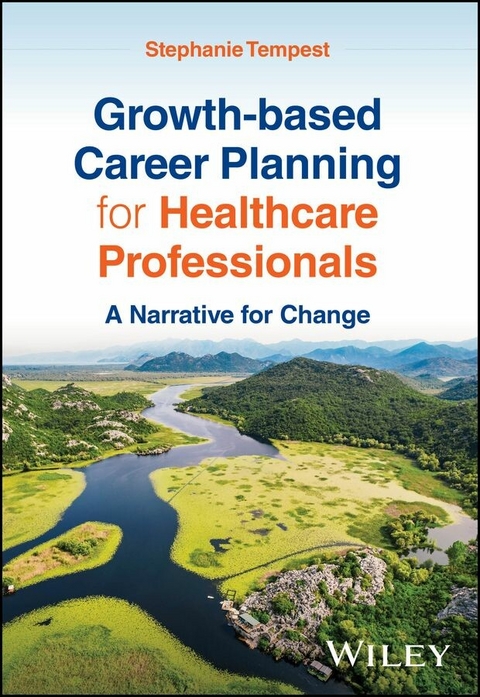
Growth-based Career Planning for Healthcare Professionals (eBook)
393 Seiten
Wiley (Verlag)
978-1-394-23250-5 (ISBN)
Reimagines career development to empower healthcare professionals to grow across sectors and settings
With retention rates continuing to challenge the sector-not only among newly qualified professionals-Growth-based Career Planning for Healthcare Professionals offers a timely re-evaluation of career development rooted in contemporary workforce issues. This innovative book shifts the focus from outdated promotion-based models toward a perspective that values diverse roles, experiences, and aspirations, introducing a new narrative that emphasises opportunity, agency, and actionable insights for practitioners, managers, and leaders alike.
Inviting readers to think more holistically about their career journeys within the health and care ecosystem, Growth-based Career Planning for Healthcare Professionals:
- Provides practical strategies for implementing inclusive career development across the four pillars of practice: clinical practice, leadership, education, and research
- Highlights the connection between career planning, well-being, and workforce sustainability
- Explores real-world applications of the Kawa model to support personal and professional growth
- Features reflective, solution-focused questions to guide individual and organisational action planning
- Offers narrative-driven insights into the career journeys of diverse health and care professionals
- Addresses wider structural and cultural dynamics, offering strategies to foster equity and diversity as part of a humanistic approach to workforce development
Supporting person-centred workforce development through adaptable models applicable across sectors and settings, Growth-based Career Planning for Healthcare Professionals: A Narrative for Change serves as a vital resource for all healthcare practitioners, line managers, operational leaders, and strategic workforce planners across sectors. It is ideal for pre-registration learners (students and apprentices) in healthcare, particularly in modules related to workforce development, professional practice, career development, and leadership.
Stephanie Tempest, PhD, is an Occupational Therapist and Learning and Workforce Development Consultant with nearly three decades of experience across neurorehabilitation, academia, and national healthcare leadership. She is the director of Stephanie Tempest Consultancy Ltd and co-director of The Creative Health Alliance.
Reimagines career development to empower healthcare professionals to grow across sectors and settings With retention rates continuing to challenge the sector not only among newly qualified professionals Growth-based Career Planning for Healthcare Professionals offers a timely re-evaluation of career development rooted in contemporary workforce issues. This innovative book shifts the focus from outdated promotion-based models toward a perspective that values diverse roles, experiences, and aspirations, introducing a new narrative that emphasises opportunity, agency, and actionable insights for practitioners, managers, and leaders alike. Inviting readers to think more holistically about their career journeys within the health and care ecosystem, Growth-based Career Planning for Healthcare Professionals: Provides practical strategies for implementing inclusive career development across the four pillars of practice: clinical practice, leadership, education, and research Highlights the connection between career planning, well-being, and workforce sustainability Explores real-world applications of the Kawa model to support personal and professional growth Features reflective, solution-focused questions to guide individual and organisational action planning Offers narrative-driven insights into the career journeys of diverse health and care professionals Addresses wider structural and cultural dynamics, offering strategies to foster equity and diversity as part of a humanistic approach to workforce development Supporting person-centred workforce development through adaptable models applicable across sectors and settings, Growth-based Career Planning for Healthcare Professionals: A Narrative for Change serves as a vital resource for all healthcare practitioners, line managers, operational leaders, and strategic workforce planners across sectors. It is ideal for pre-registration learners (students and apprentices) in healthcare, particularly in modules related to workforce development, professional practice, career development, and leadership.
About the Author – in Three Forms
To introduce myself, I have taken three approaches. The first is a traditional style ‘About the author’ and the second is a contemporary version of the same text. These are the only paragraphs in this book written with help from artificial intelligence (AI) – mainly because I find writing about myself in this way to be deeply uncomfortable, as I know many of us do. The final ‘About the author’ version is real and, like the rest of this book, is written by human beings.
A traditional ‘About the author’ (with the help of AI)
‘Dr Stephanie Tempest, PhD, MSc, PGCert LTHE, BSc (Hons), Chartered FCIPD, is an experienced occupational therapist, allied health professional and learning and development consultant. With nearly 30 years of experience in healthcare, she has worked across neurorehabilitation practice, academia, research and national strategic leadership roles.
Stephanie is the founder and director of stephanie tempest consultancy ltd and co‐founder and co‐director of The Creative Health Alliance, where she champions workforce development, learning, health and well‐being. She has published extensively in peer‐reviewed journals and presents regularly at national and international conferences.
She is the co‐author of Neuropsychology for Occupational Therapists and Supervision for Occupational Therapists.
All of the above is true and I gain a great sense of value, identity, purpose and joy from what I do. But it does not capture who I am or the reality of my context which warrants an alternative ‘About the author’.
An alternative ‘About the author’ (with the help of AI)
An alternative ‘About the author’ would contain the previous paragraphs that outline what I have done so far in my career but would also include a bit more about me as a person, including my life outside of work. I've still used AI to write this as there are large chunks of it that make me a bit squeamish! So, the alternative version of ‘About the author’ could include an additional paragraph:
‘Stephanie – who prefers to go by Steph – has built a career that defies traditional trajectories, choosing to explore diverse roles across the healthcare ecosystem rather than climbing a conventional ladder. A devoted parent to teenage sons, as well as a dedicated sister, daughter, niece, cousin, friend, and dog‐owner, she values the harmony between work and life, embracing both with purpose and passion. While her career path has not been without challenges, it has allowed her to contribute in ways that bring deep meaning and satisfaction. Her writing reflects this rich, multifaceted journey, offering insight, authenticity, and heart’.
The real ‘About the author’ (written by me)
The real ‘About the author’ is more of a long read and I have chosen to include it because I believe that, as human beings, we are wired for connection. I want you to have a sense of where I am coming from and what may sit underneath some of the views and interpretations that I will share with you. This version describes me and my career so far, as the imperfect and often unplanned human story that it is.
As you read it, notice the key things that spring to mind. These could be things that you relate to from your own experience or things that jump out as different. I've used sub‐headings to capture my key learning points about career planning so far, including:
- The value of life and work experience
- Career decisions are not made in isolation of life outside of work
- From failure comes opportunity
- Being in the right place at the right time
- Growth across the four strands of practice (clinical, education, leadership, research)
- Striving for better life–work integration
- Keeping an open mind.
Steph's Career River So Far
The Value of Life and Work Experience
My career river started to flow in the late 1980s and early 1990s. While at school and sixth‐form college, I had various paid part‐time jobs including as a childminder, a waitress, a factory worker, a cook in a convent and as a ‘Saturday girl’ at the local branch of a national stationery store. I had several voluntary roles within the church, as a charity fundraiser and at the Scouts. These roles taught me many transferable skills which I brought into my career including time management, organisational skills, team‐working, customer service skills, communication and negotiation skills (especially when trying to get young children to go to their beds!). I met people from a wide range of backgrounds, and I learnt from many valuable life experiences.
I then went to university to study occupational therapy. I decided I wanted a holiday job within a health or care setting, so I wrote to many local service providers to see if anything was available. There was, and I spent every holiday working in a doctor's surgery, supporting the transition from paper records to an early form of electronic tagging (this was the mid‐1990s). It gave me invaluable experience within a health setting and I learnt to respect the importance of confidentiality, to read doctor’s notes, make sense of medical language and terminology, understand the value of accurate data and be part of a quality service improvement project.
Career Decisions Are Not Made in Isolation of Life Outside of Work
My career as a registered occupational therapist officially started on 1 September 1997 at a large general hospital in the south of England. I chose to work there for many reasons. I wanted a rotational post, so I could spend six months in different clinical areas (I wasn't sure what specialism I wanted to work in or indeed if I wanted to specialise in any area). I chose to work in a hospital because I had limited awareness there were other places where I could work. I wanted to work for the National Health Service (NHS) because I had been fortunate to receive an NHS bursary which funded a large part of my studies. I chose to work in the south of England because I carried a lot of student debt – the move meant I could live back at home with mum and dad for a while. My very lovely boyfriend also lived in the area.
Fast forward a few years and while still very lovely, things didn't work out on the romantic front. I found myself newly single and with a world of opportunities at my feet, so I moved to the bright lights of the capital city. Through my rotational work experience, I had discovered a new work love for the specialism of neurology and neurosciences. After a few rejected applications, I secured an exciting promotion to work in a regional neurorehabilitation unit. I was off. For the next five years or so, I worked in different clinical roles – some were lateral moves at the same grade, so I could gain experience in different hospitals, others were promotions within the same hospital as opportunities arose. I grew from every challenge and every experience, both professionally and personally.
From Failure Comes Opportunity (especially if you are blessed with a brilliant line manager)
Another subsequent failed job application, for a very specialist job in another neuro‐disability hospital, proved to ultimately divert my career river in a direction I hadn't anticipated. I really wanted that job and it hurt me that I didn't get it. So, I will always be grateful to my line manager, who at the time was also the head occupational therapist of a large team at the north London hospital where I worked. Even though I worked in a different building, when I told her (by email) that I hadn't been successful in the job interview, she took time out of her very busy day to come and find me in person. Less than 30 minutes later, I sat feeling elated at her proposal. She recognised I was ambitious and knew how much I loved to learn, develop and grow. If I stayed, she would support me to study for my master’s degree (as she had for other therapists). Of equal importance, I felt cared for and valued at what was a low point in my career. The following September, I started studying part‐time for my master’s in neurorehabilitation. At the same time, a physiotherapy colleague, Cherry Kilbride, started doing an action research project in part fulfilment for her doctoral‐level studies. I was invited to be one of her research participants. You'll meet Cherry later in this book (now Professor Cherry Kilbride) – she is one of our storytellers and for nearly 25 years has been a trusted friend.
Being in the Right Place at the Right Time
I completed my master's degree and, in the process, fell in love with research. I'd learnt a lot from being a research participant in Cherry's study, including the power of action research as a methodology. I wanted to grow the research element of my own career, but this was at a time when there were huge rocks in the way – clinical academic posts for all health and care professionals were not widely available and the scope for research in practice was very limited. Apart from Cherry, whose circumstances were unique to her, I couldn't see anyone else working clinically while doing research, so...
| Erscheint lt. Verlag | 2.12.2025 |
|---|---|
| Sprache | englisch |
| Themenwelt | Medizin / Pharmazie ► Pflege |
| Schlagworte | career planning healthcare • healthcare career growth • healthcare professional development • healthcare workforce development • health sector retention • inclusive healthcare workforce planning • Kawa model healthcare • leadership in healthcare |
| ISBN-10 | 1-394-23250-0 / 1394232500 |
| ISBN-13 | 978-1-394-23250-5 / 9781394232505 |
| Informationen gemäß Produktsicherheitsverordnung (GPSR) | |
| Haben Sie eine Frage zum Produkt? |
 EPUB (Adobe DRM)
Kopierschutz: Adobe-DRM
Adobe-DRM ist ein Kopierschutz, der das eBook vor Mißbrauch schützen soll. Dabei wird das eBook bereits beim Download auf Ihre persönliche Adobe-ID autorisiert. Lesen können Sie das eBook dann nur auf den Geräten, welche ebenfalls auf Ihre Adobe-ID registriert sind.
Details zum Adobe-DRM
Dateiformat: EPUB (Electronic Publication)
EPUB ist ein offener Standard für eBooks und eignet sich besonders zur Darstellung von Belletristik und Sachbüchern. Der Fließtext wird dynamisch an die Display- und Schriftgröße angepasst. Auch für mobile Lesegeräte ist EPUB daher gut geeignet.
Systemvoraussetzungen:
PC/Mac: Mit einem PC oder Mac können Sie dieses eBook lesen. Sie benötigen eine
eReader: Dieses eBook kann mit (fast) allen eBook-Readern gelesen werden. Mit dem amazon-Kindle ist es aber nicht kompatibel.
Smartphone/Tablet: Egal ob Apple oder Android, dieses eBook können Sie lesen. Sie benötigen eine
Geräteliste und zusätzliche Hinweise
Buying eBooks from abroad
For tax law reasons we can sell eBooks just within Germany and Switzerland. Regrettably we cannot fulfill eBook-orders from other countries.
aus dem Bereich