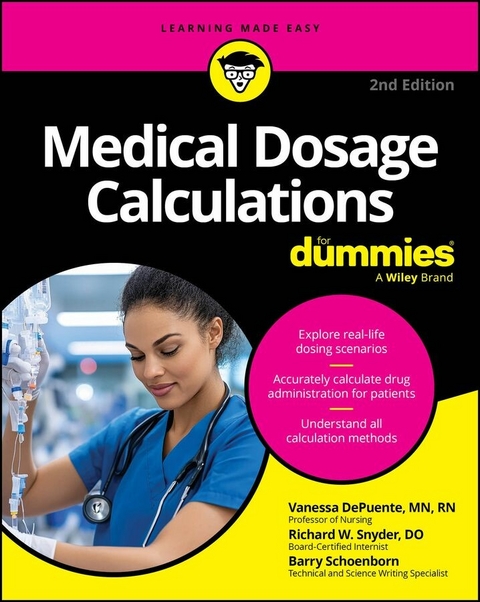
Medical Dosage Calculations For Dummies (eBook)
490 Seiten
For Dummies (Verlag)
978-1-394-37585-1 (ISBN)
An accurate and easy-to-read resource for students in medical dosage calculation classes
Medical Dosage Calculations For Dummies, 2nd Edition is an accurate guide to dosage calculation that tracks to standard course curricula. It's an easy-to-follow supplementary resource for students of nursing, pharmacology, paramedic programs and beyond, walking you through ratio-proportion, formula, and dimensional analyses for a wide variety of medication types.
You'll learn how medications are given, to whom, and how to chart accurately and clearly. You'll also discover how to handle the processes and language of medical dosing, as well as how to navigate the electronic medical records (EMRs) and electronic health records (EHRs).
Inside:
- Brush up on your math
- Understand the best practices in medical administration, including needle insertion instructions
- Discover evidence-based practice guidelines and methods
Perfect for students currently taking a medical dosage calculations class, Medical Dosage Calculations For Dummies is also a great resource for working professionals interested in brushing up on the fundamentals.
Vanessa DePuente, MN, RN, is the Interim Associate Dean of the Nursing Program at Everett Community College.
Richard W. Snyder, DO, is an internist and nephrologist who has been in clinical practice since 2004.
Barry Schoenborn is a long-time math, science, and technical writer. He is an author or co-author of numerous For Dummies books.
An accurate and easy-to-read resource for students in medical dosage calculation classes Medical Dosage Calculations For Dummies, 2nd Edition is an accurate guide to dosage calculation that tracks to standard course curricula. It's an easy-to-follow supplementary resource for students of nursing, pharmacology, paramedic programs and beyond, walking you through ratio-proportion, formula, and dimensional analyses for a wide variety of medication types. You'll learn how medications are given, to whom, and how to chart accurately and clearly. You'll also discover how to handle the processes and language of medical dosing, as well as how to navigate the electronic medical records (EMRs) and electronic health records (EHRs). Inside: Brush up on your math Understand the best practices in medical administration, including needle insertion instructions Discover evidence-based practice guidelines and methods Perfect for students currently taking a medical dosage calculations class, Medical Dosage Calculations For Dummies is also a great resource for working professionals interested in brushing up on the fundamentals.
Chapter 1
Brushing Up on Your Math Skills and Entering the Healthcare Field
IN THIS CHAPTER
Looking at the basics of medical math and dosage calculations
Taking a look at healthcare careers and the need for math
Remembering the importance of compassion, empathy, and other important skills
If you’re a healthcare professional (or planning to be one), you’re in one of the most important careers around today. In essence, you help healthy people stay healthy and you help sick people get well. You also help people with critical health conditions manage their illness and maintain quality of life. Of course, nursing and all health professions involve more than just calculating and administering medications. They’re vocations for comforting the sick and injured — clearly they involve much more than just “pushing meds.”
Being a successful healthcare provider means being an able mathematician. After all, the field of medicine relies extensively on administering medications, and you must be able to calculate meds correctly before you dispense them. In any healthcare education program, medical dosage calculations come up in practically every course (or they should). In addition, many schools of nursing have an entire course devoted to medical dosage calculations.
In this chapter, we introduce you to the math you need to know to perform basic and complex medical dosage calculations. We also provide an overview of the different careers available in the healthcare field (and show you how they all use medical math). Finally, we go beyond math and focus on the other essential components of being a good healthcare provider.
Florence Nightingale was a nurse with a great gift for mathematics. She was a pioneer in presenting information visually — especially health statistics. She has been recognized for developing a form of the pie chart now known as the polar area diagram.
Knowing What Math You Need to Know in Healthcare
In healthcare, you need to know the following three kinds of dosing math:
- School math: The math you learn to pass tests while getting an education
- NCLEX (National Council Licensure Examination) math: The math you learn to get your license
- Real-world math: The math you use to handle your job
It’s true; you’ll sometimes find questions on tests in school or in practicing for the NCLEX that may never come up in real life, but you still need to be prepared for those questions. Conversely, real life will surely present you with math problems that you never practiced in school. In this section, we cover the math concepts and calculation methods you need to know to be prepared for just about any scenario in healthcare.
Never despair about medical dosage calculations. Each principle in this book is easy if you look at it the right way. Medical dosing math isn’t harder than you think; it’s actually easier!
Nailing down basic arithmetic
Nursing and related professions require basic math skills, but don’t worry if math hasn’t always been your favorite subject in school. The best part about medical math is that it’s easy to identify just how much math you need to know.
Basic math is essentially just arithmetic — addition, subtraction, multiplication, and division. And you mostly use multiplication and division in your dosage calculations. But don’t forget that counting is math, too. For example, when you count out 4 tablets, you’re doing addition ().
In case you missed some of what you need to know math-wise in school, we cover the most important principles in Chapters 2 through 4.
Fiddling with fractions in four forms
Medical dosage calculations use fractions 90 percent of the time (or 9/10 of the time or in a 9:1 ratio). In case you’re wondering, all those phrases mean the same thing.
The four forms a fraction can take are:
- Common fraction (also called a vulgar fraction):
- Decimal fraction: 0.56 mL
- Percent fraction: 0.9% normal saline (NS)
- Ratio: 1:9
Of these four types, you use only two (common fractions and decimal fractions) to do most of the work in your dosage calculations.
Conquering the calculation methods
A word to the wise about the complex math used in this book: there isn’t any. All the math used in medical dosage calculations is very simple. For example, one of the most common calculations you see in dosing problems is unit conversion. To convert units, you just have to know how to use some simple formulas, called conversion factors, like 1 kg (kilogram) = 2.2 lb (pounds). You use conversion factors mostly to convert mass (weight) and liquid volumes. Chapter 4 explains everything you need to know about units and conversion.
As far as figuring out drug dosage and administration, you use the following three basic calculation methods: the formula method, the ratio-proportion method, and the dimensional analysis method. Chapter 8 walks you through each method and shows you when and how to use it.
The following problem is an example of some of the math you have to do when calculating medical dosages. It uses the ratio-proportion method (see Chapter 8 for more details).
If 250 mg are in 5 mL and you need to give 333 mg, what’s the dose in mL?
To find out, follow these steps:
- Set up the following proportion:
- Cross-multiply and solve.
The answer is 6.66 mL. You give 6.7 mL to provide the needed 333 mg.
Calculations with multiple steps may look complex, but they aren’t because the math involved in each step is fairly simple. For example, when you calculate a weight-dependent dosage that you must administer intravenously, your calculations typically follow this pattern:
- Convert the patient’s weight from lb (pounds) to kg (kilograms).
- Determine the number of mg (milligrams) of the med to give for that body weight.
- Because the med is in a liquid suspension, calculate the mL that contain the number of mg you need to give.
- Because intravenous (IV) meds are often ordered to be dosed per min (minute) but are infused in mL/hr (milliliters per hour), calculate the flow rate by converting from mL/min (milliliters per minute) to mL/hr so you can program an electronic infusion pump.
MEASURING PRECISELY IS HALF THE BATTLE
After you calculate a dose accurately, you must dispense it accurately. Sometimes accurate dispensing is as simple as counting out the right number of tablets. However, many doctors’ orders call for administering liquid volumes via injections and intravenous (IV) infusions. When administering liquid volumes, accurate dispensing means measuring exactly the amount of the med you need and drawing it up into the syringe.
When you give a med intravenously, you usually dispense it over time. For IV administration, you must calculate accurate IV flow rates and/or drip rates and then set them accurately (see Chapter 11 for details).
Living in a metric world
Dosing medications — whether you’re working in a hospital, clinic, rehab center, or home setting — is built on the metric system. Don’t start panicking — because the metric system is based on a system of tens, it’s easy to learn and to use.
For a long time, medicine used an older system (once called the English system) with units like lb (pounds) and fl oz (fluid ounces). Medicine also used the obsolete apothecaries’ system with units such as the grain, dram, and scruple. The United States still commonly uses its household system, which includes units like fl oz (fluid ounces) and Tbsp (tablespoons), but it does so mostly in the kitchen, not the hospital.
Because the older systems haven’t disappeared completely, be aware that you sometimes have to convert units from one system to units of another. (See Chapter 4 for tons more details on units and conversion.)
Tools of the Trade for Dosing Meds
It goes without saying, so we’ll say it, but accurate dosing is vital in the healthcare profession. It’s a good thing the math isn’t hard, because there’s no room for error. After all, the practice of medicine relies primarily on medications to get healing done, so errors in dosage calculations can mean critical errors in patient health and safety.
Following are three tools of the trade that help you do medical dosing calculations accurately every time:
- Undivided attention: Anyone who works in healthcare knows how busy the day can get. When you’re dealing with medications, especially when you’re performing medical dosage calculations, your undivided attention is paramount to reducing the chance of any dosing error. Take the time to double-check your calculations. The most important mathematical tool you have is your mind.
- Calculator: When you’re dealing with decimals, percentages, and complex calculations, you have tools that are more reliable than your fingers and a pen and paper. You need a calculator to do more complex calculations. There’s one on your smartphone and there are plenty of calculators on the...
| Erscheint lt. Verlag | 25.11.2025 |
|---|---|
| Sprache | englisch |
| Themenwelt | Medizin / Pharmazie ► Allgemeines / Lexika |
| Schlagworte | medical dosage calculation best practices • Medical dosage calculation book • medical dosage calculation examples • medical dosage calculation guide • medical dosage calculation processes • medical dosage calculation terminology • nursing guide |
| ISBN-10 | 1-394-37585-9 / 1394375859 |
| ISBN-13 | 978-1-394-37585-1 / 9781394375851 |
| Informationen gemäß Produktsicherheitsverordnung (GPSR) | |
| Haben Sie eine Frage zum Produkt? |
 EPUB (Adobe DRM)
Kopierschutz: Adobe-DRM
Adobe-DRM ist ein Kopierschutz, der das eBook vor Mißbrauch schützen soll. Dabei wird das eBook bereits beim Download auf Ihre persönliche Adobe-ID autorisiert. Lesen können Sie das eBook dann nur auf den Geräten, welche ebenfalls auf Ihre Adobe-ID registriert sind.
Details zum Adobe-DRM
Dateiformat: EPUB (Electronic Publication)
EPUB ist ein offener Standard für eBooks und eignet sich besonders zur Darstellung von Belletristik und Sachbüchern. Der Fließtext wird dynamisch an die Display- und Schriftgröße angepasst. Auch für mobile Lesegeräte ist EPUB daher gut geeignet.
Systemvoraussetzungen:
PC/Mac: Mit einem PC oder Mac können Sie dieses eBook lesen. Sie benötigen eine
eReader: Dieses eBook kann mit (fast) allen eBook-Readern gelesen werden. Mit dem amazon-Kindle ist es aber nicht kompatibel.
Smartphone/Tablet: Egal ob Apple oder Android, dieses eBook können Sie lesen. Sie benötigen eine
Geräteliste und zusätzliche Hinweise
Buying eBooks from abroad
For tax law reasons we can sell eBooks just within Germany and Switzerland. Regrettably we cannot fulfill eBook-orders from other countries.
aus dem Bereich