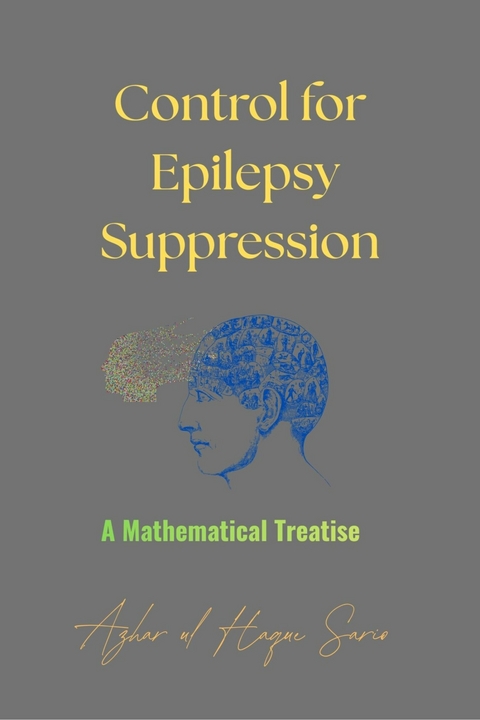
Control for Epilepsy Suppression (eBook)
198 Seiten
Azhar Sario Hungary (Verlag)
978-3-384-76429-4 (ISBN)
What if we could finally stop epilepsy not by cutting the brain or drowning it in drugs, but by speaking its own mathematical language?
This book is the first to treat epilepsy as a pure control-engineering problem. It starts with your brain as a living graph-nodes, wires, white-matter highways-and shows exactly how seizures follow the hidden roads revealed by spectral graph theory and the Laplacian eigenvalue λ₂. It moves into dynamic linear state-space models that let us watch effective connectivity change second by second. Then it dives deep into the famous Epileptor equations, explaining in plain terms how the slow 'permittivity' variable z quietly drags the brain across a bifurcation into chaos, and why ordinary EEG misses the vital DC shifts that announce the coming storm.
You'll meet Kuramoto oscillators that explain hypersynchrony, Lyapunov exponents that measure the terrifying loss of complexity before a seizure, critical slowing down as nature's universal early-warning signal, Kalman filters that let implants 'see' hidden deep foci, network controllability Gramians that reveal which single electrode can rule the whole network, and real optimal-control recipes (LQR, MPC, sparse LASSO control) that stop seizures with the absolute minimum current-protecting both battery and brain tissue. Every chapter gives you the core formulas, biological meaning, and practical ways to turn theory into tomorrow's closed-loop neurostimulators.
No other book bridges the gap like this. Popular epilepsy books stay at the patient-story or drug level. Classic neuroscience texts stop at beautiful models but never reach actual control design. Engineering control books ignore the wet, plastic, chaotic reality of brain networks. This one refuses to choose sides: it drags spectral graph theory, bifurcation analysis, phase-locking metrics, chaos measures, and modern network control theory into the epilepsy clinic and shows-step by step, equation by equation-how to build devices that predict, prevent, and gently abort seizures instead of just reacting when it's almost too late. It is written for neurologists who want to understand the math, for engineers who want to save patients, and for researchers who believe the next revolution in epilepsy treatment will be mathematical.
© 2025 Azhar ul Haque Sario. This book is an independently produced scholarly work created under nominative fair use and fair comment provisions. It has no affiliation with any medical board, university, manufacturer, or regulatory body. All models and methods are presented for scientific and educational
The Rhythm of Rebellion: Kuramoto Dynamics and Synchronization
The Mathematics of the Mob: When the Brain Starts Chanting
To understand the chaos of a seizure, we first have to unlearn a common misconception: we tend to think of seizures as "electrical storms," implying random, noisy violence.
But a seizure isn't noise. It is the opposite. It is hyper-order.
Imagine a bustling jazz club. The saxophone is improvising, the drummer is off-beat, the piano is exploring a new chord. It sounds chaotic, but it is rich, complex, and functional. This is your healthy brain.
Now, imagine that abruptly, every single musician stops playing their song and begins slamming a single note, in perfect unison, at maximum volume. Bang. Bang. Bang.
That is a seizure. It is the moment the complex democracy of the brain collapses into a totalitarian chant. To understand how this happens, we turn to the Kuramoto Model—the mathematical story of how individuals surrender to the mob.
Part 1: The Cast of Characters
The Kuramoto model treats the brain not as a computer, but as a collection of oscillators—things that cycle over and over again, like a pendulum, a firefly, or a neuron.
To solve the mystery of the mob, we have to meet the three distinct personalities vying for control inside your head.
1. The Runner: The Phase (θi)
"Where am I?" Imagine a runner on a circular track. The variable θ (theta) is simply where they are on that loop.
In the Brain: It represents the neuron's specific moment in its firing sequence. Is it resting? Is it charging up? Is it spiking?
2. The Ego: Natural Frequency (ωi)
"I want to run at my own pace." Left to their own devices, every neuron has a preferred speed. This is ω (omega).
The Healthy Conflict: In a vibrant brain, you want disagreement. You want the visual cortex running at a different speed than the auditory cortex. Diversity of speed creates complexity of thought.
3. The Peer Pressure: Coupling Strength (K)
"Do what everyone else is doing." This is the villain and the hero of our story. K represents how much attention a neuron pays to its neighbors.
The Balance: If K is too low, the neurons ignore each other (coma/confusion). If K is too high, the neurons lock together (seizure).
Part 2: The Tug of War
The mathematical equation that governs this behavior is a literal tug-of-war. It calculates the "velocity" of a neuron—how fast it is moving around the track.
θ˙i=ωi+NKj=1∑Nsin(θj−θi)
Let’s translate this from math into human behavior.
The Drive for Independence (ωi): The first part of the equation says: "I am going to move at my own speed." If there were no connection to others, this is all that would matter.
The Social Pull (NK∑sin(…)): The second part says: "But I am being pushed and pulled by the crowd."
If my neighbor is ahead of me, the math pulls me forward to catch up.
If my neighbor is behind me, the math drags me back to wait for them.
The Insight: Every millisecond, your neurons are fighting a battle between their Ego (ω) and the Peer Pressure (K). In a seizure, the peer pressure wins. The voice of the individual is drowned out by the shout of the group.
Part 3: The Watcher on the Wall
How do we know who is winning? We use a mathematical tool called the Order Parameter, denoted as r(t). Think of this as the "Volume Knob" of the brain's synchronization.
r(t)eiψ(t)=N1j=1∑Neiθj(t)
Don't let the exponents scare you. Visualizing it is simple:
The Healthy Whisper (r≈0): Imagine a crowd pointing arrows in random directions. If you average them all out, they cancel each other. The net result is zero. The brain is humming quietly, processing a million different thoughts.
The Seizure Scream (r≈1): Imagine the crowd suddenly turning and pointing their arrows at the exact same target. They add up. The "volume" hits maximum.
Part 4: The Tipping Point (The Millennium Bridge)
The scariest thing about the Kuramoto dynamics is that the change isn't gradual—it is a Phase Transition. It happens in the blink of an eye.
The most famous real-world example isn't in a brain, but on a bridge.
In 2000, the Millennium Bridge opened in London. As thousands of people walked across, the bridge began to sway slightly. To keep their balance, pedestrians unconsciously adjusted their steps to match the sway.
The Sway acted as the Coupling Strength (K).
The Steps synchronized.
The Result: The more they synchronized, the harder the bridge swayed. The harder it swayed, the more they synchronized.
Within minutes, a crowd of strangers locked into a terrifying, unified march. The bridge had a seizure. In epilepsy, the "sway" is the electric field. Once it gets strong enough, neurons have no choice but to march to the beat.
Part 5: The "Chimera" and The Fatigue
Modern computational neuroscience has found two fascinating wrinkles in this story that give us hope.
1. The Chimera State
For years, we thought the brain was either Sync (Seizure) or Async (Healthy). Recently, simulations revealed the Chimera State: a ghostly condition where half the brain is seizing, and the other half is normal. This perfectly models focal seizures. It is a "partial rebellion," where a rogue neighborhood starts a riot while the rest of the city goes about its business. Detecting these "fractures" in the network is the new frontier of prediction.
2. Why the Riot Stops (The Fatigue Hypothesis)
Why doesn't a seizure last forever? In our simulations, we view the "Natural Frequency" (ω) not as a constant, but as a battery.
The seizure starts.
Neurons fire rapidly, chanting in unison.
They get tired. They run out of metabolic energy.
Their "Ego" slows down. They can no longer keep up with the fast pace of the mob.
The synchronization breaks.
The rebellion fails because the rebels exhaust themselves.
Conclusion: The Beauty of Chaos
The Kuramoto model teaches us a profound philosophical lesson about our own biology. We usually crave order and structure in our lives. But inside our skulls, order is dangerous.
Health is a state of "metastability"—a delicate, dancing balance where we are synchronized enough to understand the world, but chaotic enough to remain individuals.
We need the noise. We need the jazz. Because when the noise stops and the chanting begins, the music is over.
The precarious Edge: Order, Chaos, and the Chimera
If you were to stand inside a living brain, it wouldn't sound like a well-oiled machine. It would sound like a crowded cocktail party. Thousands of voices—neurons—are chattering away, each with its own rhythm, its own distinct pitch. This clamor, this "noise," is what keeps us alive. It is the sound of possibility.
But the brain is constantly fighting a gravitational pull toward a darker state. It exists on a knife-edge. Lean too far into chaos, and thoughts scatter like dust. Lean too far into order, and the cocktail party stops. Everyone starts chanting in unison. The clamor becomes a roar. This is the seizure.
In the physics of the brain, we study this battle using the Kuramoto model, specifically focusing on the moment the battle is lost: the Phase Transition.
7.2 The Cliff Edge: Phase Transitions and the Cost of Perfection
We tend to think of disease as a gradual decline. But in nonlinear dynamics, the brain behaves less like a dimmer switch and more like water turning to ice. One moment it flows; the next, it is solid. This is the Phase Transition.
The governor of this transition is a parameter called Coupling Strength (K). Think of K as "peer pressure" between neurons. It is the force that encourages them to sync up.
There is a mathematical line in the sand, a specific threshold called Critical Coupling (Kc).
Safety Zone (K<Kc): The neurons listen to each other but keep their own rhythm. We are conscious.
The Danger Zone...
| Erscheint lt. Verlag | 26.11.2025 |
|---|---|
| Reihe/Serie | The Body by Numbers Bio Code |
| Sprache | englisch |
| Themenwelt | Medizin / Pharmazie ► Medizinische Fachgebiete ► Neurologie |
| Schlagworte | closed loop neurostimulation • epilepsy control theory • Epileptor model • network controllability • optimal brain stimulation • seizure prediction • Spectral Graph theory |
| ISBN-10 | 3-384-76429-3 / 3384764293 |
| ISBN-13 | 978-3-384-76429-4 / 9783384764294 |
| Informationen gemäß Produktsicherheitsverordnung (GPSR) | |
| Haben Sie eine Frage zum Produkt? |
 EPUB (Ohne DRM)
Digital Rights Management: ohne DRM
Dieses eBook enthält kein DRM oder Kopierschutz. Eine Weitergabe an Dritte ist jedoch rechtlich nicht zulässig, weil Sie beim Kauf nur die Rechte an der persönlichen Nutzung erwerben.
Dateiformat: EPUB (Electronic Publication)
EPUB ist ein offener Standard für eBooks und eignet sich besonders zur Darstellung von Belletristik und Sachbüchern. Der Fließtext wird dynamisch an die Display- und Schriftgröße angepasst. Auch für mobile Lesegeräte ist EPUB daher gut geeignet.
Systemvoraussetzungen:
PC/Mac: Mit einem PC oder Mac können Sie dieses eBook lesen. Sie benötigen dafür die kostenlose Software Adobe Digital Editions.
eReader: Dieses eBook kann mit (fast) allen eBook-Readern gelesen werden. Mit dem amazon-Kindle ist es aber nicht kompatibel.
Smartphone/Tablet: Egal ob Apple oder Android, dieses eBook können Sie lesen. Sie benötigen dafür eine kostenlose App.
Geräteliste und zusätzliche Hinweise
Buying eBooks from abroad
For tax law reasons we can sell eBooks just within Germany and Switzerland. Regrettably we cannot fulfill eBook-orders from other countries.
aus dem Bereich