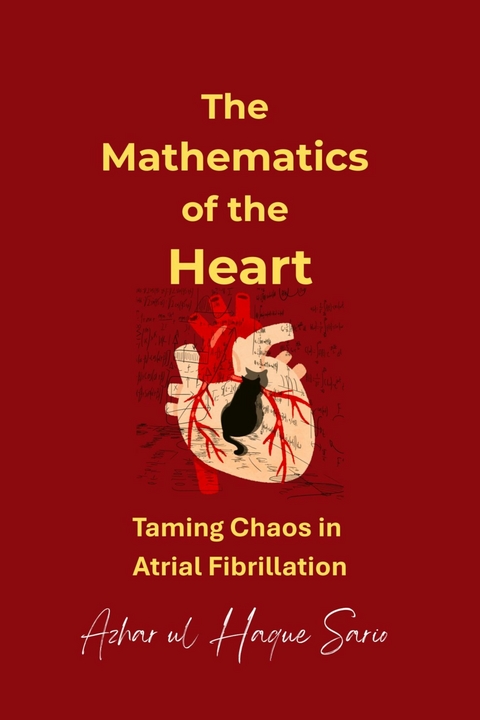
The Mathematics of the Heart (eBook)
192 Seiten
Azhar Sario Hungary (Verlag)
978-3-384-76322-8 (ISBN)
Discover the Hidden Math Behind a Beating Heart
Hey there, if you've ever wondered why hearts go haywire in atrial fibrillation (AF), this book breaks it down like a friendly chat over coffee. It starts with the basics: the heart as a biological oscillator gone chaotic. We dive into the monodomain equation that models electrical waves in cardiac tissue. Anisotropy in fiber directions stabilizes those tricky scroll waves. Ionic currents like sodium and potassium drive the nonlinear reactions. Patient-specific meshes from MRI scans bring virtual atria to life. Fractional diffusion handles fibrotic delays better than standard models. Inverse problems map conductivity to spot slow zones. Ablation tweaks boundaries to shrink reentry areas. Restitution curves explain why fast rates lead to wavebreaks. Slopes over 1 trigger alternans and rotors. Dynamic pacing builds slope maps in the lab. Drugs flatten curves to prevent chaos. Phase singularities define rotor cores with topological charge. Hilbert transforms extract phases from signals. Filaments in 3D twist through walls. Eikonal equations approximate wavefront speeds with curvature effects. Fast marching methods simulate activations quickly. Entropy quantifies signal disorder in complex electrograms. High entropy flags rotor pivots. Frequency hierarchies reveal dominant drivers via Fourier analysis. Gradients show mother rotors overdriving tissue. Drift equations predict rotor movement toward scars. Percolation theory explains fibrosis thresholds for zig-zag conduction. Fractal dimensions measure scar roughness for anchoring risks. Graph theory finds minimum cuts to break circuits. Hopf bifurcations model triggers like early afterdepolarizations. Bioheat equations govern ablation heating. Bayesian inference guides decisions under uncertainty. Optimization minimizes ablation costs. Digital twins integrate multi-physics for personalized sims.
What sets this book apart is its laser focus on math as the cure, not just a tool-other books skim the surface with biology or procedures, but here we connect equations directly to clinical wins, like using topology to pinpoint rotors or percolation to homogenize scars. No fluff; it's a roadmap from chaos theory to bedside, filling gaps in fragmented texts by weaving non-linear dynamics, simulations, and real-world apps into one cohesive story. You'll get why empirical ablations fail and how computational engineering triumphs, with fresh insights from recent models that outdated books miss.
This book is independently produced under nominative fair use. The author has no affiliation with any board or entity mentioned.
The Fractal Geometry — The Hausdorff Dimension
The Cartographer of the Heart
If you zoom in on a map of Great Britain, a strange thing happens. You measure the island with a mile-long ruler, and you get a number. But if you swap that ruler for a yardstick, you suddenly discover inlets you missed before. Swap that for a micrometer, and you are measuring the jagged edge of every pebble.
The closer you look, the longer the coastline gets. It stretches toward infinity.
This is the Coastline Paradox. It is a quirk of math, but unfortunately for us, it is also a quirk of biology. Because inside your chest, hidden in the dark, wet rhythmic chamber of the left atrium, there is a coastline.
And if that coastline gets too rough, it creates a storm that never ends.
I. The Ghost Dimension
We are taught that the world is made of simple shapes. A line is 1D. A sheet of paper is 2D. A box is 3D.
But nature hates perfection. Nature loves the jagged, the rough, the crumbled.
Think of a piece of paper crumpled into a ball. Is it still a flat 2D sheet? Not really. Is it a solid 3D ball? Not quite. It exists in the gray area between dimensions.
This is the Hausdorff Dimension (Df). It is the mathematical measure of "roughness."
Df≈1: A smooth line. A highway.
Df→2: A chaotic scribble. A sponge. A trap.
In the world of cardiology, this number is the difference between a heart that beats and a heart that quivers.
II. The Spiderweb and the Boulder
In a healthy heart, the cells are like a freshly paved autobahn. Electricity glides over them. It is smooth, fast, and synchronized.
But time, age, and high blood pressure act like potholes. The body tries to patch them with collagen. We call this fibrosis (scarring). But not all scars are created equal. The geometry of the scar determines your fate.
The Boulder (Replacement Fibrosis)
Imagine a large rock sitting in a stream. The water hits it and flows around it. This is the dense scar of a heart attack. It is a "boulder." It blocks electricity. It is simple. It is a wall.
The Web (Interstitial Fibrosis)
This is the silent killer. This is not a boulder; it is a briar patch. The scar tissue weaves distinct, microscopic threads between live muscle cells. It creates a fractal maze.
This is where the math turns deadly. When the scar is a "Web," the dimension (Df) shoots up. The coastline becomes infinitely complex.
III. The Storm in the Harbor
Why does this texture matter?
Imagine the electricity in your heart is a boat. In a healthy heart, the shoreline is smooth, and the boat sails past.
But in a heart riddled with fractal scarring, the shoreline is full of jagged hooks, deep bays, and twisting coves. The electrical wave gets caught in these "fingers." It enters a narrow channel of live tissue, hits a dead end, turns around, and tries to exit.
But by the time it exits the maze, the rest of the heart has reset. The wave sees an opening and spins back on itself.
The boat begins to circle in the harbor.
This is a Rotor. It is an electrical tornado.
The Sticky Trap
We used to think these tornados drifted randomly. We were wrong. Supercomputer simulations have revealed that high-fractal scars are magnetic. They possess Dynamical Anchoring.
The curvature of the spinning electrical wave perfectly matches the microscopic curvature of the jagged scar. The scar acts like a gear tooth, catching the tornado and locking it in place. The storm anchors itself to the roughness and spins forever.
IV. The View from the Cold Room
To understand the tragedy of this geometry, you have to stand next to the Electrophysiologist (EP).
You are in a cath lab—a room kept freezing cold to protect the equipment. You are wearing twenty pounds of lead armor. On the screen, you see the interior of a human heart.
You are looking for the short circuit. You are holding a catheter that burns tissue, trying to build a firebreak to stop the wildfire.
The Easy Case: The patient has a smooth heart (Df≈1.1). You burn a circle around the vein. The signal stops. The patient is cured.
The Fractal Heart: The patient has a textured heart (Df≈1.7). You place your sensor against the wall, and you don't hear a clean thump. You hear a hiss. A crackle. A "snowstorm."
This is the sound of electricity shattering through a fractal web.
If you try to burn the rotor, it doesn't die. It just jumps to the next hook in the web. You are trying to catch a ghost in a hall of mirrors. The roughness is everywhere, so the storm can live anywhere.
V. The Digital Twin
We are moving past the era of guessing. We are entering the era of the Digital Twin.
Soon, before a doctor ever touches a patient, we will scan their heart. We will feed that scan into a cloud algorithm that counts the boxes, measures the coastline, and calculates the Hausdorff Dimension.
We will build a virtual copy of your heart and set it on fire with virtual electricity.
If the computer sees that your "coastline" is too jagged, we won't just try to block the vein. We will see the landscape for what it is. We might burn lines to connect the fractal islands, smoothing out the coast. We will turn the chaotic web into a solid wall.
We will use geometry to tame the biology.
The Takeaway
The heart is not just a pump; it is a landscape.
For centuries, we treated arrhythmias like a mechanical failure. Now, we realize it is a topographical problem. The difference between a long life and a stopped heart is often hidden in the microscopic roughness of the edges.
We are finally learning how to read the map.
The Cartography of Chaos: Taming the Fractal Heart
In the dimly lit silence of the Electrophysiology (EP) lab, the monitor doesn’t just show a heart; it reveals a terrain. To the uninitiated, it’s a medical scan. To us, standing there in lead aprons, navigating a catheter through the femoral vein, the Left Atrium is a living landscape. It has smooth plains, rolling valleys, and—most dangerously—jagged, treacherous coastlines of scar tissue.
For years, we treated Atrial Fibrillation (AF) like a fire, hunting for the "sparks" (triggers) that usually ignite near the pulmonary veins. But in the most difficult cases, the problem isn't the spark. It’s the dry brush. It’s the substrate.
We are no longer just doctors; we are cartographers of chaos, using the mathematics of nature to predict the storms of the human heart.
I. The Math of Roughness: Why "Jagged" Matters
In the Euclidean geometry we learned in school, the world is tidy. A line is 1D; a square is 2D. But the human body rebels against straight lines. Disease is messy.
The scar tissue (fibrosis) in a sick heart isn't a perfect square. It is "fractal"—ragged, irregular, and self-similar, much like the coastline of Britain or the branching of a lightning bolt. To understand the danger a patient faces, we don't measure how big the scar is; we measure how rough it is.
The Coastline Paradox
Imagine water flowing around a smooth, polished rock. It glides effortlessly. Now, imagine water hitting a piece of coral with a thousand tiny inlets and sharp edges. The water gets trapped, swirls, and eddies.
This is exactly what happens to electricity in the heart.
Simple Fibrosis (Df≈1): Smooth edges. The electricity glides past.
Fractal Fibrosis (Df>1.3): Ragged, fingered edges. The electricity gets trapped in the bays and coves, spinning into the chaotic tornadoes we call "rotors."
To quantify this mess, we use the Fractal Dimension (Df):
Df=ϵ→0limlog(1/ϵ)logN(ϵ)
In this equation, we are calculating how the complexity of the scar scales as we look closer. It is the mathematical difference between a patient who goes home cured and one who returns to the ER in a week.
II. The Tipping Point: The Rule of 1.3
Diagnostic imaging has evolved from a photograph into a prophecy. Before we even touch the patient, we use Late Gadolinium Enhancement (LGE) MRI to create a "Complexity Score."
Software strips away the noise, leaving us with a...
| Erscheint lt. Verlag | 24.11.2025 |
|---|---|
| Reihe/Serie | The Body by Numbers Bio Code |
| Sprache | englisch |
| Themenwelt | Medizin / Pharmazie ► Medizinische Fachgebiete ► Innere Medizin |
| Schlagworte | ablation optimization • Atrial Fibrillation • cardiac chaos theory • computational electrophysiology • monodomain equation • Phase singularity • rotor mapping |
| ISBN-10 | 3-384-76322-X / 338476322X |
| ISBN-13 | 978-3-384-76322-8 / 9783384763228 |
| Informationen gemäß Produktsicherheitsverordnung (GPSR) | |
| Haben Sie eine Frage zum Produkt? |
 EPUB (Ohne DRM)
Digital Rights Management: ohne DRM
Dieses eBook enthält kein DRM oder Kopierschutz. Eine Weitergabe an Dritte ist jedoch rechtlich nicht zulässig, weil Sie beim Kauf nur die Rechte an der persönlichen Nutzung erwerben.
Dateiformat: EPUB (Electronic Publication)
EPUB ist ein offener Standard für eBooks und eignet sich besonders zur Darstellung von Belletristik und Sachbüchern. Der Fließtext wird dynamisch an die Display- und Schriftgröße angepasst. Auch für mobile Lesegeräte ist EPUB daher gut geeignet.
Systemvoraussetzungen:
PC/Mac: Mit einem PC oder Mac können Sie dieses eBook lesen. Sie benötigen dafür die kostenlose Software Adobe Digital Editions.
eReader: Dieses eBook kann mit (fast) allen eBook-Readern gelesen werden. Mit dem amazon-Kindle ist es aber nicht kompatibel.
Smartphone/Tablet: Egal ob Apple oder Android, dieses eBook können Sie lesen. Sie benötigen dafür eine kostenlose App.
Geräteliste und zusätzliche Hinweise
Buying eBooks from abroad
For tax law reasons we can sell eBooks just within Germany and Switzerland. Regrettably we cannot fulfill eBook-orders from other countries.
aus dem Bereich