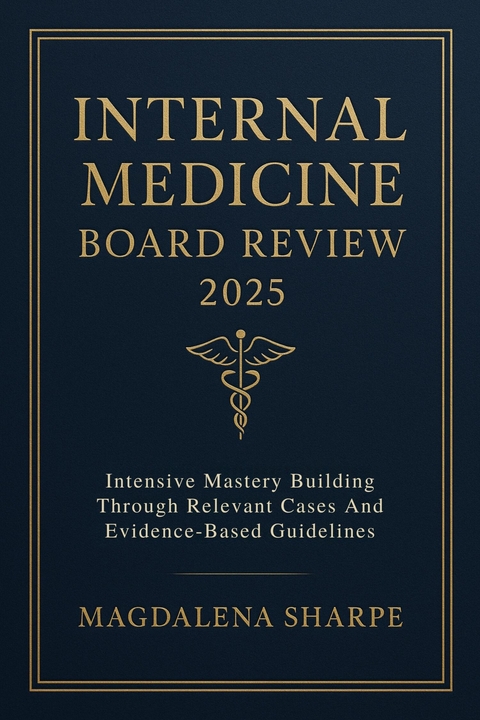
Internal Medicine Board Review 2025 (eBook)
144 Seiten
Publishdrive (Verlag)
978-0-00-110942-1 (ISBN)
Do you feel overwhelmed by the sheer breadth of Internal Medicine as you prep for the 2025 boards?
Are you unsure which high-yield topics and evidence-based guidelines actually move your score?
Do you want a clear, case-driven plan to build mastery-not just memorize facts?
If you answered YES to at least one of these questions, you MUST KEEP READING...
Master the Internal Medicine Boards with Confidence-Using Cases, Not Chaos
Countless candidates drown in minutiae, chase ever-changing guidelines, and burn out on question banks that don't teach clinical thinking. Time pressure, tricky stems, and look-alike diagnoses compound the stress. It's no wonder many feel stuck, second-guessing even bread-and-butter problems.
You're not alone-and you don't have to study that way.
Presenting: Internal Medicine Board Review 2025: Intensive Mastery Building Through Relevant Cases And Evidence-Based Guidelines
Introduction — Internal Medicine Board Review 2025: Intensive Mastery Building Through Relevant Cases And Evidence-Based Guidelines
“Boards reward decisive thinking under uncertainty.” The purpose of this book is to train that decisiveness — not by piling on trivia or reciting endless lists, but by shaping a disciplined, reflex-level approach to internal medicine reasoning. You are not just preparing to answer 240 questions on a test day; you are refining the clinical instincts that will define your everyday practice. Medicine, at its core, is decision-making under time pressure with incomplete data, and the boards are designed to expose where that decision-making wavers. This book turns that challenge into your training ground.
Internal medicine is too vast to memorize and too interconnected to learn in isolation. Most candidates fail not because they lack information, but because they lack a mental architecture for retrieving and applying it when confronted with messy, multi-system problems. The difference between a competent clinician and a board-level performer is not knowledge volume—it’s cognitive engineering: how you arrange, trigger, and deploy what you know. This guide rebuilds that architecture from the ground up.
Every section begins with a case, not a concept. You start with the move — what the clinician does — and only afterward analyze the reasoning behind it. The logic is simple: the boards test decisions, not definitions. Memorization creates static recall, but mastery requires procedural memory — a trained instinct that activates the right rule under pressure. When you see “syncope while shaving,” your mind should not wander through a differential list; it should snap to situational reflexes: carotid hypersensitivity → tilt table → rule out medication trigger. That’s the kind of fluency this book builds through repetition and structure.
How to Use This Book for Mastery (Not Memorization)
This book does not want you to “get through” chapters; it wants you to train with them. Each one follows a deliberate sequence built around how your brain actually encodes durable clinical reasoning. You begin with a case-first navigation — an archetypal vignette that forces an immediate decision. The point is not whether you get the answer right, but how you think your way there. Each case embeds friction points — the exact junctures where candidates commonly hesitate or overthink. Right after, the text unpacks the rationale: not as a dry explanation, but as a contrast between correct and common wrong turns.
The supporting facts — thresholds, diagnostic criteria, treatment durations — come second, contextualized around action. This sequence reverses the traditional study model. Instead of stacking facts to reach an action, you begin with the action and backfill the facts that justify it. By the time you close a chapter, your procedural reasoning is mapped to cognitive anchors that stick.
When guidelines conflict, you’ll see evidence ladders. Not all recommendations weigh equally, and understanding hierarchy builds confidence when evidence diverges. At the top are systematic reviews and meta-analyses; below them, guidelines shaped by those findings; then landmark randomized trials that shaped the field; finally, expert consensus or common practice. Knowing where each piece of guidance lives on that ladder teaches you when you can safely adapt and when you must adhere. Board questions often exploit ambiguity — they expect you to recognize not just the “right” answer, but the level of certainty that supports it.
Finally, every subchapter ends with one-minute drills — concise, timed practice cases accompanied by three-step algorithms. They’re designed for repetition. The more you rehearse them, the more your clinical decision loop tightens. It’s the same principle athletes use to automate movements: repetition under mild cognitive load hardwires reflexes. By test day, the steps will feel instinctive — an automatic sequence that requires no conscious reconstruction.
Pattern Libraries & Rapid Retrieval
To master the boards, you must learn not just facts, but recognition. Every clinical vignette contains a stem — often long, distractingly detailed, and psychologically designed to overload working memory. The key to decoding it lies in stem forensics: extracting the answerable predicate from the clutter. In this book, you’ll train to read stems in a fixed order — demographics → tempo → red flags → can’t-miss conditions. This pattern isolates the essential clue in under 10 seconds, filtering noise before you fall into distractor traps.
Equally important is learning trigger phrases to actions. When you read “painless jaundice,” you should reflexively map it to “pancreatic head mass until proven otherwise.” When you see “platelets 60,000 after heparin,” your brain should immediately activate “stop heparin, start argatroban, confirm HIT.” When “nocturnal cough with normal spirometry” appears, you pivot to “GERD or post-nasal drip, not asthma escalation.” Each of these phrases encodes a high-yield shortcut — a diagnostic door that opens without hesitation. These are not gimmicks; they’re cognitive economy. The boards prize efficient pattern retrieval because it mirrors real medicine: the clinician who recognizes a pattern early saves lives.
But recognition alone isn’t enough; you must also defend against your own brain. Humans are wired for bias — anchoring, confirmation, availability — and exam writers know it. That’s why this book installs cognitive guardrails, or “bias breakers,” throughout. You’ll learn to trust the vitals before the narrative, to check pre-test probability before ordering a test, to reconsider the outlier value before chasing it. These habits transform not only your test performance but your clinical safety. The boards are less about obscure diseases than about avoiding predictable mental errors.
Each chapter reinforces this discipline through deliberate contrast — the wrong turns most examinees take and why. By repeatedly confronting and correcting these instinctive errors, you rewire how your mind approaches clinical puzzles. The result is durable clarity under uncertainty — exactly what the boards are built to measure.
Study Architecture & Assessment
Passing the boards is not a function of total hours but of structured retrieval. Passive reading produces comfort, not competence. This book operationalizes active recall as your main study engine. Every fact, threshold, or treatment duration is formatted as a flashable rule — something you can turn into a question, answer, and self-check loop. You’ll find cross-references to encourage spaced retrieval — revisiting similar concepts across chapters (for example, ACE inhibitor use in both nephrology and cardiology contexts) to reinforce flexible knowledge transfer.
Internal medicine is an ecosystem, not a siloed discipline. To reflect that, the book introduces case mix periodization: a rotating schedule that cycles through organ systems while reserving integration weeks for overlap zones — cardio-renal, metabolic-endocrine, pulmonary-rheumatologic. These integration sets simulate the mixed blocks you’ll face on exam day and train your brain to shift context without cognitive fatigue. They also mirror real-world reasoning, where a diabetic patient’s kidney function, cardiovascular risk, and medication regimen are inseparable.
Another innovation is tracking the metric that matters: decision latency. Instead of obsessing over percentage correctness, measure how long it takes you to commit to a decision on a new question. Fast, accurate commitment reflects pattern mastery; slow, hesitant reasoning signals weak architecture. Board-level mastery is not knowing everything — it’s recognizing enough to act decisively. By focusing on first-order accuracy (correct on first exposure), you train the mental agility that distinguishes mastery from memorization.
You are encouraged to keep a log of your own “uncertainty triggers” — those moments where you hesitate despite knowing the data. Over time, these become diagnostic of your reasoning habits. Are you overvaluing rare causes? Under-trusting your initial read of vitals? Delaying therapeutic decisions because you overcheck labs? Identifying these micro-patterns allows you to target weakness at the meta-cognitive level, turning your study hours into precision training.
The Philosophy Behind This Book
Medicine evolves; principles endure. This book’s structure rests on one enduring truth: the boards do not test information—they test judgment under constraint. The best clinicians think in frameworks. They can justify every action with evidence, but they act through intuition that has been rehearsed, tested, and refined. That’s what this book cultivates — intuition that’s not mystical, but methodical.
Every decision rule presented here is drawn from publicly available, evidence-based sources — guidelines, trials, and reviews — synthesized into practical algorithms. Citations aren’t ornaments; they are your scaffolding. The moment you understand why a rule exists and how strong its evidence is, it stops being arbitrary and becomes memorable. Evidence, then, is not a list to memorize but a map of confidence — where you can step firmly and where the ground still shifts.
Think of this manual as both a training simulator and a diagnostic tool for your thinking. Use it iteratively: run through...
| Erscheint lt. Verlag | 17.11.2025 |
|---|---|
| Sprache | englisch |
| Themenwelt | Medizin / Pharmazie ► Studium |
| ISBN-10 | 0-00-110942-1 / 0001109421 |
| ISBN-13 | 978-0-00-110942-1 / 9780001109421 |
| Informationen gemäß Produktsicherheitsverordnung (GPSR) | |
| Haben Sie eine Frage zum Produkt? |
 EPUB (Adobe DRM)
Kopierschutz: Adobe-DRM
Adobe-DRM ist ein Kopierschutz, der das eBook vor Mißbrauch schützen soll. Dabei wird das eBook bereits beim Download auf Ihre persönliche Adobe-ID autorisiert. Lesen können Sie das eBook dann nur auf den Geräten, welche ebenfalls auf Ihre Adobe-ID registriert sind.
Details zum Adobe-DRM
Dateiformat: EPUB (Electronic Publication)
EPUB ist ein offener Standard für eBooks und eignet sich besonders zur Darstellung von Belletristik und Sachbüchern. Der Fließtext wird dynamisch an die Display- und Schriftgröße angepasst. Auch für mobile Lesegeräte ist EPUB daher gut geeignet.
Systemvoraussetzungen:
PC/Mac: Mit einem PC oder Mac können Sie dieses eBook lesen. Sie benötigen eine
eReader: Dieses eBook kann mit (fast) allen eBook-Readern gelesen werden. Mit dem amazon-Kindle ist es aber nicht kompatibel.
Smartphone/Tablet: Egal ob Apple oder Android, dieses eBook können Sie lesen. Sie benötigen eine
Geräteliste und zusätzliche Hinweise
Buying eBooks from abroad
For tax law reasons we can sell eBooks just within Germany and Switzerland. Regrettably we cannot fulfill eBook-orders from other countries.
aus dem Bereich