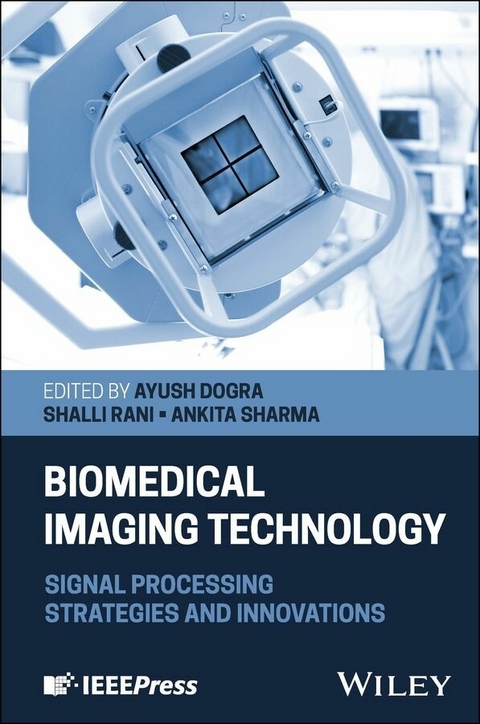
Biomedical Imaging Technology (eBook)
412 Seiten
Wiley-IEEE Press (Verlag)
978-1-394-34806-0 (ISBN)
Explore emerging applications for AI, machine learning, and deep learning in biomedical imaging technologies
In Biomedical Imaging Technology, a team of distinguished researchers deliver an expert discussion on the application of imaging and signal processing techniques to healthcare technologies like X-ray, MRI, CT, ultrasound, and others. Beginning with an introduction to biomedical imaging, the book goes on to explain more advanced imaging technologies, such as molecular and optical imaging.
This book provides a blend of theory and practical applications, exploring the role of AI and AI algorithms in enhancing diagnostic accuracy. It discusses machine and deep learning approaches for improving computer-aided diagnosis systems and the integration of signal processing within various imaging modalities.
Readers will also find:
- A thorough introduction to contemporary approaches to optical imaging, including fluorescence imaging, photoacoustic imaging, and Optical Coherence Tomography (OCT)
- Comprehensive explorations of image-guided interventions, theranostics in cancer treatment, and advancements in surgical navigation
- Practical discussions of emerging trends in the field and up-and-coming innovations
- Case studies and practical examples from real-world locations
Perfect for researchers in biomedical engineering, imaging, and signal processing, Biomedical Imaging Technology will also benefit undergraduate and graduate students studying electrical engineering subjects, such as biomedical imaging and signal processing.
Ayush Dogra, PhD, is an Assistant Director at Chitkara University, Punjab, India. His research areas include image fusion, image enhancement, image registration, and image denoising.
Shalli Rani, PhD, is a Professor and Director at Chitkara University, Punjab, India. She is a Senior Member of the IEEE and her research interests include Internet of Things, WSN, cloud computing, network security, and machine learning.
Ankita Sharma, PhD, is an Assistant Professor at Chitkara University, Punjab, India. She has authored numerous national and international publications in peer-reviewed journals.
Explore emerging applications for AI, machine learning, and deep learning in biomedical imaging technologies In Biomedical Imaging Technology, a team of distinguished researchers deliver an expert discussion on the application of imaging and signal processing techniques to healthcare technologies like X-ray, MRI, CT, ultrasound, and others. Beginning with an introduction to biomedical imaging, the book goes on to explain more advanced imaging technologies, such as molecular and optical imaging. This book provides a blend of theory and practical applications, exploring the role of AI and AI algorithms in enhancing diagnostic accuracy. It discusses machine and deep learning approaches for improving computer-aided diagnosis systems and the integration of signal processing within various imaging modalities. Readers will also find: A thorough introduction to contemporary approaches to optical imaging, including fluorescence imaging, photoacoustic imaging, and Optical Coherence Tomography (OCT)Comprehensive explorations of image-guided interventions, theranostics in cancer treatment, and advancements in surgical navigationPractical discussions of emerging trends in the field and up-and-coming innovationsCase studies and practical examples from real-world locations Perfect for researchers in biomedical engineering, imaging, and signal processing, Biomedical Imaging Technology will also benefit undergraduate and graduate students studying electrical engineering subjects, such as biomedical imaging and signal processing.
1
Historical Evolution and Technological Advancements in Biomedical Imaging
Shubham Gupta and Suhaib Ahmed
Center for Applied AI, Model Institute of Engineering and Technology, Jammu, India
1.1 Introduction
The realm of biomedical imaging is one of the keys to modern healthcare and its multidisciplinary approach, which has transformed diagnosis, treatment, and disease monitoring. Recent developments in signal processing have opened new ways of improving image quality, extracting valuable information, and performing real‐time analysis [1]. These technologies are fusing innovative algorithms and machine learning (ML) to expand the horizons of accuracy and efficiency. The chapter discusses the most recent signal processing techniques that are fueling advances in the field of biomedical imaging, with emphasis on their innovative impact on clinical and research perspectives.
1.1.1 Role of Biomedical Imaging in Modern Medicine
Biomedical imaging is the foundation of contemporary medicine and is an essential approach for the diagnosis, treatment, monitoring, and management of different diseases. It is a major medical breakthrough that can help clinicians visualize internal structures non‐invasively and enables accurate and rapid clinical decision making. Imaging modalities (i.e. X‐ray, computed tomography (CT), magnetic resonance imaging (MRI), ultrasound (USG)) are ubiquitous and irreplaceable tools of clinical practice worldwide.
For instance, in oncology, MRI offers higher sensitivity for detecting soft‐tissue contrast in brain tumors, while positron emission tomography (PET) imaging is preferred for detecting metabolic activity related to cancer spread. In cardiovascular imaging, echocardiography and cardiac MRI are often combined to assess both function and structure. The choice of modality impacts diagnosis and prognosis and is increasingly tailored using clinical decision support systems (CDSS) driven by imaging data (Table 1.1).
Table 1.1 Biomedical imaging in modern medicine.
| Aspect | Description | Impact on modern medicine |
|---|
| Early detection and diagnosis | Advanced imaging modalities like MRI, CT, PET, and ultrasound are used to identify abnormalities | Early and accurate detection of diseases, such as cancer, cardiovascular conditions, and neurological disorders, leads to improved prognosis and timely intervention |
| Treatment planning | Provides detailed anatomical and functional insights for planning surgeries or therapies | Enables precise localization of tumors, identification of surgical pathways, and assessment of treatment targets, reducing risks and improving treatment outcomes |
| Real‐time monitoring | Facilitates intraoperative imaging and real‐time guidance during surgeries or minimally invasive procedures | Enhances surgical precision and ensures effective execution of interventions, such as tumor resections or catheter placements |
| Personalized medicine | Integrates patient‐specific data to customize imaging protocols and treatment plans | Improves diagnostic accuracy and patient outcomes by tailoring imaging techniques and therapies to individual needs |
| Disease progression | Monitoring tracks changes in disease states using longitudinal imaging studies | Enables clinicians to evaluate the effectiveness of treatments and adjust therapeutic strategies as needed |
Biomedical imaging serves other purposes beyond diagnostics. It plays a basic part in influencing therapeutic interventions, including picture‐guided medical procedures and, for example, radiotherapy [2]. Interventional radiology uses imaging to apply treatments as carefully as possible to tumors or other targets to minimize damage to nearby tissue. In addition, imaging plays a critical role in assessing therapeutic efficacy, such as monitoring the reduction in tumor volume after chemotherapy or the status of wound healing.
It would provide new knowledge of biological kinetics at the molecular and cellular scales for medical research in biomedical imaging. in vivo techniques, including functional imaging (fMRI, PET), enable researchers to investigate dynamic brain activation, metabolic processes, and more general disease mechanisms. This has pioneered new territories in neuroscience, oncology, cardiology, and beyond. Furthermore, integrating imaging with artificial intelligence (AI) and ML has been essential in precision medicine, enabling the use of individualized treatment strategies based on a given patient's unique imaging findings.
1.1.2 Historical Context of Imaging Techniques
Over the last few centuries, biomedical imaging has evolved to what we see today, an intermediate between several critical discoveries and breakthroughs that have redefined our perspective of the human body. It all began with the discovery of X‐rays by Wilhelm Roentgen back in 1895. With this breakthrough, doctors could view the human body for the first time and provide the basis of diagnostic radiology. X‐ray imaging rapidly established itself as a staple of diagnosis, changing the diagnosis of all types of fractures, infections, pulmonary diseases, etc.
Several imaging modalities were invented during the mid‐20th century. Accordingly, in the 1950s, USG imaging was developed as a safe tool to assess soft tissue and organ systems by taking inspiration from sonar imaging [3]. This was especially groundbreaking in the field of obstetrics, where fetal development can now be monitored safely. Concurrently, the origination of nuclear imaging techniques like single‐photon emission computed tomography (SPECT) and PET made possible the visualization of physiologic processes and functional imaging to complement anatomical imaging.
Another advancement came with CT, invented in the 1970s by Godfrey Hounsfield and Allan Cormack as shown in Figure 1.1. CT, on the other hand, combined X‐ray exposure (CT stands for computed tomography) with advanced computer algorithms to generate images of the body in cross‐section, with much more detail than was possible through traditional
Figure 1.1 Historical context of imaging techniques.
X‐ray scans. Around then, MRI came along, providing high‐contrast imaging of soft tissues. Based on the principles of nuclear magnetic resonance, MRI quickly became utilized in the fields of neurology, orthopedics, and oncology. Optical imaging methods, including fluorescence microscopy and confocal microscopy, have also diversified and expanded the possibilities for biomedical imaging. Those methods allowed visualization with cellular and subcellular resolution, which has resulted in major advances in molecular biology and pathology.
1.1.3 Objectives and Scope of the Chapter
This chapter aims to serve as a comprehensive synthesis of traditional, modern, and emerging signal processing methods used in biomedical imaging, grounded in both theoretical concepts and practical applications. It is particularly relevant for clinicians, researchers, and policymakers seeking to understand the multidisciplinary evolution of biomedical imaging. By integrating current research, AI‐driven innovation, and challenges related to regulation and accessibility, we aim to contribute to evidence‐based and ethically responsible advancements in healthcare.
1.2 Early Milestones in Biomedical Imaging
Following centuries of development and discovery, biomedical imaging has played a crucial role in the progress of modern medicine. Before the availability of imaging technologies, physicians depended on narrow diagnostic instruments and observational methods. The path from rudimentary anatomical studies to advanced nuclear imaging captures humanity's unflagging desire to comprehend the human body and its diseases [4]. This chapter covers the early days of biomedical imaging, along with the pre‐imaging period, the epoch‐making discovery of X‐ray, followed by radioisotope imaging as shown in Figure 1.2.
Figure 1.2 Early milestones in biomedical imaging.
1.2.1 Pre‐Imaging Era: Anatomy and Physical Diagnosis
Earlier, physicians were dependent on anatomy and physical diagnosis. Physicians had to rely on external telltales, probing with their fingers or with the stethoscope to identify internal infirmities. Ancient Egypt and Greece are two examples of classical civilizations that made substantial contributions to early anatomical knowledge, with their people having studied human remains extensively. Without imaging tools, medicine was built on the pioneering work of anatomists such as Hippocrates and Galen. Their scale of bodily functions and pathologies were primitive by later standards, but they emphasized the crucial role of observation. However, these methods had a limited scope. While invaluable, autopsies were often hampered by cultural and religious taboos, limiting anatomical investigation.
From the Renaissance onward, systematic dissections resulted in major improvements in anatomical knowledge. The Great Andreas Vesalius...
| Erscheint lt. Verlag | 20.11.2025 |
|---|---|
| Sprache | englisch |
| Themenwelt | Medizin / Pharmazie ► Medizinische Fachgebiete |
| Schlagworte | Biomedical imaging ai • biomedical imaging ai case studies • biomedical imaging deep learning • biomedical imaging deep learning case studies • biomedical imaging machine learning • biomedical imaging machine learning case studies • mri ai • x-ray ai |
| ISBN-10 | 1-394-34806-1 / 1394348061 |
| ISBN-13 | 978-1-394-34806-0 / 9781394348060 |
| Informationen gemäß Produktsicherheitsverordnung (GPSR) | |
| Haben Sie eine Frage zum Produkt? |
 EPUB (Adobe DRM)
Kopierschutz: Adobe-DRM
Adobe-DRM ist ein Kopierschutz, der das eBook vor Mißbrauch schützen soll. Dabei wird das eBook bereits beim Download auf Ihre persönliche Adobe-ID autorisiert. Lesen können Sie das eBook dann nur auf den Geräten, welche ebenfalls auf Ihre Adobe-ID registriert sind.
Details zum Adobe-DRM
Dateiformat: EPUB (Electronic Publication)
EPUB ist ein offener Standard für eBooks und eignet sich besonders zur Darstellung von Belletristik und Sachbüchern. Der Fließtext wird dynamisch an die Display- und Schriftgröße angepasst. Auch für mobile Lesegeräte ist EPUB daher gut geeignet.
Systemvoraussetzungen:
PC/Mac: Mit einem PC oder Mac können Sie dieses eBook lesen. Sie benötigen eine
eReader: Dieses eBook kann mit (fast) allen eBook-Readern gelesen werden. Mit dem amazon-Kindle ist es aber nicht kompatibel.
Smartphone/Tablet: Egal ob Apple oder Android, dieses eBook können Sie lesen. Sie benötigen eine
Geräteliste und zusätzliche Hinweise
Buying eBooks from abroad
For tax law reasons we can sell eBooks just within Germany and Switzerland. Regrettably we cannot fulfill eBook-orders from other countries.
aus dem Bereich