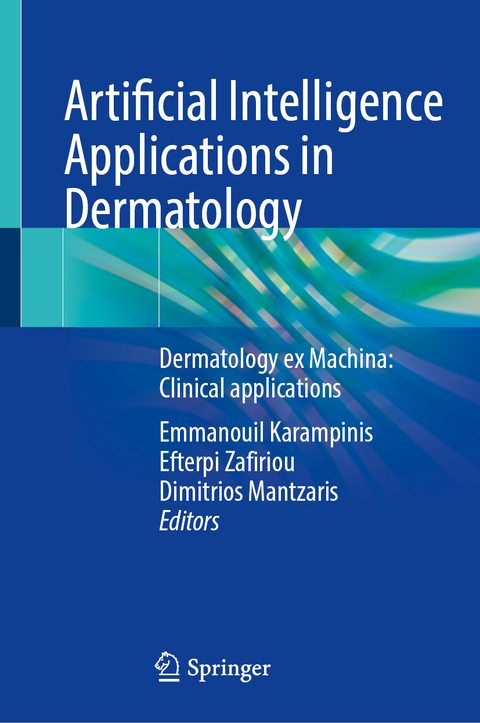
Artificial Intelligence Applications in Dermatology
Springer International Publishing (Verlag)
978-3-032-15613-6 (ISBN)
- Noch nicht erschienen - erscheint am 29.03.2026
- Versandkostenfrei
- Auch auf Rechnung
- Artikel merken
This work fittingly titled Artificial Intelligence Applications in Dermatology - Dermatology ex Machina: Clinical applications is centred on the clinical perspectives of the use of A.I. in dermatology, will be a valued manual for dermatologists to understand the evolving landscape of A.I. in medicine. It presents a comprehensive outline of all different functionalities and possibilities of accessible A.I. programs, such as chatbots or image-based diagnostic tools, and their applications in treating skin conditions. Covering diverse aspects of clinical dermatology in dedicated chapters such as skin cancer, inflammatory dermatoses, and aesthetic medicine, this practical book offers various application options for A.I. technology in skin conditions, including prevention, diagnosis, personalized treatment, and follow-up strategies aiming to enhance a dermatologists' diagnostic skills, and treatment customization capabilities.
By addressing cutting-edge technology in a clear, practical style especially thought for practitioners, this handy guide will assist dermatologists and clinicians of related disciplines in choosing the best treatment options for their patients.
Doctor Emmanouil Karampinis, MD, MSc, PhD is Academic Collaborator of Second Dermatology Department of Aristotle University of Thessaloniki, Greece, as well as Associate lecturer at the Dermatology department of University of Thessaly, Greece, and Tutor of USW postgraduate program of Clinical Dermatology, UK. He owns postgraduate certificates in the domain of clinical dermatology, pediatric dermatology, dermoscopy and aesthetic medicine, while his PhD focused on Photocarcinogenesis. His research mainly deals with the topics of post-COVID-19 vaccination cutaneous manifestations, dermoscopy, skin of colour, cutaneous oxidative stress disturbances and the incorporation of Artificial Intelligence into dermatological practices.
Doctor Efterpi Zafiriou, MD, MSc, PhD is an Associate Professor at the Department of Dermatology, Faculty of Medicine, School of Health Sciences at the University of Thessaly and Head of Dermatology Department at the University General Hospital in Larissa, Greece. Prof. Dr. Efterpi Zafiriou s research interests include Psoriasis, Atopic Dermatitis, Urticaria, Alopecia areata, Pyoderma gangrenosum, Therapeutic Outcomes, Skin cancer (NMSC), Melanoma, Systemic Oxidative Stress.
Doctor Dimitrios Mantzaris, MSc, PhD is Teaching Staff on Computational Intelligence and Health Informatics at the Department of Nursing, School of Health Sciences, University of Thessaly in Larissa, Greece. His research interest includes Computational Intelligence in Health Sciences, Generative Artificial Intelligence, Deep Learning, Convolutional Neural Networks, Genetic Algorithms and Large Language Model.
Chapter 1. Artificial Intelligence (A.I.) main concepts: a glimpse inside A.I. Black Box
chapter 2. Dermatology: the ideal field for A.I. to thrive
Chapter 3. Pioneering AI in Dermatology Education: Recognizing the Initial Milestone
Chapter 4. Medicolegal issues arising from the Use of AI in Dermatology
Chapter 5. Bioethics in the use of AI in Dermatology
Chapter 6. Artificial Intelligence in Non-Melanoma Skin Cancer
Chapter 7. Melanoma and Artificial Intelligence
Chapter 8. Non-cancerous lesions and artificial intelligence
Chapter 9. Psoriasis and Artificial Intelligence
Chapter 10. Atopic Dermatitis and Artificial Intelligence
Chapter 11. AI-powered approach of Acne
Chapter 12. AI-powered approach of Rosacea
Chapter 13. Artificial Intelligence and Bullous Dermatoses
Chapter 14. Skin care guided by AI
Chapter 15. Applications of toxin and fillers and AI use
Chapter 16. Laser application and AI
Chapter 17. Hair disorders and Artificial Intelligence
Chapter 18. Nail disorders and AI
Chapter 19. Artificial Intelligence Promises and Successes in Dermatology
Chapter 20. Artificial Intelligence failures, bias and limitations in Dermatology
Chapter 21. Artificial Intelligence and Special Populations: Age Considerations
Chapter 22. Artificial Intelligence and Special Populations: Skin of Color Considerations
Chapter 23. Can Artificial Intelligence replace dermatologists?
| Erscheint lt. Verlag | 29.3.2026 |
|---|---|
| Zusatzinfo | 84 illus. in color |
| Verlagsort | Cham |
| Sprache | englisch |
| Maße | 155 x 235 mm |
| Themenwelt | Medizin / Pharmazie ► Medizinische Fachgebiete ► Dermatologie |
| Schlagworte | acne • aesthetic medicine • Artificial Intelligence • automatic technology • Deep learning • Dermatology technology • Digital Healthcare • gdpr • Inflammatory dermatoses • machine learning • medicolegal issues • Precision Healthcare • Psoriasis • skin cancer • Skin imaging |
| ISBN-10 | 3-032-15613-0 / 3032156130 |
| ISBN-13 | 978-3-032-15613-6 / 9783032156136 |
| Zustand | Neuware |
| Informationen gemäß Produktsicherheitsverordnung (GPSR) | |
| Haben Sie eine Frage zum Produkt? |
aus dem Bereich