


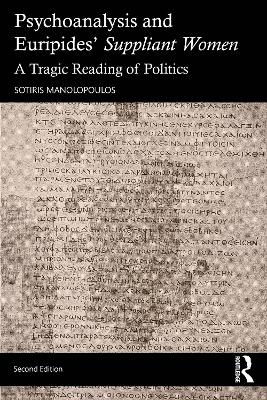
Psychoanalysis and Euripides' Suppliant Women
A Tragic Reading of Politics
Seiten
2026
|
2nd edition
Routledge (Verlag)
978-1-032-95433-2 (ISBN)
Routledge (Verlag)
978-1-032-95433-2 (ISBN)
- Noch nicht erschienen (ca. Mai 2026)
- Versandkostenfrei
- Auch auf Rechnung
- Artikel merken
This book explores how ancient tragedy illuminates contemporary political crises through a psychoanalytic lens. Through a “tragic” reading of Euripides’ play, The Suppliant Women, it demonstrates how fractured societies attempt to "heal" themselves through populism, authoritarianism, cruelty, and cultures of deception.
Psychoanalysis and Euripides' Suppliant Women explores how ancient tragedy illuminates contemporary political crises through a psychoanalytic lens. Through a “tragic” reading of Euripides’ play, The Suppliant Women, it demonstrates how fractured societies attempt to "heal" themselves through populism, authoritarianism, cruelty, and cultures of deception. It examines how democratic politics requires integrating split-off elements of mythical religious beliefs linked to mourning processes and feminine existence.
The book presents Euripides' painful diagnosis that humans are fundamentally split beings whose public life constitutes a struggle to integrate primitive, "supernatural" forces that exist beyond rational political order. It analyses how humans struggle with omnipotence, bisexuality, and drives of love and destruction, often defending against painful knowledge through catastrophic tragic acts including war, suicide, and violence. The book uses the mother-infant relationship as a model for understanding societal and political functions, showing how tragic plots transform impossible impasses into tolerable paradoxes within transitional spaces.
This interdisciplinary study will be of interest to psychoanalysts in practice and in training, as well as academics and scholars of psychoanalytic studies, politics, and classical studies, and anyone seeking to understand how ancient wisdom addresses modern democratic challenges and the pathological mental functioning manifest in contemporary politics.
Psychoanalysis and Euripides' Suppliant Women explores how ancient tragedy illuminates contemporary political crises through a psychoanalytic lens. Through a “tragic” reading of Euripides’ play, The Suppliant Women, it demonstrates how fractured societies attempt to "heal" themselves through populism, authoritarianism, cruelty, and cultures of deception. It examines how democratic politics requires integrating split-off elements of mythical religious beliefs linked to mourning processes and feminine existence.
The book presents Euripides' painful diagnosis that humans are fundamentally split beings whose public life constitutes a struggle to integrate primitive, "supernatural" forces that exist beyond rational political order. It analyses how humans struggle with omnipotence, bisexuality, and drives of love and destruction, often defending against painful knowledge through catastrophic tragic acts including war, suicide, and violence. The book uses the mother-infant relationship as a model for understanding societal and political functions, showing how tragic plots transform impossible impasses into tolerable paradoxes within transitional spaces.
This interdisciplinary study will be of interest to psychoanalysts in practice and in training, as well as academics and scholars of psychoanalytic studies, politics, and classical studies, and anyone seeking to understand how ancient wisdom addresses modern democratic challenges and the pathological mental functioning manifest in contemporary politics.
Sotiris Manolopoulos is a member of the Hellenic Psychoanalytic Societies, and is a child analyst, training analyst, former director of training and president of the Hellenic Society.
Foreword (by Marilia Aisenstein). Introduction. 1. The plot 2. The tragic position 3.The work of mourning 4. The feminine core 5. The Homeric hymn to Demeter: mourning and femininity 6. The order of politics 7. Democracy: The work of a tragic chorus 8. An Ur-text of political theory: A kind of conclusion. References.
| Erscheint lt. Verlag | 22.5.2026 |
|---|---|
| Verlagsort | London |
| Sprache | englisch |
| Maße | 156 x 234 mm |
| Themenwelt | Geisteswissenschaften ► Psychologie ► Psychoanalyse / Tiefenpsychologie |
| Medizin / Pharmazie ► Medizinische Fachgebiete ► Psychiatrie / Psychotherapie | |
| Sozialwissenschaften ► Politik / Verwaltung ► Politische Theorie | |
| ISBN-10 | 1-032-95433-7 / 1032954337 |
| ISBN-13 | 978-1-032-95433-2 / 9781032954332 |
| Zustand | Neuware |
| Informationen gemäß Produktsicherheitsverordnung (GPSR) | |
| Haben Sie eine Frage zum Produkt? |
Mehr entdecken
aus dem Bereich



aus dem Bereich
Entwicklungen seit 1975 und aktuelle Bilanz
Buch | Softcover (2025)
Kohlhammer (Verlag)
CHF 34,95


