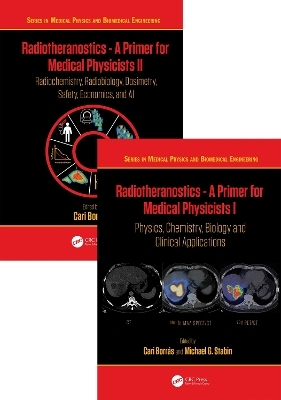
Radiotheranostics Two Volume Set
CRC Press
978-1-041-14324-6 (ISBN)
- Noch nicht erschienen (ca. Januar 2027)
- Versandkostenfrei
- Auch auf Rechnung
- Artikel merken
The first volume addresses the Physics. Chemistry, Biology and Clinical Applications of Radiotheranostics.
This book covers scientific, clinical, and educational aspects of radiotheranostics in cancer control. Setting the framework, the first volume defines radiotheranostics and describes the history of radionuclide therapy and theranostics, and the biology of cancer. It examines the clinical applications of unconjugated radionuclides, such as ¹³¹I and ²²³Ra, and of radionuclide-conjugated cancer-specific vectors: peptides, small molecules, antibodies, and nanoparticles; introduces clinical trials and drug development; and reviews epidemiological studies and the adverse effects of radionuclide therapy – both radiation injuries and chemical toxicity. It presents the chemistry and physics of radionuclide production, discusses radioactivity measurements and traceability, and addresses important instrumentation aspects: calibration, quantitative imaging, and quality control. Volume I concludes with guidance on the education, training, and competence of a radiotheranostic multidisciplinary team and summarizes the principal physics characteristics of theranostics today – including many to be expanded in the second volume – while offering a glimpse into tomorrow. This volume provides the foundations for the more advanced second volume, which explores dosimetric and radiation safety, aiming to empower medical physicists and demonstrate to the cancer community how to improve cancer control and yield increased patient survival times.It will be a valuable reference for medical and health physicists with basic knowledge of nuclear medicine.
The second volume covers Radiation Chemistry, Radiation biology, Dosimetry, Safety, Economics and Artificial Intelligence aspects of Radiotheranostics.
The book expands upon the radiotheranostic topics in cancer care covered in Volume I, which includes cancer biology, clinical applications, radionuclide production, source calibration, imaging instrumentation, and staff education, training, and competencies. Building on these foundational elements, Volume II offers in-depth coverage of radiopharmaceutical preparation and radiolabeling strategies. It presents new insights into radiation biology, including studies on human and animal radiation embryology. The dosimetry section addresses alpha-, beta-, and Auger-emitting radionuclides and explores the therapeutic potential of positrons. It emphasizes biokinetic modeling, standardized and image-based dosimetry procedures, and the quantification of uncertainties in dose calculations. Essential safety topics are also thoroughly examined, including radiation shielding, facility design, the management of deceased radiotheranostic patients, and current regulatory requirements. The volume concludes with forward-looking chapters on the economics of theranostics and the transformative role of artificial intelligence in enhancing precision medicine. The chapters are designed to equip medical physicists with the tools necessary to accurately estimate and document individual patient dosimetry and demonstrate the clinical value of dose calculations in improving cancer outcomes and survival rates. The book is intended for academic and practicing clinical medical and health physicists with a basic knowledge of nuclear medicine. Although not structured as a textbook, medical physicists in nuclear medicine physics training will also find the book helpful.
Key Features:
Provides a comprehensive introduction to the topic, presenting readers with thorough treatment in a cohesive two-volume book.
Presents a rigorous approach while remaining accessible to students and trainees in the field.
Contains consistent and extensive references to allow readers to delve deeper into the subject.
Cari (Caridad) Borrás is a certified medical physicist in Washington, DC, USA, where she works as an international consultant and has an adjunct faculty position at the George Washington University School of Medicine and Health Sciences. She obtained a Doctor of Science (Physics) degree from the University of Barcelona, Spain, having done a thesis research project on the dosimetry and embryological effects of Astatine- 211 at Thomas Jefferson University in Philadelphia, PA, USA, as a Fulbright scholar. The American Board of Radiology certified her in Radiological Physics and the American Board of Medical Physics in Medical Health Physics. She has worked as a radiological physicist in Barcelona, Spain; Philadelphia, PA; San Francisco, CA; Recife, Brazil; and Washington, DC, where for 15 years she was responsible for the Radiological Health Program of the Pan American / World Health Organization. She has lectured in more than 300 seminars/courses/congresses, many organized by her; authored/contributed around 100 articles and six book chapters; and edited/coedited three books. She is a Fellow of ACR, AAPM, IOMP, HPS, and IUPESM, and has received awards/recognitions from SEFM, AAPM, ALFIM, IOMP, IUPESM, ACCE, ACR, and ABR. Michael G. Stabin is a Certified Health Physicist, President of the Radiation Dose Assessment Resource, Inc., living in Kennewick, WA, USA, where he worked for NV5 – Technical Engineering & Consulting Solutions and Hanford Mission Integration Solutions. He was an Associate Professor in the Radiology and Radiological Sciences Department at Vanderbilt University, in Nashville, TN, and a Scientist at the Radiation Internal Dose Information Center of Oak Ridge Institute for Science and Education. He received a Ph.D. in Nuclear Engineering (Health Physics emphasis) from the University of Tennessee, is a member of the HPS and the SNMMI, and is also a Fulbright scholar. He has over 225 publications in the open literature, most on internal dosimetry for nuclear medicine applications, including complete textbooks on health physics and internal dose assessment.
Volume One
List of Common Acronyms
Part 1 – Introduction
Chapter 1 What is radiotheranostics?
Chapter 2 History of radionuclide therapy and theranostics
Chapter 3 Biological principles behind targeted radionuclide therapy for cancer
Part 2 – Clinical Applications of Targeted Radionuclide Therapy in Cancer Control
Chapter 4 Unconjugated radionuclides
Chapter 5 Radionuclide-conjugated cancer-specific vectors: Peptides
Chapter 6 Radionuclide-conjugated cancer-specific vectors: Small Molecules and antibodies
Chapter 7 Radionuclide-conjugated cancer-specific vectors: Nanoparticles
Chapter 8 Introduction to clinical trials and drug development for radionuclide therapies
Chapter 9 Epidemiologic Studies of Cancer Risk among Patients Administered Radionuclides
Chapter 10 Adverse effects of radionuclide therapy
Part 3 – Radiation Chemistry and Physics
Chapter 11 Radionuclide production
Chapter 12 Radioactivity measurement and traceability
Chapter 13 Instrumentation, calibration, quantitative imaging, and quality control
Part 4 - The Future
Chapter 14 Human resources: Multidisciplinary team education, training, and competence
Chapter 15 Theranostics today: Looking backwards to tomorrow
Volume Two
List of Common Acronyms
Part 1 – Introduction
Chapter 1. Radiotheranostics: Challenges Today
Part 2 – Radiochemistry and Radiobiology
Chapter 2. Radiopharmaceutical Preparations and Radiolabeling Strategies
Chapter 3. New Insights Into the Radiation Biology of Radiotheranostics
Chapter 4. Radiation Embryology: Human and Animal Studies
Part 3 – Particle Dosimetry
Chapter 5. Alpha- and Beta-particle Therapy and Dosimetry
Chapter 6. Auger Emitters
Chapter 7. Positrons: Their Potential Role in Radionuclide Therapy
Part 4 – Dosimetry Formalisms
Chapter 8. Biokinetic Modelling For Radionuclide Dosimetry
Chapter 9. Standardized Tumor and Organ Dosimetry
Chapter 10. Image-based Dosimetry Procedures
Chapter 11. Combining External Beam Radiotherapy and Radionuclide Therapy
Chapter 12. Uncertainties in Dose Calculations
Part 5 – Safety
Chapter 13. Design, Shielding, and Operational Radiation Safety Aspects of the Radiotheranostic Facility
Chapter 14. Management of Deceased Patients Under Treatment (Radioactive Cadavers)
Chapter 15. Radiopharmaceutical Regulatory Requirements
Part 6 – Future Directions and Opportunities
Chapter 16. The Economics of Theranostics
Chapter 17. Artificial intelligence in Radiotheranostics
| Erscheint lt. Verlag | 25.1.2027 |
|---|---|
| Reihe/Serie | Series in Medical Physics and Biomedical Engineering |
| Zusatzinfo | 36 Tables, black and white; 31 Line drawings, color; 12 Line drawings, black and white; 32 Halftones, color; 12 Halftones, black and white; 63 Illustrations, color; 24 Illustrations, black and white |
| Verlagsort | London |
| Sprache | englisch |
| Maße | 178 x 254 mm |
| Themenwelt | Medizin / Pharmazie ► Medizinische Fachgebiete ► Onkologie |
| Medizinische Fachgebiete ► Radiologie / Bildgebende Verfahren ► Radiologie | |
| Naturwissenschaften ► Physik / Astronomie ► Angewandte Physik | |
| ISBN-10 | 1-041-14324-9 / 1041143249 |
| ISBN-13 | 978-1-041-14324-6 / 9781041143246 |
| Zustand | Neuware |
| Informationen gemäß Produktsicherheitsverordnung (GPSR) | |
| Haben Sie eine Frage zum Produkt? |
aus dem Bereich