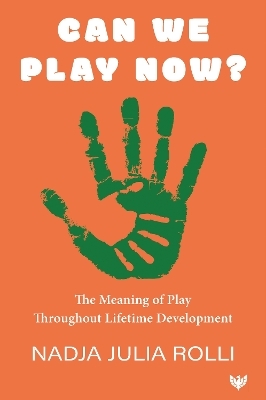
Can We Play Now? The Meaning of Play Throughout Lifetime Development
Phoenix Publishing House (Verlag)
978-1-80013-423-2 (ISBN)
- Noch nicht erschienen (ca. Februar 2026)
- Versandkostenfrei
- Auch auf Rechnung
- Artikel merken
Play comes in many forms, such as solitary play, imaginary play, social play, construction play, and many more. To understand the evolution of play, Can We Play Now? introduces five forms of play: sensory play, attachment play, construction play, fantasy play, and competitive play. It then links these five forms of play with Maslow’s well-known hierarchy of needs. This allows the use of a common language to gain evidence-based insight into the physical and emotional development of a human being. In this way, play becomes a roadmap to understanding the emotional world and identity formation of a child, young person, or adult, and addresses the specific needs of each developmental stage. The book also discusses how socioeconomic and cultural influences, such as the use of technology, social media, loss, developmental trauma, intergenerational trauma, and the Covid-19 pandemic, are impacting young people in the context of play development.
Can We Play Now? aims to bring a unique contribution to the field of child and adolescent psychotherapy that links key theoretical influences on the role of play within developmental milestones. It aligns findings from neuroscience, object relations, and psychodynamic theories with the various stages and challenges of emotional growth from childhood to adulthood. Clinical examples are integrated to bring the theoretical background of each chapter to life, showing the effectiveness of this approach. The ability to share these insights with child psychotherapists and other professionals who work with children, as well as parents, facilitates the creation of the best environment possible for each child to face the challenges of today’s world. It is also ideal reading for adult psychotherapists who want to understand the continuing importance of play in their clients’ lives.
Nadja Julia Rolli, MA, is an integrative child and adolescent psychotherapist with over twenty years of experience in working with vulnerable children and their families. Formerly a primary school teacher, she initially trained in Basel/Switzerland in psychomotor therapy, a somatic psychotherapeutic approach that integrates elements of play and art therapy into the clinical work, before completing a master’s in integrative child and adolescent psychotherapy and counselling. Nadja has worked in special needs education settings, in numerous primary and secondary schools, and has been working in private practice since 2019. She co-founded the Child Psychotherapy Council (CPC), a charity established to promote and maintain the standards of practice, education, and training of child psychotherapy.
Acknowledgements
About the author
Introduction
1. From the beginning
2. The system around the child
3. Physiological needs—sensory play
4. Safety needs—attachment play
5. Need for love and belonging—constructive play
6. Need for esteem—fantasy play
7. Need for self-actualisation—competitive play
8. Developmental trauma and its impact on play
9. Technology and play development
10. Where do we go from here?
References
Index
| Erscheint lt. Verlag | 5.2.2026 |
|---|---|
| Sprache | englisch |
| Maße | 152 x 229 mm |
| Themenwelt | Geisteswissenschaften ► Psychologie ► Entwicklungspsychologie |
| Medizin / Pharmazie ► Medizinische Fachgebiete ► Psychiatrie / Psychotherapie | |
| ISBN-10 | 1-80013-423-1 / 1800134231 |
| ISBN-13 | 978-1-80013-423-2 / 9781800134232 |
| Zustand | Neuware |
| Informationen gemäß Produktsicherheitsverordnung (GPSR) | |
| Haben Sie eine Frage zum Produkt? |
aus dem Bereich