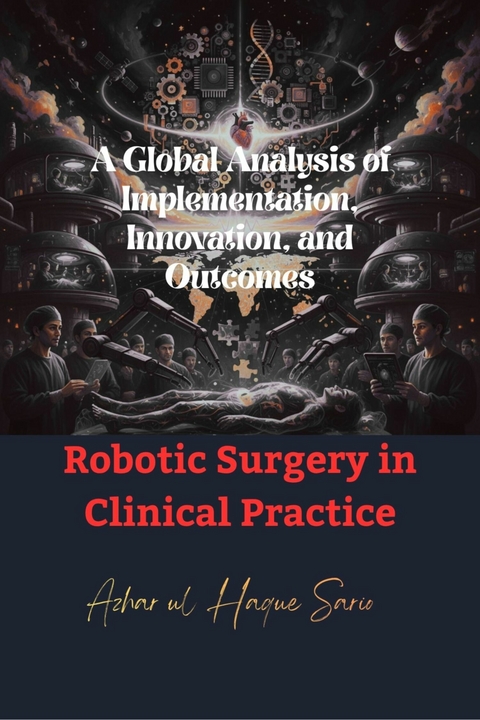
Robotic Surgery in Clinical Practice (eBook)
172 Seiten
Azhar Sario Hungary (Verlag)
978-3-384-75176-8 (ISBN)
Discover the real story of robotic surgery-beyond the hype, across the globe.
Hey, imagine a world where surgeons operate with superhuman precision, where a doctor in Beijing saves a life in a remote village, or where a tiny robot swims through your brain to fix a stroke. That world is here now-in 2025-and this book takes you inside it. Robotic Surgery in Clinical Practice: A Global Analysis of Implementation, Innovation, and Outcomes is not another dry textbook. It's a lively journey through 15 countries, dozens of hospitals, and the latest 2024-2025 data. Short sentences pack big punches. You'll meet the da Vinci 5 with its new force feedback. You'll see China's Toumai robot perform surgery across continents using 5G. You'll watch Japan's Saroa cut tissue force by 50% thanks to real haptics. From Yonsei University doing 13,000 cases to AIIMS Delhi treating cancer for free, every chapter is a real case study. Tables compare platforms, regulations, outcomes. You finish knowing exactly who leads, who catches up, and what still needs fixing.
Other books stay stuck in America or repeat old 2020 data. They praise the tech but ignore the price tag, the training mess, or why Germany builds amazing robots yet barely uses them. This book is different. It's global, fresh, and honest. It shows South Korea's high-volume mastery, UK's strict cost-per-QALY rules, India's fight against cancer costs, Switzerland's watch-making microrobots, Canada's AI that teaches surgeons, France's new Wi-Fi 6 telesurgery tricks, Italy's soft robots that crawl inside veins, Singapore's open-source future. No other book gives you 2025 numbers, national strategies, and clear research gaps in one place. Surgeons, students, hospital managers, policymakers-everyone gets practical takeaways they can actually use tomorrow.
© 2025 Independent Author. This book is an independently produced work and has no affiliation with any medical board, society, or manufacturer mentioned. All trademarks are used under nominative fair use for identification and critical discussion purposes only.
Part I: Theoretical Foundations and Established Knowledge
United States: The Foundational Framework for Robotic Surgery
1.1. Foundational Research and Development: From DARPA to the da Vinci System
The journey to the modern surgical robot is a story of convergence. It’s not a simple, linear path from a single lab. Instead, it’s a compelling narrative where disparate, high-stakes objectives—chiefly, U.S. military strategy and space exploration—accidentally provided the complete toolkit for a revolution in civilian medicine. The da Vinci system wasn't born in a hospital; it was conceived for the battlefield and the stars.
The Military and Space Imperative: Telepresence
In the 1970s, the Defense Advanced Research Projects Agency (DARPA) was focused on a core problem: how to save the lives of soldiers who were wounded in "forward-deployed" scenarios—on a battlefield, a submarine, or another location too hazardous or remote for a surgical expert to be. The concept, championed by individuals like U.S. Army Colonel Dr. Richard Satava, was "telepresence surgery." The goal was to project a surgeon's hands over vast distances.
This military objective was paralleled by NASA, which faced a similar logistical nightmare: what happens if an astronaut on a multi-year mission to Mars needs an emergency appendectomy? The time lag and distance would make bringing them home impossible.
This research, centered at institutions like the Stanford Research Institute (SRI), wasn't focused on improving surgery. It was focused on replicating it. The central challenge was creating a "telemanipulator" system that could provide the surgeon with a sense of proprioception (where your limbs are in space) and haptic feedback (the feel of tissue).
A key breakthrough came from Phil Green at SRI, who developed a system where the surgeon's hands, in a "master" console, were perfectly mirrored by a "slave" robotic manipulator. This was the birth of the master-slave paradigm. The system was designed to filter out the surgeon's natural hand tremors and could even scale movements, allowing for incredibly fine, precise motions.
The First Steps: From PUMA to Competing Systems
The first-ever use of a robot in a human surgical procedure is widely recognized as the 1985 PUMA 560 case. This was an industrial robotic arm (Programmable Universal Machine for Assembly) adapted for a medical purpose. A neurosurgical team used it to guide a needle for a brain biopsy with a level of stereotactic precision that was superhuman. This, however, was not telepresence; it was a pre-programmed, image-guided tool.
The true "telepresence" lineage split in the 1990s into two key competitors:
Computer Motion, Inc. This company, founded by Dr. Yulun Wang, developed the AESOP (Automated Endoscopic System for Optimal Positioning). AESOP was a voice-controlled robotic arm that simply held the endoscopic camera, replacing the (often fatigued) human assistant. It was a huge success. This company then evolved AESOP into a full telepresence system called ZEUS.
Intuitive Surgical, Inc. This company was founded by Frederick Moll, Robert Younge, and John Freund. They acquired the core intellectual property and patents from SRI—the "master-slave" telemanipulator technology that had been funded by DARPA.
For a brief period, ZEUS and the new "da Vinci" system were direct competitors. The competition was fierce, but the da Vinci's design—with its immersive 3D console and "EndoWrist" instruments that mimicked the human wrist's range of motion—was widely seen as the more ergonomically and functionally superior platform.
A landmark moment that proved the military's original concept was "Operation Lindbergh" in 2001. Using the ZEUS system, surgeons in New York performed a complete cholecystectomy (gallbladder removal) on a patient in Strasbourg, France. It was a flawless demonstration of telesurgery, the original DARPA dream.
Ultimately, the market couldn't sustain both. In 2003, Intuitive Surgical and Computer Motion merged, consolidating the patents and market, leaving Intuitive Surgical and its da Vinci platform as the undisputed leader. The FDA's full approval of the da Vinci for general laparoscopic surgery in 2000 was the final piece. The technology, born from military and space ambitions, was now exclusively in the hands of the medical-industrial complex, ready to define the next two decades of surgery.
1.2. The FDA Regulatory Model: 510(k) Clearance and "Predicate Creep"
The technological dominance of the da Vinci system is only half of the story. The other, arguably more critical, half is the commercial and regulatory strategy that built a nearly impenetrable fortress around this technology. This was achieved through a masterful and persistent navigation of the U.S. Food and Drup Administration's (FDA) unique regulatory pathways.
The 510(k) vs. PMA "Moat"
When a company wants to market a new medical device in the U.S., it faces two primary paths, overseen by the FDA's Center for Devices and Radiological Health (CDRH):
Premarket Approval (PMA): This is the most rigorous, expensive, and time-consuming path. It is required for Class III devices—those that are novel, high-risk, or life-sustaining. A PMA application is a scientific paper in itself, requiring extensive clinical trial data to prove the device is safe and effective. It can take years and cost tens of millions of dollars.
Premarket Notification 510(k): This path is vastly faster and cheaper. A 510(k) does not require new clinical trials. Instead, the manufacturer must simply demonstrate that their new device is "substantially equivalent" in safety and effectiveness to a "predicate device" that is already legally on the market.
This 510(k) pathway was the key. Intuitive Surgical's original da Vinci system went through the more rigorous approval process. But every single subsequent generation—the S, Si, Xi, SP (Single Port), and the new da Vinci 5 (cleared in March 2024 via 510(k) K232610)—was cleared through the 510(k) pathway.
"Predicate Creep": A Strategy of Iteration
This process is what academics and critics refer to as "predicate creep." It works like this:
Device A (the original da Vinci) is approved.
The company creates Device B (e.g., the da Vinci Si), which has a new feature, like better imaging. It files a 510(k) claiming it is "substantially equivalent" to its own Device A. The FDA agrees and clears it.
The company then creates Device C (e.g., the da Vinci Xi), with new instruments. It files a 510(k) claiming equivalence not to the original, but to Device B.
This cycle repeats. The new da Vinci 5, for example, claimed its predicate was the da Vinci Xi (Model IS4000).
After two decades of this, the new da Vinci 5 is technologically light-years beyond the original 2000 model. It has force-feedback sensors, vastly improved computing power, and a new console. Yet, it has "crept" to this point without ever having to undergo a new, large-scale PMA clinical trial to prove its superiority.
This strategy created an economic and regulatory "moat." For over 20 years, Intuitive Surgical was protected by a thicket of patents. When those patents began to expire, new competitors like Medtronic (with its Hugo system) and Johnson & Johnson (with its Ottava system) arrived.
However, they faced a massive barrier. If their new system was too different (e.g., used a different console design, a new arm architecture), they couldn't claim substantial equivalence to the da Vinci. They would be forced down the multi-year, multi-million-dollar PMA pathway. Meanwhile, Intuitive could continue to iterate and improve its own platform every 18-24 months via the 510(k) pathway. This "predicate creep," while legal and brilliant, effectively locked competitors out of the market and cemented the da Vinci as the only system hospitals could buy, ensuring its technological paradigm became the global standard by default.
1.3. Establishing Clinical Dominance: Publication and Institutional Leadership
With a regulatory monopoly secured, the next phase of U.S. dominance was academic and clinical. For a new, capital-intensive technology to be adopted, it must be validated. This validation comes in the form of clinical trials and, most importantly, publications in peer-reviewed journals. The United States didn't just participate in this; it dominated the entire conversation for two decades.
The Power of Publication Volume
American surgical institutions, armed with the new da Vinci systems, began producing a torrent of clinical research. This sheer volume accomplished two goals:
It built the evidence base: Surgeons in urology (for prostatectomies) and gynecology (for hysterectomies) published thousands of case studies and papers, creating the "established knowledge" that robotic surgery was feasible, safe, and, in some cases, offered benefits like reduced blood loss and shorter hospital stays.
It established a global standard: When a surgeon, hospital administrator, or health policymaker in Brazil, Japan, or Germany wanted to learn about robotic surgery, the overwhelming...
| Erscheint lt. Verlag | 11.11.2025 |
|---|---|
| Sprache | englisch |
| Themenwelt | Medizin / Pharmazie ► Medizinische Fachgebiete ► Chirurgie |
| Schlagworte | AI in surgery • da Vinci 5 • robotics global implementation • robotics haptic feedback • robotic surgery • surgical robotics 2025 • telesurgery |
| ISBN-10 | 3-384-75176-0 / 3384751760 |
| ISBN-13 | 978-3-384-75176-8 / 9783384751768 |
| Informationen gemäß Produktsicherheitsverordnung (GPSR) | |
| Haben Sie eine Frage zum Produkt? |
 EPUB (Ohne DRM)
Digital Rights Management: ohne DRM
Dieses eBook enthält kein DRM oder Kopierschutz. Eine Weitergabe an Dritte ist jedoch rechtlich nicht zulässig, weil Sie beim Kauf nur die Rechte an der persönlichen Nutzung erwerben.
Dateiformat: EPUB (Electronic Publication)
EPUB ist ein offener Standard für eBooks und eignet sich besonders zur Darstellung von Belletristik und Sachbüchern. Der Fließtext wird dynamisch an die Display- und Schriftgröße angepasst. Auch für mobile Lesegeräte ist EPUB daher gut geeignet.
Systemvoraussetzungen:
PC/Mac: Mit einem PC oder Mac können Sie dieses eBook lesen. Sie benötigen dafür die kostenlose Software Adobe Digital Editions.
eReader: Dieses eBook kann mit (fast) allen eBook-Readern gelesen werden. Mit dem amazon-Kindle ist es aber nicht kompatibel.
Smartphone/Tablet: Egal ob Apple oder Android, dieses eBook können Sie lesen. Sie benötigen dafür eine kostenlose App.
Geräteliste und zusätzliche Hinweise
Buying eBooks from abroad
For tax law reasons we can sell eBooks just within Germany and Switzerland. Regrettably we cannot fulfill eBook-orders from other countries.
aus dem Bereich