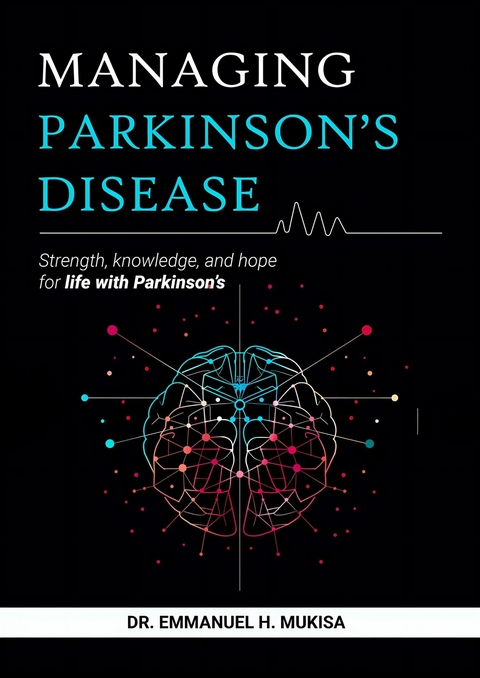
Managing Parkinson's Disease (eBook)
180 Seiten
Publishdrive (Verlag)
978-0-00-109835-0 (ISBN)
Living with Parkinson's disease comes with unique challenges, but it also offers opportunities for resilience, growth, and connection. Managing Parkinson's disease is a comprehensive guide that equips individuals, families, and caregivers with the tools and knowledge to navigate life with Parkinson's effectively.
The book begins by demystifying the condition, offering clear explanations of symptoms, progression, and the science behind Parkinson's, while dispelling common myths. It explores the latest research and treatments, from medications and surgical options to alternative therapies and dietary strategies for brain health.
With a focus on holistic care, managing Parkinson's disease delves into building a supportive care team, managing anxiety and depression, and embracing mindfulness and resilience. Beyond management, it celebrates thriving with Parkinson's by exploring mobility solutions, fostering social connections, and staying engaged with hobbies and interests.
Understanding Parkinson’s Disease
Parkinson’s disease is a powerful force in the lives of millions, but it is also one that brings out extraordinary strength and resilience in those who face it. This book is for anyone affected by Parkinson's, whether directly or through a loved one. It is not just a resource; it’s a journey of understanding, support, and hope. Throughout these pages, we’ll explore the complexities of Parkinson's and provide practical tools to navigate its challenges.
These pages are one way of sharing stories of inspiration and examples of remarkable strength born from adversity. Tales of Strength and Hope will guide you through the stories of people who lived their lives with Parkinson's disease. It is such stories as these that remind us of the indomitable human spirit possible, to rise even from those circumstances which sometimes to us appear insurmountable-a mean between the struggle.
In and of itself, the general nature of Parkinson's disease remains one of the most critical issues that will be discussed. A section entitled General Overview will seek to better define and explain what the disease is, how the disease comes to be a problem, and the general nature of risk factors. We are going to break down the scientific concepts of Parkinson's into pieces that one can understand, befitting a person who has just started learning about the disease.
Symptoms and the advancement of the disease all differ in each and every person who has Parkinson's. We take you through an understanding of what to expect in the course of the disease through clear, concise information on symptoms one should expect, ranging from tremors and rigidity to cognitive impairments. Motor and non-motor symptoms-including their evolution-are discussed here to give a hint of what possibly lies ahead.
Now, to understand how it affects the brain, keeping that in mind, we take you through neurologically-based underpinning with our Brain Changes in Parkinson's chapter. You will understand herein how the loss of dopamine-producing cells in your brain leads to motor symptoms. You shall be enlightened that new discoveries give reasons for believing that treatments, let alone cures, which are not far, open doors previously impassable.
This is because it will bring a considerable difference in the management of the condition, hence bringing health into control. Foods for Brain Health will review how nutrition has played a huge role in keeping brains working and slowing down degeneration of symptoms. It enables one to discover foods full of nutrients promoting brain plasticity, reducing inflammation with practical ideas to put into daily life.
Living with Parkinson's is all about environmental modifications. We would be giving some tips on how to learn to make the place of stay safe and friendly in Adjusting Your Home for Comfort. Some of these simple tips on minimizing the risk of falls, incorporating equipment providing ease in walking may give a better world for oneself and give them a good feeling of reliability for the patient and caregivers too.
With every diagnosis, a whole load of questions always follows, and in the case of PD, this certainly does not differ. Dealing with your emotions into daily challenges, Common Concerns helps to sort out so many questions running in mind. The area of focusing in this module will, therefore, throw light on commonly faced problems due to the recent diagnosis along with some practical tips for tackling such a situation.
Throughout the book, both the emotional and physical aspects of living with Parkinson's disease unfold. A diagnosis that is overwhelming brings greater understanding through personal experiences and expert guidance to comfort. It may help lessen some of the fear and isolation many experience by knowing you are not alone.
It will result in an informative resource, aside from informing it, becoming a direct call to action for carers, relatives, and friends. Helping a person with Parkinson's disease stands on tiptoes and faces a job that needs patience and great responsibility. The following guide shall permit you to be the ally that supports, bringing enrichment with the necessary knowledge to take over being a support system for your loved one.
As will be learned throughout the next few chapters, this is not about learning to cope with Parkinson's but how to live with it. From ideas ranging over mental and physical wellness to tales of ordinary bravery, this is something more than a combination of facts within one book. This book is one in which you not only can prosper and change but confidently face whatever comes your way in the future.
Tales of strength and hope.
But let this be said: Parkinson's is overpowering, yet it is a fantastic test of strength in the human spirit. So many people diagnosed with Parkinson's will not be defined by their sickness. They make certain that diagnosis gives them the reason to forge ahead, meet each day with determination, and live full lives. As one of the patients put it, Sarah, "I might have Parkinson's but Parkinson's will never have me". This is normally the reaction and a way of feelings expressed by quite many living with this illness.
John framed his experience of living with Parkinson's in his late 50s as one of adjustment: "I learned to adapt my lifestyle, and then gradually I started feeling ways in which I liked living." That might suggest others could tell their own stories, and en masse be resilient in support within the Parkinson's disease support group which John founded. Hope and resilience evolve from networks of relationship.
Exercise for many is the most powerful ally in living with Parkinson's. Lisa took up yoga because it enhanced balance and flexibility. She was diagnosed five years ago. "Yoga has transformed my body and my mind," she says. Specialists like Dr. John N. Caviness, a neurologist who specializes in Parkinson's, believe exercise may go a long way toward delaying decline in symptoms and improving general well-being. Lisa does believe that movement makes her healthy.
Peter had been a teacher and is now retired, but for more than a decade now, he had been living with Parkinson's. Early on, he made a conscious decision: the disease was not to take his pleasure of teaching away from him. Unable to stop and continuing this urge to share knowledge, he would volunteer at the local schools. "I can make a difference, even with Parkinson's," says Peter. It was also of great importance to have the PD people find new meaningful things and interests many years after the diagnosis date.
However, sometimes living through the Parkinson's emotional highway is not as easy as this; it is in these that their strengths flow most visibly in the marriages. Currently married for 30 years to her husband Mark, Parkinson's actually brought them much closer together. Emma will open, "Parkinson's taught us patience-to be patient with each other-and love." Strong and unending was this love as aptly depicted in how they behaved to one another.
First, she was devastated with the diagnosis; Carol always had one or another reason for channeling her energy into something very positive. Now a granny of three, Carol first initiated with her backyard and found peace in maintaining simple things. "The garden reminds me that life goes on and keeps going despite setbacks," explains Carol while explaining comfort with nature and a hobby for consolation and livelihood.
But so does hope-as the kind of medical treatment evolves. According to a researcher in Parkinson's diseases, Dr. Jane Smith, new therapies can make some difference in patients. "We are seeing promising results from clinical trials, and that gives us hope," she says. And it is this scientific progress that has been keeping many with Parkinson's through the tough times inspired to keep holding onto the belief that someday this may be a curable condition.
Support groups are important to cope with Parkinson's, and Michael had been attending the weekly Parkinson's support group. "I don't feel alone facing this anymore," he says. Shared experiences and empathy from other people do indeed take that isolated feeling often associated with a diagnosis away. The community brings hope, vividly told by Michael's experience.
Yet again, time and again, such patients with Parkinson's do not allow that to stand in their way as they go about living productive lives. Every day is another day to learn how to deal with this thing and enjoy my days," says Karen, a retired nurse, whose words echo many other patients who have learned to live with the disease, adapt to the illness, and refuse the disease to define their lives. Karen herself sounds optimistic when times get worse.
The new-found awareness seems the product of the hard road these patients have gone through, as most find their strength in trying to help others who are newly diagnosed with Parkinson's. Diagnosed two years ago, James has since volunteered to mentor others through some of the same trials. "I want to show them that life does not end with Parkinson's," he says. This would give hope a contagious factor whereby such acts of sharing one's strengths create cycles of positivity.
What is parkinson’s disease?
The onset and development of PD is primarily agitated through the ability to move, characterized by death or impairment of nerve cells, neurons in the brain that are responsible for developing a neurotransmitter chemical known as dopamine, which usually helps coordinate and govern movements and balances. During such death instances, the brain cannot organize movements appropriately. Various signs and symptoms including motor and non-motor are presented with...
| Erscheint lt. Verlag | 28.10.2025 |
|---|---|
| Sprache | englisch |
| Themenwelt | Medizin / Pharmazie ► Medizinische Fachgebiete ► Allgemeinmedizin |
| ISBN-10 | 0-00-109835-7 / 0001098357 |
| ISBN-13 | 978-0-00-109835-0 / 9780001098350 |
| Informationen gemäß Produktsicherheitsverordnung (GPSR) | |
| Haben Sie eine Frage zum Produkt? |
 EPUB (Adobe DRM)
Größe: 1,0 MB
Kopierschutz: Adobe-DRM
Adobe-DRM ist ein Kopierschutz, der das eBook vor Mißbrauch schützen soll. Dabei wird das eBook bereits beim Download auf Ihre persönliche Adobe-ID autorisiert. Lesen können Sie das eBook dann nur auf den Geräten, welche ebenfalls auf Ihre Adobe-ID registriert sind.
Details zum Adobe-DRM
Dateiformat: EPUB (Electronic Publication)
EPUB ist ein offener Standard für eBooks und eignet sich besonders zur Darstellung von Belletristik und Sachbüchern. Der Fließtext wird dynamisch an die Display- und Schriftgröße angepasst. Auch für mobile Lesegeräte ist EPUB daher gut geeignet.
Systemvoraussetzungen:
PC/Mac: Mit einem PC oder Mac können Sie dieses eBook lesen. Sie benötigen eine
eReader: Dieses eBook kann mit (fast) allen eBook-Readern gelesen werden. Mit dem amazon-Kindle ist es aber nicht kompatibel.
Smartphone/Tablet: Egal ob Apple oder Android, dieses eBook können Sie lesen. Sie benötigen eine
Geräteliste und zusätzliche Hinweise
Buying eBooks from abroad
For tax law reasons we can sell eBooks just within Germany and Switzerland. Regrettably we cannot fulfill eBook-orders from other countries.
aus dem Bereich