Anxiety Toolkit (eBook)
150 Seiten
Publishdrive (Verlag)
978-0-00-109800-8 (ISBN)
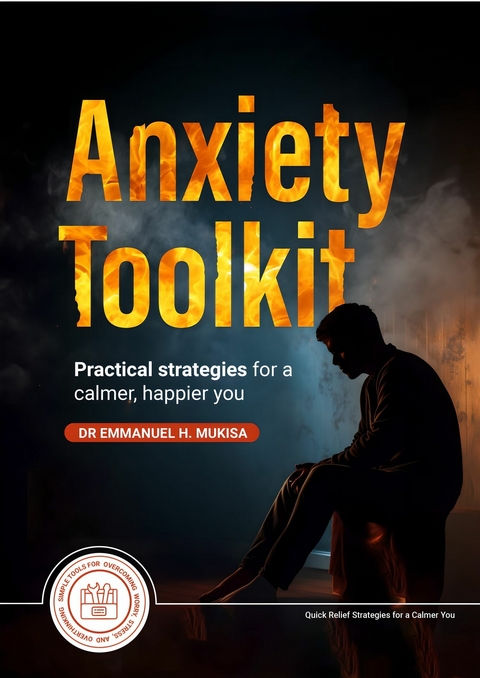
Anxiety Toolkit is your practical, empowering guide to navigating anxiety with confidence, clarity, and calm. This book isn't just about understanding anxiety, it's about transforming how you manage it, respond to it, and ultimately live beyond it.
Inside, you'll find a carefully curated collection of tools, from breathing techniques and mindfulness strategies to journaling prompts, CBT methods, and grounding routines. Each chapter is designed to be accessible and actionable, helping you regain control over your mind, body, and emotions, one step at a time.
Whether you're dealing with daily stress, social anxiety, or overwhelming worry, this toolkit offers a personalized path to relief. Anxiety Toolkit reminds you that you're not powerless, and you're never alone.
Recognizing the impact of anxiety on daily life
Anxiety can render a person highly crippling in his day-to-day functioning-even the level at which he undertakes basic activities will be different, starting with not being able to get out of bed to going on and accomplishing big tasks related to job or school. Anxiety might turn everything for him into some colossal monumental chore. Constant tension and fear act as a damper to decision, concentration, or relishing of small moments of life. The problem in such anxiety-avoidance behaviors is that, practiced for a long time, they will gradually turn the person to himself and away from social interactions and situations which may trigger anxious thoughts. It may indeed be true that limitations accrued long-term offer a sense of isolation, one in which the interaction with others, or the development of interests, is increasingly hard. Anxiety management to live a productive life again starts first with the awareness of such effects.
Anxiety, if chronic, may cause sudden discontinuity in the work or performance of a person. Anxiety itself may not allow one to concentrate on the given task or job, either in the office or at school. The person suffering from anxiety will also show a lack of punctuality over completion of work and poor performance. One cannot even undertake minor work as they are also afraid of making a mistake or judgment by others. Anxiety can also be physical, such as general symptoms like fatigue, headache, or muscle tension, which may further impair the ability to perform well. The stress following from difficulties in performing well either at work or when studying is a sort of vicious circle: because anxiety leads to poor performance, while poor performance in turn is increasing anxiety. Being able to reduce anxiety is, therefore, key to productivity and success.
Anxiety can also considerably hamper social interactions. People with anxiety are very apprehensive about their look in front of others; because of this, some kind of phobia of some situations in social life might arise. Some can be manifested by avoiding parties or being extremely uneasy in a group and even dealing with just one single person. Social anxiety makes people interact inadequately with others or enjoy the company of people. Not making enough sense and not acting the fool buffers from real contact. A feeling of isolation, lonely, and creates an interacting cycle, feeding back again in feelings of anxiety.
These are usually individuals who also have their improved confidence levels through social interactions after the counselor shows ways to better anxiety management. One symptom of anxiety, sleep disturbance, places much impact on the functionality of a person. People with anxiety do have sleep disturbances due to racing thoughts or physical sensations of anxiety manifested by rapid heartbeats and shallow breathing. In the event that they actually get to fall asleep, the quality of rest is usually poor, and they will always wake up tired and exhausted the following day. Such sleep deprivations may only heighten symptoms of anxiety in a vicious circle of stress and eventual exhaustion. The lack of sleep itself will further exacerbate the person's psychic deficit in the tasks of sustaining alertness and managing his or her emotions. Improvement will usually be realized when anxiety symptoms are relieved because sleep quality will improve with one's progress in health.
It is also probably that anxiety precipitates other physical health conditions apart from the feeling of jitters or edginess. Anxiety is also considered a contributing factor in high blood pressure and a risk to cardiovascular issues. Anxiety always keeps the human body under pressure. Since anxiety affects all the systems of the body, it leads to serious complications in their health afterward. Most people who undergo anxiety in terms of muscle tension cause chronic pain mainly in the neck, shoulder, and back regions. Anxiety being a not just an emotional issue but also a physiological one, to be considered in order for the whole being to feel healthiness and wellness.
Anxiety is emotionally depleting which may be manifested by feelings of hopelessness, frustration, and helplessness. The overwhelming feeling of anxiety about the future or how something may go wrong steals any sense of pleasure that may occur and thereby makes happiness very hard to experience. Anxiety will at other times present in symptoms of irritability or mood swings due to high tension levels. Chronic emotional stressors such as this have a possibility of eventually culminating in depression and further complicating the mental outlook. It is a thing to treasure. Anxiety has been taken out on an emotional level. The anxiety gets in the way of recovery and into the way of a lifestyle, such therapies of mindfulness strategies and self-care may be lightening some of this toll. Besides, it gets in the way even of day-to-day decisions-even the very minor choices are seemingly impossible to make."
Anxiety is said to be associated with an individual who thinks over every action or even minute details-just not to make a wrong choice. Therefore, he lives being plagued with every other adversity. This mere overthinking procrastinates on making decisions; it freezes the man. Long-lasting effects would begin to manifest within personal and professional life through feelings of intrusion and self-doubt and inadequacy in general. They suffer on account of lost opportunities and stagnation when one can't make any decisions. It is helpful in letting the people learn to trust themselves once again, knowing that anxiety does not get the best of them. Anxiety has several other important effects.
One of the most important being the fact that it stultifies the pursuit of goals and personal growth. Anxiety would not let them attempt or follow anything due to the mere reason that it made them afraid of failure or criticism. Anxiety brings overwhelming phobia of the unknown in everything coming along, be it a new job, a new hobby, or even a journey. This will make a person want to be within his or her comfort zone, avoiding all challenges that can lead them to their development. These long periods of avoidance, in turn, create feelings of a life wasted or an opportunity missed. Working through anxiety allows an individual to move from a comfort zone into new and more fulfilling levels of growth and expansion. Relationships in the family or friends also suffer because the anxiety makes it tough for an individual to express needs or verbalize their emotions. It makes them incapable of being present within those relationships due to anxiety and fear about that eternal state.
Family and friends misunderstand symptoms, both emotional and physical-are frustrating. There is a sense of isolation-a time when persons have fear of burdening others with one's problems. And reaching out in such situations becomes tough. It is here that open communication and anxiety education may strengthen these relationships and thus understanding may be possible. But it is very crucial to have people close by who will share the anxiety with. Another important question concerns anxiety's influence on self-esteem.
Feeling always on edge, inferior or helpless cannot but affect their self-esteem. The anxious individuals internalize their failures and hence perceive that they cannot cope with life. Such a partial view of the self may make the individual not believe in his own decisions and judgments concerning his life. Anxiety also creates a situation where persons compare themselves with others thus increasing their feelings of inadequacy. Through therapy and practice of self-compassion, persons may rebuild their self-esteem to view themselves in positive light. Anxiety generally entails bad coping strategies since these are ways used by individuals to deal with their stress that actually exacerbate the situation.
Some would self-medicate with alcohol, drugs or overeating. They may temporarily alleviate the problem but usually contribute to more ills such as addiction and physical health problems. Other very common coping strategies include the avoidance of situations or responsibilities that make a person anxious. Thing is, though, with avoidance, it reinforces anxiety whenever it makes it even more difficult later on in life to approach the challenges thrown at them. Healthier ways of coping, including mindfulness and exercise, may decrease anxiety without many of those crippling side effects associated with such aforementioned destructive behaviors. Another vast area in which anxiety does tend to have quite a big effect is regarding money matters.
These nagging thoughts of money, debt problems, and job concerns put tremendous stress on the mental wellbeing in entirety. Mostly, anxiety increases the fear that they will never take care of themselves or their family again. The same nagging financial concerns may further cause sleepless nights, low output, and even relationships at an all-time low. It will also make them avoid matters of finance, further escalating the situation. It is about learning how to handle financial stress either by budgeting or seeking financial counseling in order to lessen anxieties about money. Time management becomes the major headache of the anxiety-prone individual.
This eternal state of apprehension about unfinished jobs or expectation fulfillment results in procrastination and inability to prioritize tasks. Anxiety is the emotional state featuring a feeling in the individual of inability to cope with demands placed even when he or she is quite capable of meeting such demands and has all the resources, including time, to meet the demand. This results in missed deadlines, low performance, and constant tension in life. Many...
| Erscheint lt. Verlag | 3.11.2025 |
|---|---|
| Sprache | englisch |
| Themenwelt | Medizin / Pharmazie ► Medizinische Fachgebiete ► Psychiatrie / Psychotherapie |
| ISBN-10 | 0-00-109800-4 / 0001098004 |
| ISBN-13 | 978-0-00-109800-8 / 9780001098008 |
| Informationen gemäß Produktsicherheitsverordnung (GPSR) | |
| Haben Sie eine Frage zum Produkt? |
 EPUB (Adobe DRM)
Größe: 1,3 MB
Kopierschutz: Adobe-DRM
Adobe-DRM ist ein Kopierschutz, der das eBook vor Mißbrauch schützen soll. Dabei wird das eBook bereits beim Download auf Ihre persönliche Adobe-ID autorisiert. Lesen können Sie das eBook dann nur auf den Geräten, welche ebenfalls auf Ihre Adobe-ID registriert sind.
Details zum Adobe-DRM
Dateiformat: EPUB (Electronic Publication)
EPUB ist ein offener Standard für eBooks und eignet sich besonders zur Darstellung von Belletristik und Sachbüchern. Der Fließtext wird dynamisch an die Display- und Schriftgröße angepasst. Auch für mobile Lesegeräte ist EPUB daher gut geeignet.
Systemvoraussetzungen:
PC/Mac: Mit einem PC oder Mac können Sie dieses eBook lesen. Sie benötigen eine
eReader: Dieses eBook kann mit (fast) allen eBook-Readern gelesen werden. Mit dem amazon-Kindle ist es aber nicht kompatibel.
Smartphone/Tablet: Egal ob Apple oder Android, dieses eBook können Sie lesen. Sie benötigen eine
Geräteliste und zusätzliche Hinweise
Buying eBooks from abroad
For tax law reasons we can sell eBooks just within Germany and Switzerland. Regrettably we cannot fulfill eBook-orders from other countries.
aus dem Bereich