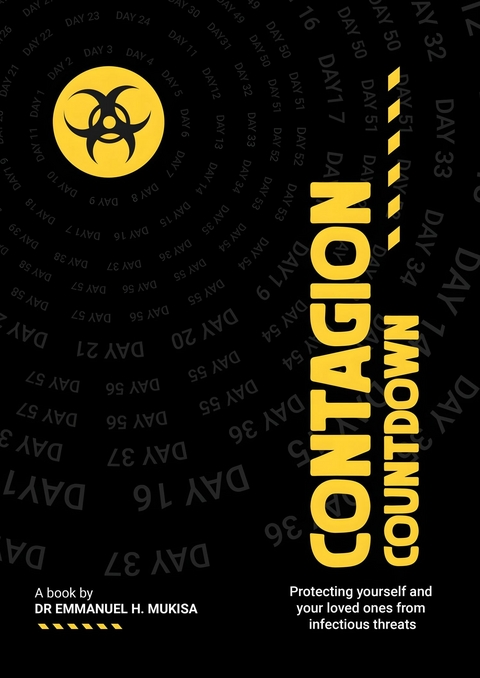
Contagion Countdown (eBook)
164 Seiten
Publishdrive (Verlag)
978-0-00-109565-6 (ISBN)
Contagion countdown is a powerful, practical guide that unpacks how infectious diseases spread and how you can protect yourself and your loved ones in a world that's always at risk of the next outbreak. Blending scientific clarity with accessible language, this book covers everything from how pathogens like viruses, bacteria, and fungi invade the body, to how our immune systems respond. You'll learn about transmission methods, the science behind hygiene practices, and how tools like masks, social distancing, and quarantine help break the chain of contagion.
But it goes deeper, exploring critical issues like herd immunity, antibiotic resistance, vulnerable populations, and the role of mental health during times of widespread illness. With a strong emphasis on preparedness, Contagion countdown also helps you build a home emergency kit, travel smart, and adopt habits like nutrition, sleep, and mindfulness that keep your immune system strong year-round.
Body's defense: The immune response
The immune system is one of the major organs controlling responses to infection. It would then recognize the foreign invader after the pathogen has gained entrance into the body and mount immediately a defense against it. However, an infection would vary in their severities and is dependent on the strength and efficiency of the immune system. Many types of immune deficiencies leave individuals susceptible to serious disease. It involves, through vaccination, familiarizing the body's system with the condition of fighting off certain pathogens without succumbing to the disease. By making sense of the concept of immunity, a person may likely reflect on how precautionary the ways are in terms of combating contagious diseases.
In another broad foundational dimension of understanding the infectious diseases lie the role played by pathogens in contagion. The invading microorganism is termed as 'pathogen' and it interferes with normal physiological functioning. With time, these pathogens may take a turn which may alter either their form of transmission or eluding capabilities of the host immunity. This is so with virus mutations that come up with strains that might just well infect someone who by now is supposed to have achieved immunity. Actually this happens quite often and explains why vaccinations for things like the flu get prepared annually. Research into the pathogenic agents serves in devising medicines and vaccinations to hamper an infectious cycle.
On larger scales, outbreaks of infectious diseases have brought societal, economical, and even major political repercussions in every given end. The chances are that a highly contagious disease may spiral out of control in no time and send the whole health machinery grinding, creating mass hysteria among ordinary people. The economies bleed when businesses fold up and workers succumb to the disease. Such outbreaks, left to the government of the countries involved, particularly those underdeveloped nations and various international bodies, would at least contain it at first to minimal damage the onslaught on the people at large. One important entity required by any public fear in order that proper dissemination to the public would result is proper communication. Secondly, a quarantine and isolation strategy in public health serves to limit the contagion.
Contagion considers yet another factor that is "herd immunity." Herd immunity defines it rightly as the concept when the majority of people in a population have lost their susceptible status to a contagious agent and the spread of it, in general is impeded in a population. An individual may acquire his or her immunity through vaccination or by previous contact with the infectious agent. Principle: The presence of large enough number of immune individuals ensures outbreak cannot occur and hence protects the people who may, due to medical reasons can never get immunized apart from saving herd immunity from those that are more susceptible, that positions the vaccination programs at the front in management infectious diseases.
Other ecological level factors contributing to emergence and transmission include: For example, climate change can favor the distribution of insects carrying pathogens and their forecasted distribution. Long-term changes in temperature and rainfall may extend the distribution range where disease vectors-like mosquitoes carrying malaria and Dengue fever are found. Some of the changes occurring in our environment due to these and similar factors will act to expose human populations to pathogens more. All these things, therefore, show in which area outbreak will happen and prepares us beforehand. The Public health officers should base their preparations against the diseases starting from the environmental considerations.
Quarantine and isolation are the two common methods of infectious diseases control in outbreaks. These are the methods used in separating the infected individuals from others to curb further transmission. Quarantine has been a consistent tool, from outbreaks of the plague right through to its most recent utilization in COVID-19. Quarantine itself and isolation do have significant, though effective roles burdened as they are, with considerable costs socially and economically. Quarantine requires an especially effective system of communication with contingency planning if such a measure was to be set in place, without generating an unnecessary panic, hardship amongst others. Their effectiveness, when applied, again generally is most pronounced during the early phase of outbreaks.
Vaccines and modern antiviral medications have contributed a great deal toward bringing contagion under better control than in earlier epochs. Vaccination is among the most important preventive tools against outbreaks of infectious diseases. They work typically by inducing the immune system against certain pathogens. While the rest, antibiotics destroy the microorganism while antiviral drugs only reduce the severity and duration of infection of some others. These pharmacologic miracles have eliminated diseases like smallpox while others, like polio is, are rare now. Others yet are called the re-emergent infectious disease, necessitate that research must now be emphasized and accelerate treatments development and vaccine preparations are put to service.
Infections are everyone's problem thus infectious disease control need the co- operation and partnership of all independent nations worldwide. Diseases know no borders, and outbreaks spill over across borders so easily. Other international bodies, like the World Health Organization return the favor of having a role in coordinating international efforts against infectious diseases by advising on best practice, distributing resources, and tracking the spread of diseases around the world. It thus needs a collaborative effort by governments, health-related associations, and interested societies the world over to work together in the direction of a decline in contagion rates across the globe. This will eventually lead to diseases ceasing to spiral into pandemic patterns before they actually do.
Technological advancement reconceptualises some of our notions about contagion and mapping. Among the ways scientists have tried to accomplish a combination of speedy tracing of pathogens in addition to trying to trace dissemination, genetic tracing, and contact mapping come forward. It is also partly because of that technology that outbreaks of Ebola were managed and, with parts, COVID-19 too. For example, contact tracing would spot people who are likely to have been exposed to viruses and in need of targeted quarantines. Artificial Intelligence and big data build up the predictive and responsive capability in the infectious disease outbreaks. New solutions unlock avenues for faster and more precise response to contagions.
Knowledge and education programs in fact are considered among the foremost infectious disease management strategy. The sensitivity of the masses toward maintaining hygiene practices and vaccination, about transmission mode of any particular disease shall reduce their possibility to be vulnerable to get that particular infection. Improves the rate of transmission by washings of hands, wearing of masks, as well as keeping social distancing in cases of outbreaks. The education on proper knowledge acquisition would be done at schools, workplaces, and communities. These diseases only bring minimal impacts if proper educative platforms concerning the diseases have been done and returned by public cooperation events of outbreaks. Infection can be curbed with the help of empowering people about the right information.
Genetics is playing a crucial role in contagion these days. It might be the case that the underlying genetic conditions control individuals' susceptibility to an infection and/or the spread of the pathogen. Whatever disease strikes anywhere in the world, the resistant and affected individual sets may have only one factor to explain genetic causes. The study is being done on both human and pathogen genomes concurrently to find such an interplay. This henceforth will improve personalized treatment and preventive measures, keeping the genetic background in view. Contagion genetics helps the researchers improve the predictability of a breakout of the disease and hence it helps in its prevention.
The resistance of antibiotics is the latest concern related to contagion studies. Due to overuse and due to its inappropriate handling the bacteria are developed into strains that can grow in resistance to such drugs. Resistant bacteria are more difficult to treat and apt to spread more. Resistant infections increase tenure of hospital stays, is also expensive as it covers highly valuable medicines and treatment practices involved and enhance mortality rate. Resistance can be fought by the correct use of antibiotics, and this shall be encouraged by developing more new therapies. This will also be a contribution to prevention in public health - not to spread the resistant bacteria and to promote proper use of antibiotics among the public.
Besides, infectious diseases of particular virulence may attack with particular virulence in people of all ages but mainly amongst the vulnerable aged and young children along with people having lowered immunity due to diseases. These inequalities-shaped by access to health services, housing, and nutrition-are the modulus through which vulnerabilities to infection and death from infectious diseases are determined. They have implications for contagion. In infectious diseases, the burdens associated with vaccination treatment and prevention minimize burdens among the susceptible populations. Were such a population's protection to be taken seriously, the implication would...
| Erscheint lt. Verlag | 3.11.2025 |
|---|---|
| Sprache | englisch |
| Themenwelt | Medizin / Pharmazie |
| ISBN-10 | 0-00-109565-X / 000109565X |
| ISBN-13 | 978-0-00-109565-6 / 9780001095656 |
| Informationen gemäß Produktsicherheitsverordnung (GPSR) | |
| Haben Sie eine Frage zum Produkt? |
 EPUB (Adobe DRM)
Größe: 948 KB
Kopierschutz: Adobe-DRM
Adobe-DRM ist ein Kopierschutz, der das eBook vor Mißbrauch schützen soll. Dabei wird das eBook bereits beim Download auf Ihre persönliche Adobe-ID autorisiert. Lesen können Sie das eBook dann nur auf den Geräten, welche ebenfalls auf Ihre Adobe-ID registriert sind.
Details zum Adobe-DRM
Dateiformat: EPUB (Electronic Publication)
EPUB ist ein offener Standard für eBooks und eignet sich besonders zur Darstellung von Belletristik und Sachbüchern. Der Fließtext wird dynamisch an die Display- und Schriftgröße angepasst. Auch für mobile Lesegeräte ist EPUB daher gut geeignet.
Systemvoraussetzungen:
PC/Mac: Mit einem PC oder Mac können Sie dieses eBook lesen. Sie benötigen eine
eReader: Dieses eBook kann mit (fast) allen eBook-Readern gelesen werden. Mit dem amazon-Kindle ist es aber nicht kompatibel.
Smartphone/Tablet: Egal ob Apple oder Android, dieses eBook können Sie lesen. Sie benötigen eine
Geräteliste und zusätzliche Hinweise
Buying eBooks from abroad
For tax law reasons we can sell eBooks just within Germany and Switzerland. Regrettably we cannot fulfill eBook-orders from other countries.
aus dem Bereich