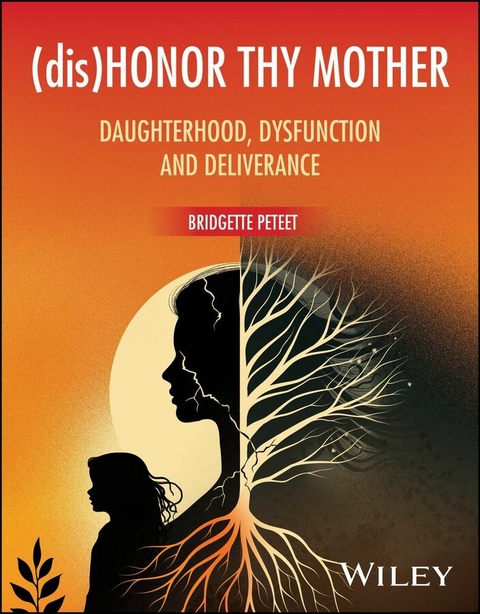
(dis)Honor Thy Mother (eBook)
342 Seiten
Wiley (Verlag)
978-1-394-35971-4 (ISBN)
Relatable stories and psychological insights on how childhood experiences shape us, and how we can reclaim ownership over our lives in the wake of trauma
Daughters who have experienced parental abuse, neglect, separation, and other traumas often find themselves in need of support later in life. (dis)Honor Thy Mother explores why our childhoods can be so haunting, and how we can build resilience through growth and healing. Through the lens of the Adverse Childhood Experiences (ACEs), this book presents personal stories-including the author's own story of growing up with and learning to grow beyond her abusive mother-that bring deep psychological insights to life.
This compelling, inventive book helps readers understand their own experiences and those of others. Each chapter weaves together narrative, psychological research, and straightforward advice. The ACEs framework provides a structure for identifying and naming the types of abuse many daughters suffer, along with their associated outcomes, particularly 'impostorism.' Abused daughters often turn into high-performing women who struggle with the feeling that their achievements are undeserved. In (dis) Honor Thy Mother, Dr. Bridgette Peteet unpacks this impostor phenomenon and provides resources for women who are ready to move past the past and embrace their own fundamental worth.
Drawing from academic literature, research evidence, clinical experience, and personal history, Dr. Peteet reaches recovering adult daughters, clinicians, and scholars alike.
BRIDGETTE PETEET, Ph.D., is a licensed clinical psychologist and a Professor in the Department of Psychology at Loma Linda University in Southern California. She provides clinical training and instruction for psychology doctoral students in multicultural therapy and substance use disorders. In her multicultural clinical practice, she has served hundreds of clients of color. Dr. Peteet has also authored 25+ research publications with more than 1,000 citations. Her research focuses on risk and resilience related to the health and well-being of marginalized communities.
Relatable stories and psychological insights on how childhood experiences shape us, and how we can reclaim ownership over our lives in the wake of trauma Daughters who have experienced parental abuse, neglect, separation, and other traumas often find themselves in need of support later in life. (dis)Honor Thy Mother explores why our childhoods can be so haunting, and how we can build resilience through growth and healing. Through the lens of the Adverse Childhood Experiences (ACEs), this book presents personal stories including the author s own story of growing up with and learning to grow beyond her abusive mother that bring deep psychological insights to life. This compelling, inventive book helps readers understand their own experiences and those of others. Each chapter weaves together narrative, psychological research, and straightforward advice. The ACEs framework provides a structure for identifying and naming the types of abuse many daughters suffer, along with their associated outcomes, particularly impostorism. Abused daughters often turn into high-performing women who struggle with the feeling that their achievements are undeserved. In (dis) Honor Thy Mother, Dr. Bridgette Peteet unpacks this impostor phenomenon and provides resources for women who are ready to move past the past and embrace their own fundamental worth. Drawing from academic literature, research evidence, clinical experience, and personal history, Dr. Peteet reaches recovering adult daughters, clinicians, and scholars alike.
CHAPTER 1
I'll Beat the Black Off of You
Adverse Childhood Experience—Physical Abuse:
Physical abuse is when a parent, stepparent, or adult in the home intentionally harms a child through physical contact: pushing, grabbing, slapping, throwing something at the child, and hitting the child so hard that they are injured or have marks.1
THE RHYTHMIC TAPPING of raindrops on the window of my cozy private practice office created a soothing background as Mia settled deeper into the worn oversized chair across from mine. I sat, one leg crossed over the other, in patient observation, waiting for her to continue.
“It's like I let everyone down,” Mia went on, her voice heavy with a mixture of what sounded like regret and frustration. “I'm supposed to be strong, the Fire Captain who could handle anything. And now … now I can't even control my own body.”
Mia, a 51‐year‐old single Black female, had served as a dedicated firefighter for 26 years until a severe fall from a ladder forced her into an unexpected early retirement. She'd endured multiple surgeries over six months, yet the incident left her with a permanent physical impairment of her left leg and chronic pain. She was referred to my psychology practice at the university where I also taught through her worker's compensation benefits. Mia was seeking support for mood issues stemming from this chronic disability. After an intake and three therapy sessions, Mia was beginning to explore her emotions in depth.
“From what you've told me, it's understandable that you'd feel that way, Mia. You've carried a heavy burden of expectations for a long time, an expectation of strength for one. You're experiencing a great deal of physical pain right now and that's a lot for anyone to deal with long‐term,” I offered.
“I haven't had pain like this since …” Mia hesitated.
I paused with her, knowing that silence can be a powerful tool in therapy, bridging paths to new exploration and insights.
“… since, my mother yanked my shoulder out of its socket when I was little,” Mia continued.
The session had turned one way while my stomach turned another. Child abuse, past or present, spikes a defensive nerve in me, an urge to protect and defend. It's the reason why I treat adult clients and teach adult learners. Working with children weighs too heavily on my psyche. Back when I was an early trainee, it pained me to work with kids only to send them home to chaotic environments and abusive parents. There's constant mandated reporting, which requires psychologists and other health professionals to contact protective services for any suspicion of child or elder abuse or neglect. God bless those who have the stomach for child therapy because even after 20 years I do not.
Mia had already shared that her mother was deceased, and I was relieved, as a mandated reporter, not to have to investigate her mother's current access to and abuse of other children. Mia continued her story.
“I was six years old and roughhousing in the living room with my younger brother. He kicked over a table lamp and it shattered. I hurried to clean up the broken pieces but knew it was too late. Mom had heard. She was rushing toward me from the kitchen, not asking questions and yanking me up from the floor by my arm. I heard a loud pop. The pain was so unbearable that I fainted. From there, my memory fades. There was a surgery and there was a story.”
“A story?”
“Yes. I can recall my mom, stepdad, and grandma at my hospital bedside after surgery telling me to say that I fell. They didn't want Mom to get into trouble. She'd been in jail before, and I didn't want to be the one to send her back. I was scared,” Mia said tearfully.
“I've never told anyone that before,” she finished just above a whisper.
“Well, I want to thank you for your vulnerability with me here today. How do you feel after sharing your story for the first time?” I probed gently.
“I feel free like a weight has been lifted. But also, a little bit guilty like I betrayed my mother by telling you. Looking back, I think my mother was mentally ill. She'd have these uncontrollable mood swings at times, hit me, and call me names. She could be very loving though. I know she loved me in her own way.”
“It sounds like your mother may have certainly suffered from mental health issues; however, that doesn't absolve her from her parental responsibilities. It also doesn't erase the harm that was done to you. I think of these external forces like mental illness and substance abuse as explanations, not justifications. An explanation tells us why; it's a point of fact. Justification implies that an action is right, okay, or acceptable. Does that make sense to you Mia?”
“I never thought about it that way Doc. I've always blamed myself, made excuses for my mother, and been the dutiful daughter even until her death. I worked hard to make something of my life to please her. I think I might want to talk about that a bit more in here if that's okay.”
“Yes, of course it is.”
“I'm an expert in this,” I thought silently.
I provided brief psychoeducation on adverse childhood experiences (ACEs) before summarizing our session and giving Mia the link to the ACEs questionnaire to complete before our next session.
Instead of immediately typing up my session note, I stared out the water‐speckled window of the office high‐rise. How many times had I treated “Mia”? Too many to count. It wasn't always a case of physical abuse; sometimes it was the hypercritical, excessively negative, or emotionally abusive mothers whose broken daughters ended up on my couch. How long would they suffer in silence? Something about that question felt hypocritical though. I'd never fully shared my story, even with my therapists. Maybe someday sharing my experience could help others, I thought. Memories began swirling like the thunderclouds above, dredging up my dark past to the surface.
***
The evening sun cast a faint glow on the quiet suburban street while shadows danced beneath the swaying trees. In one of the old paneled houses, behind a façade of normalcy, a different kind of storm brewed.
I was halfway up the carpeted staircase of my childhood home when her words struck me like a sudden gust. Swiveling on my heel, I gazed downward at my mother, Debra, who was springing up from the bathroom floor. The weight of regret settled in me instantaneously due to the unkind words I had only moments ago uttered to my younger sister, Devon.
Mom screamed at me, “THAT'S IT; I'VE HAD IT WITH YOU!”
Her tone carried a chilling promise—she was literally going to kill me this time. She ordered me back down the stairs, cussing and screaming at me the whole way. In the living room, she retrieved the 3‐ft‐long brown extension cord from the wooden corner cabinet, folding it in half with the ends in her grip. I hoped she'd hold on tight this time, or the pain and bruising from the stiff metal prongs or plastic inlet would make it doubly unbearable.
“I am going to beat the black off of you!” she promised.
My three siblings had hastily escaped to the next room, afraid of catching an accidental blow from an uncontrolled backswing. If they inadvertently got hit, she'd say it was for something else they had done that she didn't know about; there was never an apology.
I'd weighed the gravity of my crime, determining if I got to keep my clothing on as a mild buffer to the blows of the malleable plastic whip or whether I'd have to strip down to my bare skin. Jeans were the optimal shield, the only item that prevented welts. Sweatpants or khakis were equal, both lessening the sting of rubber meeting flesh. Shorts left the back of your lower legs exposed. My mother loved to show off her legs with smooth, light skin. At home, she usually wore shorts and let her breasts sag under her t‐shirt in adult rebellion against her mother's strict rule to wear a “brassiere” 24/7. I was momentarily grateful that my legs were covered by slacks that day.
I trembled at Mom's approach, hands out in front in a defensive posture in case she struck early. Eyes blazing, she walked toward me and commanded, “Drop your pants!” My eyes widened in disbelief. I had misjudged my sentence. My older brother, Tony Jr., had been whipped nude for stealing money from Mom's purse or riding his bike to another city with friends in the middle of the night. That day, I'd voiced three little words to Devon.
I slowly complied with her command and unbuttoned my pants. I was an obedient child and had spent my life trying to avoid triggering her rage. If I did everything right, I hoped I wouldn't be beaten. But I still regularly miscalculated. I'd try to avoid the whippings my siblings got for things like skipping chores, poor grades, and fighting. Still, I'd find myself as the oldest daughter held equally responsible for their failure to complete an assigned task or not making them do their homework and got whipped, too.
In our family ecosystem, I was the responsible child and yet the scapegoat for our family problems. Tony was the designated golden child, the only boy and the oldest. He did little to...
| Erscheint lt. Verlag | 3.11.2025 |
|---|---|
| Sprache | englisch |
| Themenwelt | Medizin / Pharmazie ► Allgemeines / Lexika |
| Schlagworte | Abusive mothers • Adverse Childhood Events • Child Abuse • dysfunctional mothers • maternal abuse • maternal dysfunction • maternal maltreatment • maternal mental illness • maternal neglect • maternal substance abuse • maternal violence |
| ISBN-10 | 1-394-35971-3 / 1394359713 |
| ISBN-13 | 978-1-394-35971-4 / 9781394359714 |
| Informationen gemäß Produktsicherheitsverordnung (GPSR) | |
| Haben Sie eine Frage zum Produkt? |
 EPUB (Adobe DRM)
Kopierschutz: Adobe-DRM
Adobe-DRM ist ein Kopierschutz, der das eBook vor Mißbrauch schützen soll. Dabei wird das eBook bereits beim Download auf Ihre persönliche Adobe-ID autorisiert. Lesen können Sie das eBook dann nur auf den Geräten, welche ebenfalls auf Ihre Adobe-ID registriert sind.
Details zum Adobe-DRM
Dateiformat: EPUB (Electronic Publication)
EPUB ist ein offener Standard für eBooks und eignet sich besonders zur Darstellung von Belletristik und Sachbüchern. Der Fließtext wird dynamisch an die Display- und Schriftgröße angepasst. Auch für mobile Lesegeräte ist EPUB daher gut geeignet.
Systemvoraussetzungen:
PC/Mac: Mit einem PC oder Mac können Sie dieses eBook lesen. Sie benötigen eine
eReader: Dieses eBook kann mit (fast) allen eBook-Readern gelesen werden. Mit dem amazon-Kindle ist es aber nicht kompatibel.
Smartphone/Tablet: Egal ob Apple oder Android, dieses eBook können Sie lesen. Sie benötigen eine
Geräteliste und zusätzliche Hinweise
Buying eBooks from abroad
For tax law reasons we can sell eBooks just within Germany and Switzerland. Regrettably we cannot fulfill eBook-orders from other countries.
aus dem Bereich