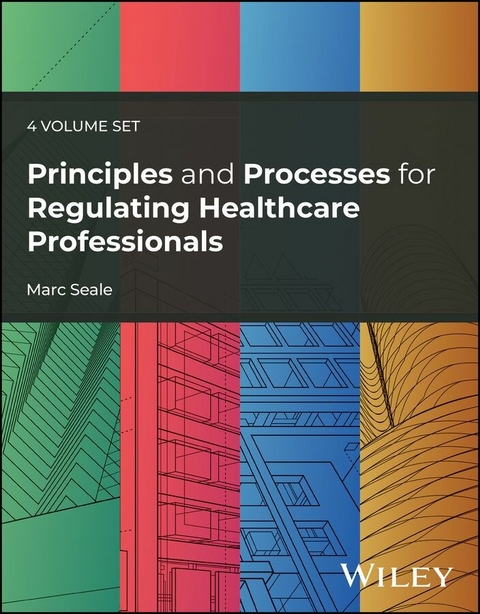
Principles and Processes for Regulating Healthcare Professionals, 4 Volume Set (eBook)
3310 Seiten
Wiley (Verlag)
978-1-394-33348-6 (ISBN)
These 4 volumes address a complex, ever-changing regulatory landscape and provide practical guidance for navigating the procedural and operational realities of healthcare regulation
In Principles and Processes for Regulating Healthcare Professionals: 4-Volume Set, experienced international healthcare regulator Marc Seale delivers a 4-volume set explaining the most critical aspects of UK healthcare regulation. This set includes:
- Foundations of the Regulation of Healthcare Professionals
- Processes to Regulate Healthcare Professionals
- Performance of Healthcare Professionals, Crossing Borders and New Professions
- The Operations of Regulators of Healthcare Professionals
Each volume offers a thorough and authoritative introduction to its topic based on the most recent legislation, best practices, regulatory standards, and tribunal and court decisions that govern the actions of UK healthcare practitioners. Perfect for the educators and teachers of healthcare students, Principles and Processes for Regulating Healthcare Professionals will also benefit consumer advocates, healthcare employers, members and leaders of professional associations, lawmakers and regulators.
Marc Seale was the Chief Executive and Registrar of the Health and Care Professions Council-the UK's multi-professional regulator-for 18 years. He has extensive experience in the regulation of healthcare professions in the UK, Europe, and the USA.
Preface
Many professions throughout the world are regulated. Most readers will be familiar with the grandees of regulated professions, such as doctors and lawyers, whose practice is regulated in virtually every country. However, what will probably be less well known to some is that hundreds of other occupations such as farriers, medical secretaries, and barbers are regulated in various countries.
In the United Kingdom, the regulation of a profession usually involves the publication and maintenance of a list, or register, of individuals, or registrants, who have achieved specific standards of education and training; maintain their knowledge skills, values, and behaviours; and have the exclusive right to use a particular job title or to undertake a distinct function. The register is a public document, which is available for inspection by all. The keeper of the register is the regulator, whose function is to ensure that standards to join and remain on the register are maintained.
A brief review of the regulation of professionals will quickly identify a range of interrelated topics, such as standards of education and training, fitness to practice, public involvement, grandparenting, etc. The number of topics is extensive, indeed there are over three thousand entries in the index of the book. The reader may start to speculate on which topics are important or controversial, how they work, how they are evolving, and how they relate to one another.
To explore these issues, the inquisitive reader will readily find a plethora of academic research papers, doctoral thesis, technical journals, and specialist books, but no single comprehensive reference guide. Grey literature such as legislation, consultation documents, and reports of government inquiries also provides further information as do the numerous publications of the regulators of healthcare professionals, consisting for example of standards, guidance, policy documents, and annual reports. Unfortunately, they are often written without any explanation of how they fit into the wider regulatory arena. Also, the authors of these publications frequently support a particular stance on how regulation should, or could, work. In addition, many of the authors often have no practical experience or knowledge of the actual challenges faced in the day‐to‐day operations by a regulator. Further barriers also arise from the use of impenetrable jargon, that is made worse by a lack of clear definitions. For example, what exactly is a professional, and why are some professions regulated whilst others are not? What is the rationale for this?
The inquisitive reader may rapidly become perplexed and frustrated, as there is no obvious, single comprehensive source that rigorously analyses all the components and their relationships of the principles and processes for regulating healthcare professionals.
The book has therefore been written to correct this deficiency and provide a single thorough reference guide to the principles and processes used to regulate healthcare professionals in the United Kingdom at the start of the twenty‐first century. It may also assist those who extemporise on the regulation of healthcare professionals.
The book does not support or reject a particular set of permutations of the many variables that form the regulatory environment of healthcare professionals. Rather, it aims to identify the principles and processes of a particular regulatory topic and then to assess the pros and cons of each variable and position each on a spectrum of choice. It is for others to decide on the merits or otherwise of a particular set of options. It also aims to assist the reader to clearly identify how a particular issue fits into the overall regulatory landscape.
The readership of this book, in terms of the their detailed understanding and familiarisation of the regulation of healthcare professionals, is potentially broad, ranging from newly appointed employees working in junior administrative roles of a regulator to knowledgeable board members of regulators with long careers and varied experiences. This raises the challenge of where to pitch the level of observation, examination, analysis, and explanation of each individual topic addressed in the book. The approach I have adopted is to assume the reader is not familiar with the topic and to start with basic principles. Readers with greater knowledge or experience in a particular area may therefore choose to skip certain sections where they have a firm grasp of the issues of the particular topic.
The potential audience of this book is as broad and varied as the issues addressed in it. Readers may work in institutions and organisations directly concerned with the regulation of healthcare professionals, or they may be on the periphery of the sector. However, the book has been written primarily for a number of specific audiences, including:
- Consumer organisations
- Educators and trainers of healthcare professionals
- Employees of regulators
- Employers of professionals
- Government officials
- Healthcare professionals
- Members of the governing bodies of regulators of professionals
- Professional associations
- Researchers
- Student healthcare professionals
I have sought to make the book as accessible to as wide an audience as possible. To accommodate the range of potential readers, the book is deliberately not written in the style of an academic journal or book. For clarity, wherever possible each section of the book addresses a discrete topic, and a limited number of publications have been referenced. I have also sought to avoid duplication. However, readers may on occasions need to refer to a number of sections to gain a broad understanding of a particular regulatory process or principle. For example, there is a single section on supervision, which covers its use in the initial education and training of healthcare professionals, the return to practice process and periods of adaptation used by professionals applying to join a register from a different jurisdiction.
The principles and process of regulating healthcare professionals relate to a range of academic fields and disciplines. They include:
- Economics
- Ethical and moral philosophy
- Healthcare sciences
- History of healthcare and science
- Jurisprudence
- Pedagogy
- Political science
- Public administration
- Psychometrics
- Sociology
I do not expect the readers of this book to be polyglots. However, although it is tempting to explore equally all of these neighbouring disciplines, I have sought to closely align the scope of the book to reflect its title. As a result, there are a number of disciplines that are not examined in the same level of detail as those that directly relate to the principles and processes of the regulation of healthcare professionals.
I have therefore only provided relatively cursory introductions to a number of significant areas of human knowledge and endeavour such as jurisprudence and pedagogy. For those individuals, such as members of the legal professions and educationalists, who require further information on these topics, there are numerous papers and reference books that they will no doubt find more appropriate.
Likewise, fields such as accountancy, communication, quality assurance, and statistics are beyond the scope of the book and are therefore not explored in depth. However, where appropriate, clear signposts are provided for those interested in venturing further afield.
I have also attempted to minimise the use of jargon and buzzwords. Where their use is unavoidable, I have aimed to provide clarity through a thorough explanation of their meaning supported by a glossary.
The book deliberately focuses on the principles and processes that are used in the United Kingdom. Thus, a majority of examples are drawn from this jurisdiction, and they specifically refer to why and how healthcare professionals are regulated in the United Kingdom. However, the principles and processes of the regulation of healthcare professionals vary from country to country. What might be appropriate for an economically developed country may be wholly inappropriate for a country ravaged by war, natural disasters, or economic deprivation. The use has therefore been made of examples from other countries to enable the reader to compare and contrast the different methods adopted to contend with the challenges of a particular geographical area or jurisdiction.
Besides healthcare professionals, many other professions are regulated including, to name but a few, actuaries, architects, teachers, and veterinary surgeons. The book may therefore be of interest to those working outside the healthcare delivery system. Also, although the book focuses on the principles and processes used to regulate healthcare professionals, many of the issues discussed may be of interest to those concerned with the regulation of occupations ranging from nursing assistants to taxi drivers, who have a markedly different set of knowledge and skills compared to the competence level of professionals.
Finally, all regulated sectors, such as communications or financial services, evolve in parallel with developments in economic activity, government, industry, and society in general. The regulation of healthcare professionals is no exception to this rule, and it is currently undergoing rapid development driven by changes in the attitude of society, technology, the healthcare delivery system, and demographics.
This is therefore a snapshot of the world of the regulation of healthcare professionals at the start of the...
| Erscheint lt. Verlag | 3.11.2025 |
|---|---|
| Reihe/Serie | Principles and Processes for Regulating Healthcare Professionals |
| Sprache | englisch |
| Themenwelt | Medizin / Pharmazie |
| Schlagworte | allied healthcare professional regulation • doctor regulation • healthcare professional regulation • healthcare profession regulation • healthcare regulation • healthcare regulation guide • nurse regulation • professional regulation in healthcare |
| ISBN-10 | 1-394-33348-X / 139433348X |
| ISBN-13 | 978-1-394-33348-6 / 9781394333486 |
| Informationen gemäß Produktsicherheitsverordnung (GPSR) | |
| Haben Sie eine Frage zum Produkt? |
 EPUB (Adobe DRM)
Kopierschutz: Adobe-DRM
Adobe-DRM ist ein Kopierschutz, der das eBook vor Mißbrauch schützen soll. Dabei wird das eBook bereits beim Download auf Ihre persönliche Adobe-ID autorisiert. Lesen können Sie das eBook dann nur auf den Geräten, welche ebenfalls auf Ihre Adobe-ID registriert sind.
Details zum Adobe-DRM
Dateiformat: EPUB (Electronic Publication)
EPUB ist ein offener Standard für eBooks und eignet sich besonders zur Darstellung von Belletristik und Sachbüchern. Der Fließtext wird dynamisch an die Display- und Schriftgröße angepasst. Auch für mobile Lesegeräte ist EPUB daher gut geeignet.
Systemvoraussetzungen:
PC/Mac: Mit einem PC oder Mac können Sie dieses eBook lesen. Sie benötigen eine
eReader: Dieses eBook kann mit (fast) allen eBook-Readern gelesen werden. Mit dem amazon-Kindle ist es aber nicht kompatibel.
Smartphone/Tablet: Egal ob Apple oder Android, dieses eBook können Sie lesen. Sie benötigen eine
Geräteliste und zusätzliche Hinweise
Buying eBooks from abroad
For tax law reasons we can sell eBooks just within Germany and Switzerland. Regrettably we cannot fulfill eBook-orders from other countries.
aus dem Bereich