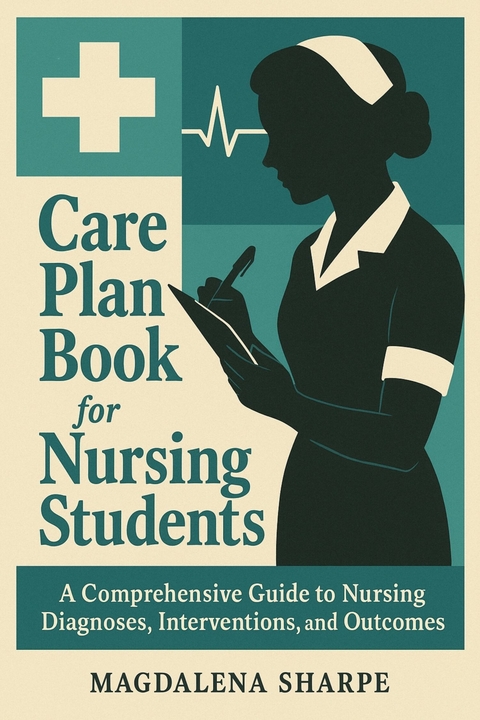
Care Plan Book For Nursing Students (eBook)
144 Seiten
Publishdrive (Verlag)
978-0-00-109479-6 (ISBN)
Do care plans leave you staring at a blank page?
Are you overwhelmed by NANDA-I, NIC, and NOC-and unsure how to connect them?
Do you want a simple, step-by-step way to turn assessment data into safe, measurable outcomes your instructors (and patients) will appreciate?
If you answered YES to at least one of these questions, you MUST KEEP READING...
Unlock the Secrets to Building Clear, Evidence-Based Care Plans-Fast
Many nursing students spend hours guessing what to write, juggling templates, and trying to 'make it sound right.' The pressure to prioritize correctly, craft SMART outcomes, add solid rationales, and document professionally can feel overwhelming-especially during busy clinical rotations. It's no surprise that many learners fall back on generic, copy-paste plans that miss the mark and cost them points (and confidence).
But don't worry-you're not alone...
Presenting: Care Plan Book For Nursing Students: A Comprehensive Guide To Nursing Diagnoses, Interventions, And Outcomes
Chapter 1 — Clinical Reasoning Under Uncertainty
It’s 07:45. You’re halfway through morning assessments when a call light blinks red. You enter the room of Mr. Alvarez, a 68-year-old man recovering from abdominal surgery. His face is pale, his hand clutches his incision site, and the monitor shows a blood pressure drop of 15 points since your last check. The IV pump alarms. You have ninety seconds before this moment either escalates or stabilizes. In those seconds, what you notice—and what you ignore—decides not just your first action, but the trajectory of your patient’s outcome.
This chapter is about those ninety seconds. Not because every scenario is an emergency, but because every clinical encounter is a negotiation with uncertainty. The nurse’s mind must continuously compress massive amounts of information—vital signs, patient behavior, lab trends, environmental context—into a coherent “problem representation.” This mental snapshot is the foundation of all nursing reasoning. Without it, care plans collapse into disorganized lists and reactive interventions.
Clinical reasoning under uncertainty doesn’t mean guessing—it means structuring ambiguity. The care plan you eventually write down begins long before the template opens on your computer; it starts with how you frame the situation in your head. That frame, the “summary statement,” is your cognitive compass. It helps you decide which NANDA-I families might be relevant, what interventions have priority, and how to anticipate complications before they occur.
1.1 Problem Representation & Summary Statements
The most effective clinicians share a habit: they think in structured sentences. They don’t merely recall facts; they organize them. In medicine and nursing alike, this organization often takes the form of a concise “summary statement” or “problem representation.” It’s the bridge between raw data and meaningful diagnosis—a single sentence that captures the essence of the patient’s story.
In nursing practice, this statement is not just a formality; it’s the seed from which every element of the care plan grows. It defines what problem you’re solving, what outcomes you’ll pursue, and where your interventions will focus. Without it, you’re swimming in data without direction.
A practical template for this mental exercise might look like this:
Age/Context + Time Course + Key Cues + Biggest Risk + Nursing Focus
For example:
“68-year-old postoperative patient, day two after colectomy, showing increasing abdominal tenderness and low-grade fever, at risk for infection; nursing focus on wound assessment, temperature trend, and early mobilization.”
That single line distills an entire chart, two pages of notes, and an ongoing assessment into one functional hypothesis. It’s not poetry—it’s clarity.
Let’s break down each element of this sentence and why it matters:
Age/Context: Age and context are your first filters. A “68-year-old postoperative patient” cues you to think about risk factors like delayed healing, comorbidities, and medication sensitivity. In contrast, “22-year-old postpartum patient” instantly changes your mental map—different physiology, different likely complications, different priorities. By anchoring context first, you prevent cognitive drift and focus your reasoning within the right boundaries.
Time Course: The timeline of a problem distinguishes transient reactions from emerging complications. “Day two after surgery” implies the initial inflammatory response should be resolving, so new pain or fever becomes clinically significant. Time transforms data into signal—it helps you discern when a symptom is “expected” versus when it’s “evolving.”
Key Cues: These are the specific findings that define the problem—what’s new, what’s abnormal, what’s worsening. The trick is selectivity. Novices often fall into the “data dump” trap: copying every assessment detail into the plan. That clutter obscures patterns instead of clarifying them. Expert nurses, in contrast, curate. They pick the few cues that change the story. A temperature of 38.2°C matters when it wasn’t there six hours ago. Tenderness that increases despite analgesia tells a different story than pain that improves with rest. Key cues are those that shift your reasoning, not just fill your notes.
Biggest Risk: Every situation carries multiple possibilities, but the professional task is prioritization. Naming the biggest risk forces you to commit to a hypothesis—what you believe could go most wrong if unaddressed. This is where nursing judgment differentiates itself from rote assessment. Is the greatest danger infection, immobility, bleeding, or psychological distress? Each leads you toward a different family of nursing diagnoses and corresponding interventions. Choosing one doesn’t mean you ignore the others—it means you establish focus and triage your cognitive energy.
Nursing Focus: The final clause translates your observation into action. It signals what you, as the nurse, will monitor, prevent, or promote. “Focus on wound assessment, temperature trend, and early mobilization” is not busywork—it’s your strategic response to the risk you’ve just defined. This closing phrase bridges assessment and intervention, ensuring that your care plan begins with intention, not inertia.
From Data Dump to Diagnostic Framing
The difference between a weak and strong care plan often lies in how the story is told. A weak plan begins with an indiscriminate list of facts:
“Patient reports pain 7/10, temperature 38.2°C, incision red, HR 98, BP 112/70, dressing dry, lungs clear, voided 350 mL, ambulated once, reports fatigue.”
This “data dump” is technically correct—but cognitively useless. It forces the reader (or you, ten minutes later) to reassemble meaning from scratch. There’s no narrative, no prioritization, no problem representation.
Now contrast that with:
“68-year-old postoperative patient, two days after colectomy, with new-onset low-grade fever and increased incisional pain, suggesting early wound infection; focus on wound evaluation, temperature monitoring, and teaching about splinting during movement.”
Same data, completely different effect. The second version is diagnostic framing—it organizes facts around a hypothesis and directs future action. You can immediately imagine which NANDA-I diagnoses might apply (Impaired Tissue Integrity, Risk for Infection, Acute Pain), and what interventions follow logically (wound care, mobility promotion, patient education).
Diagnostic framing transforms observation into reasoning. It prevents your brain from drowning in data and gives structure to your clinical intuition.
Calibrating with Peers: The Mirror Test
Even the most experienced clinicians have blind spots. The human brain has a strong tendency to confirm its first impression—what psychologists call anchoring bias. In nursing, this often appears as overconfidence in an early label (“this is just post-op pain”) and under-attention to evolving cues (“but the pain pattern changed”). The best way to counteract this is calibration—comparing your summary statement with another person’s.
During clinical rotations or study groups, try this exercise: after assessing the same patient, each student writes a one-sentence summary following the five-part structure. Then swap and compare.
You’ll notice immediate differences. One might emphasize pain, another mobility, another nutrition. Discuss why each person framed it that way. What cues led them to see a different “biggest risk”? Did someone pick up on a subtle behavioral or environmental clue you missed? These small calibration moments sharpen clinical reasoning far more effectively than memorizing NANDA-I codes.
Professional nurses in high-acuity settings do this instinctively during shift handoffs: “She’s a 72-year-old COPD patient, day three on steroids, oxygen requirement trending up, biggest risk respiratory fatigue—watch her CO₂ levels.” That’s a polished summary statement, compressed and actionable. The habit begins now, as a student, through deliberate practice.
Over time, you’ll find that the summary sentence becomes your mental shorthand for situational awareness. You’ll start forming it automatically—even before you sit down to write the formal care plan. You’ll walk into a room, scan the environment, interpret the patient’s posture, the tone of their voice, the numbers on the monitor—and your mind will quietly assemble the structure: “mid-50s cardiac patient, overnight diuresis, orthopnea improving, still at risk for fluid overload; nursing focus on daily weights, lung sounds, and medication adherence.”
That’s clinical reasoning in real time.
Making Thinking Visible
Problem representation is not just about internal clarity—it’s about communication. Nursing doesn’t happen in isolation. You’re part of an ecosystem of physicians, respiratory therapists, pharmacists, and aides, all of whom depend on clear, concise reasoning to coordinate care. When you articulate a summary statement effectively, you make your thinking visible to others. This visibility fosters trust and efficiency.
Imagine presenting during interdisciplinary rounds: instead of reading vitals from your clipboard, you begin with, “Mr. Alvarez is a 68-year-old post-colectomy patient, day two, now febrile with increasing tenderness suggesting early infection; our nursing focus is wound care and...
| Erscheint lt. Verlag | 31.10.2025 |
|---|---|
| Sprache | englisch |
| Themenwelt | Medizin / Pharmazie ► Pflege |
| ISBN-10 | 0-00-109479-3 / 0001094793 |
| ISBN-13 | 978-0-00-109479-6 / 9780001094796 |
| Informationen gemäß Produktsicherheitsverordnung (GPSR) | |
| Haben Sie eine Frage zum Produkt? |
 EPUB (Adobe DRM)
Größe: 3,5 MB
Kopierschutz: Adobe-DRM
Adobe-DRM ist ein Kopierschutz, der das eBook vor Mißbrauch schützen soll. Dabei wird das eBook bereits beim Download auf Ihre persönliche Adobe-ID autorisiert. Lesen können Sie das eBook dann nur auf den Geräten, welche ebenfalls auf Ihre Adobe-ID registriert sind.
Details zum Adobe-DRM
Dateiformat: EPUB (Electronic Publication)
EPUB ist ein offener Standard für eBooks und eignet sich besonders zur Darstellung von Belletristik und Sachbüchern. Der Fließtext wird dynamisch an die Display- und Schriftgröße angepasst. Auch für mobile Lesegeräte ist EPUB daher gut geeignet.
Systemvoraussetzungen:
PC/Mac: Mit einem PC oder Mac können Sie dieses eBook lesen. Sie benötigen eine
eReader: Dieses eBook kann mit (fast) allen eBook-Readern gelesen werden. Mit dem amazon-Kindle ist es aber nicht kompatibel.
Smartphone/Tablet: Egal ob Apple oder Android, dieses eBook können Sie lesen. Sie benötigen eine
Geräteliste und zusätzliche Hinweise
Buying eBooks from abroad
For tax law reasons we can sell eBooks just within Germany and Switzerland. Regrettably we cannot fulfill eBook-orders from other countries.
aus dem Bereich