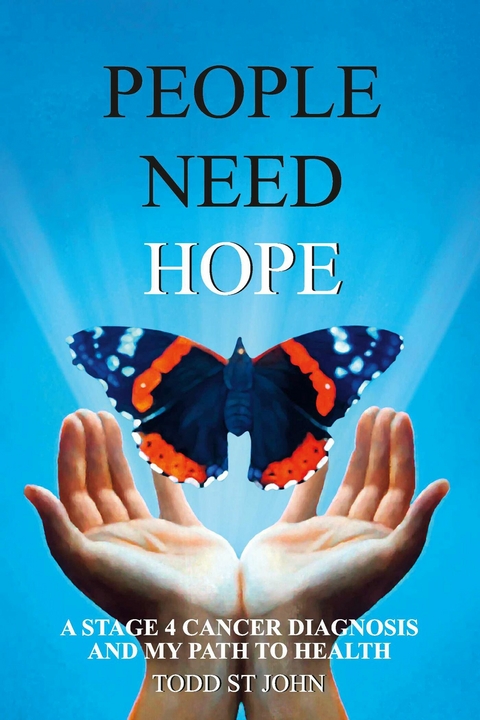
People Need Hope (eBook)
236 Seiten
Bookbaby (Verlag)
979-8-3509-9245-8 (ISBN)
Todd received his formal education with a Bachelor of Science Degree in Electrical Engineering from the Michigan Technological University and a Master of Science Degree also in Electrical Engineering from the University of Michigan. He has spent over 25 years in the automotive engineering industry, including a stint working with the Honda IndyCar engine program when they first entered IndyCar and teamed up with the Rahal/Hogan race team. Todd prefers to spend his summers in the town of Marquette, Michigan along the shoreline of Lake Superior, but would rather spend the depths of winter in Florida. When he isn't working, Todd enjoys trout fishing in northern Michigan, weekend drives with his wife Pamela Lynn in their 1970 Mustang MACH1, and playing 'piggy' with their Coton de Tulear, Sunny Boy.
When you or someone you love is diagnosed with Stage 4 cancer, or any stage of cancer for that matter, it's downright frightening. Starting your journey with unanswered questions makes the situation even more difficult. After you've had time to process the dreadful news, the difficulty of your situation is magnified by the lack of basic knowledge on where to begin. "e;People Need Hope"e; is written for those folks, like Todd St John who found himself in this same predicament in November 2017. In "e;People Need Hope"e;, Todd St John shares his personal journey of being a Stage 4 cancer patient and everything he encountered on the topic of cancer, including FDA and non-FDA therapies. His ideas, suggestions, perspectives, and personal experiences may provide readers with answers to present and future questions amidst their diagnosis and treatment. Todd wrote from his own personal experience in the hope of giving readers some comfort from the knowledge of what may lie ahead. As you read through this book, at times you will feel like you are reading a personal essay of Todd's experiences and at other times you will feel like you are reading a science book. You will hear an intimate description of what Todd encountered from his first diagnosis up through today. Today he is cancer free or as the oncologists prefer to call this "e;No Evidence of Disease"e;. You should walk away with a good foundational explanation of the various naturopathic therapies in which Todd investigated in his desire to be cancer free. Todd put this book together in a way that he could not find himself in a single book about cancer. Most books he found strictly covered one topic in detail and other cancer books were largely only from the personal perspective of the cancer patient. What Todd could not find was a book as he captured here for you. Todd's wish is that his book will give you hope. People Need Hope will inform you: What you can most likely expect when you are first diagnosed with cancer What Todd wished he had known when first diagnosed Stage 4 Suggestions, perspectives, and personal experiences from Todd's cancer diagnosis The world of oncology, FDA-approved treatments and the cost of pharmaceuticals The reality of cancer and chemotherapy statistics Melanoma in-depth details for the melanoma patients reading this book Character traits of and the importance of being your own patient advocate Let food be your medicine - nutrition, naturopath and an integrative medicine practitioner Todd's 3-month "e;Target Cancer Diet"e; and his diet today using an orthomolecular medicine-like approach as his prophylactic measure against cancer Healthy food choices, Budwig diet, Gerson therapy and diet, Mediterranean diet, juicing and fasting Supplements and supplement usages Cannabis, medical marijuana and cancer answering the questions "e;What is Rick Simpson Oil (RSO)? What is hemp? What kinds of marijuana are out there? How do you read the cannabis oil and product labels? How much should I take? What is the difference between 1 gram and 1 ml of cannabis oil?"e; Making cannabis oil capsules and suppositories Immunotherapy - the cutting edge of cancer treatment Other sources of knowledge
Chapter 1
Round One
Here We Go
We had just arrived the night before in Sault Ste Marie, Michigan and I was the first person to get to work that morning. Every winter typically beginning after the New Year’s Day holiday, automotive and brake engineers head north for a couple months to what we call “Winter Test”. Typical automotive winter test sites in the United States are in the Upper Peninsula of Michigan or northern Minnesota. This is where automotive engineers design, tune and test your car’s braking system under severe cold weather conditions. Stopping your car safely on ice, giving your car sufficient traction in snow and ice and giving you confidence that your car can safely travel across various cold weather road conditions is our goal.
It was here on an early Monday morning in February 2014 when I first noticed it: A spot on the crown of my head, tacky to the touch. I would soon come to find that the tacky feeling was a malignant melanoma tumor breaking through the top layer of my skin. Good grief, right? In medical terms, this is called an “ulceration” and in my case, the ulceration was a breakdown of the skin over the melanoma tumor. According to the American Cancer Society, melanomas that are ulcerated tend to have a worse outlook—a fact I would not realize until three and a half years later (American Cancer Society. Cancer Facts and Figures 2024. Atlanta: American Cancer Society, Inc). More on that part of the story later.
I wasn’t able to make an appointment with my dermatologist until eight days after I first noticed the ulceration (even saying that word out loud “ulceration” sounds horrible). We’d just arrived in Sault Ste Marie, Michigan, and I had a significant amount of work to accomplish that week. A lot of time, resources, and money are put into our annual vehicle testing during winter test. I had a dermatologist back home that I liked, but that was a five-hour drive south, so the appointment had to wait.
I finally got in to see Dr. Dorman on Tuesday, February 11, 2014, and he decided to perform a biopsy. Seven days later, I received the cancer diagnosis. My doctor referred me to the University of Michigan hospital to meet with the staff at the Melanoma Clinic in the main hospital in Ann Arbor, Michigan. His office had already sent the information that I’d been diagnosed through a biopsy with melanoma for their review. Two days later, I had a consultation and exam scheduled with the staff at the University of Michigan Melanoma Clinic, which would be followed with a visit with the surgeon who would be removing the tumor that had made its residence on the top of my head under that ulceration.
Welcome to the Machine
My consultation and exam were scheduled for March 5, two weeks after my initial cancer diagnosis. The surgery to remove my cancer occurred another 20 days after the consultation at the Melanoma Clinic and was scheduled for Tuesday, March 25. Two weeks sure seemed like a long time to simply get an appointment to see an oncologist to discuss a treatment plan and other options. After the visit with the surgeon, we were told it would be almost another three weeks before the actual surgery would take place. We already had the diagnosis of cancer, so what the heck are we waiting for?
If you’re taking mental notes, you have already noticed that the waiting time between the initial phone call from my dermatologist until the date of my surgery was five weeks. My wife and I nervously waited 5 weeks for the cancer to be extracted from the crown of my head. During these five weeks all I could think about was that the cancer on top of my noggin’ was just waiting to be unleashed, quickly spreading into my brain and at some point, dumping into my blood stream to spread to other parts of my body. We thought, Why aren’t the doctors moving quicker than the cancer? I didn’t even know any of the medical professionals assigned to my treatment (so I could call or email with questions or concerns) nor did I know anyone who had had cancer to speak to them about this seemingly long waiting period. I wondered what I could possibly do to be proactive for my own care on my own behalf.
If you yourself are now caught up in this waiting period as I was then, it’s unfortunately not unusual. Whether you are waiting to see a doctor or waiting for your surgery or even waiting for your initial cancer treatment to begin, your wait time is based upon many different factors. It’s beyond the scope of this book to go into detail about standard cancer care wait times, but I will point out a few things that may be helpful for you to understand the wait time and to hopefully alleviate your undue anxiety—things I wish I had known then.
Whether you live in the United States or Canada or anywhere else in the industrialized world, you typically have to wait for medical care, not just cancer care. In the United States, a research study identified that the median time from your initial cancer diagnosis until the start of your treatment was 29 days. I had to wait 35 days. The study presented was focused upon a large sample size of 3,672,561 patients who were diagnosed from 2004 to 2013 with early-stage solid-tumor cancers. A variety of cancer types such as breast, prostate, colorectal, non-small-cell lung, renal, and pancreatic cancers were included in the study (Khorana, A., et al., 2019).
The most common cancer diagnosed worldwide is lung cancer; it is also the most common cause of cancer death. In 2016, JCO Oncology Practice, which is a journal of the ASCO, published a study that focused on patients with small-cell or non-small-cell lung cancer (Vidaver et al., 2016). Patients were recruited from June 2012 to June 2014. The study found that, on the basis of the dates reported by 275 patients, the median time was 36.5 days from the abnormal scan results to the start of treatment, 15 days from the initial diagnosis to the first therapy, and 16 days from referral for treatment to first therapy. The ASCO journal went on to discuss the necessity of establishing a benchmark for patients with lung cancer. It recommended that the benchmark median time should be 52 days from the first presentation of the disease in the cancer patient until they receive their initial treatment (Vidaver et al., 2016).
Fifty-two days sure seems like a long time after the initial scare that you may have cancer. I had to wait 35 days. On the brighter side, the waiting period was only an issue for me at the onset of the disease. Your future appointments may make you anxious, but the anxiety of the waiting times for appointments should be behind you. Once you are in the system, your blood draws, oncologist appointments, and infusions will be well orchestrated and timely. They will set you up to have a pattern of scheduled appointments, weekly, biweekly, or monthly, and your appointment schedule will be consistent. You will find out that you will also become well-acquainted with the people making your appointments. Strangely, that itself is comforting. Welcome to the machine.
Standard Care
The doctor assigned to my surgery was the chair of the Otolaryngology – Head and Neck Surgery Department at the University of Michigan Hospital. I learned that an otolaryngologist is often called an ear, nose, and throat doctor (ENT). Not knowing anyone who’d had surgery to remove cancerous tumors, I found it strange that the staff at the melanoma clinic was giving me directions to walk over to the ENT department (in a separate wing of the hospital) as the next step of my cancer treatment. Looking back, after that initial visit with the melanoma clinic, all appointments for my initial cancer treatment were with the ENT surgeon and not the melanoma clinic doctors.
Standard care for melanoma is based upon what doctors’ call “staging.” Cancer staging is a way for the doctors to rate and describe the extent of your cancer. Cancer can be defined by the growth of the original cancer tumor and its spread to other parts of your body. Melanoma pathology results define at a minimum (1) the Breslow depth, i.e., how deep the tumor has grown into the skin; (2) Clark’s level, which is similar to the Breslow depth but also includes additional details of which levels of the skin are affected by the tumor growth; (3) ulceration status; and (4) if any of the regional lymph nodes were found to have cancer cells. The pathology report from my dermatologist’s original skin tissue “shave biopsy” identified “Malignant melanoma, invasive to a depth of at least 1.88 mm, at least Clark’s Level IV, extending to the peripheral and deep margins.” If that didn’t sink in the first time, the pathologist went on to further describe the tumor as “Abundant tumor present at the peripheral and deep margins.” That didn’t sound good at all.
Standard care for melanoma cancer offers wide excision as the primary treatment, which is surgery to remove (excise) the entire melanoma lesion (tumor) along with a border (margin) of normal-appearing skin around the cancer site. The width or diameter of the border of the normal skin to be removed depends on the depth of the melanoma. My pathology report identified a depth of at least 1.88 mm. At the time, the National Comprehensive Cancer Network [NCCN] treatment guidelines suggest a margin of 1.0–2.0 cm for a tumor depth of that size [Tan, 2024]. Further, with a depth of that measure and associated with an ulceration (as was in my case), the same...
| Erscheint lt. Verlag | 2.8.2025 |
|---|---|
| Sprache | englisch |
| Themenwelt | Medizin / Pharmazie ► Medizinische Fachgebiete ► Onkologie |
| ISBN-13 | 979-8-3509-9245-8 / 9798350992458 |
| Informationen gemäß Produktsicherheitsverordnung (GPSR) | |
| Haben Sie eine Frage zum Produkt? |
 EPUB (Ohne DRM)
Größe: 1,6 MB
Digital Rights Management: ohne DRM
Dieses eBook enthält kein DRM oder Kopierschutz. Eine Weitergabe an Dritte ist jedoch rechtlich nicht zulässig, weil Sie beim Kauf nur die Rechte an der persönlichen Nutzung erwerben.
Dateiformat: EPUB (Electronic Publication)
EPUB ist ein offener Standard für eBooks und eignet sich besonders zur Darstellung von Belletristik und Sachbüchern. Der Fließtext wird dynamisch an die Display- und Schriftgröße angepasst. Auch für mobile Lesegeräte ist EPUB daher gut geeignet.
Systemvoraussetzungen:
PC/Mac: Mit einem PC oder Mac können Sie dieses eBook lesen. Sie benötigen dafür die kostenlose Software Adobe Digital Editions.
eReader: Dieses eBook kann mit (fast) allen eBook-Readern gelesen werden. Mit dem amazon-Kindle ist es aber nicht kompatibel.
Smartphone/Tablet: Egal ob Apple oder Android, dieses eBook können Sie lesen. Sie benötigen dafür eine kostenlose App.
Geräteliste und zusätzliche Hinweise
Buying eBooks from abroad
For tax law reasons we can sell eBooks just within Germany and Switzerland. Regrettably we cannot fulfill eBook-orders from other countries.
aus dem Bereich